Article

Complete guide to the thermoforming process

The world of manufacturing is constantly seeking solutions that enable the production of increasingly high-performance products while maximising the efficiency of the value chain. In this context, the thermoforming process is emerging as a key technique for applying plastic films to various substrates.

Among coating technologies, thermoforming represents an innovative method in which a plastic sheet is heated until flexible, allowing it to be shaped into precise forms that adhere closely to the underlying materials, such as MDF panels.

Naturally, not all solutions are equal, and increasing efficiency and quality in production lines first means understanding the complexities of the thermoforming process, then choosing the machines that best meet the specific needs of the company and its customers.

This guide aims to provide a comprehensive overview of the process, its variations, and the benefits it can offer today to companies operating in various manufacturing sectors. 

Overview of the thermoforming process 

The thermoforming process plays a crucial role in modern industry, especially in sectors where aesthetics and durability are key success factors for business development.


By using heat to soften plastic sheets, manufacturers can create complex and customised designs that enhance the visual appeal and functionality of products. The process begins with selecting the appropriate plastic material, followed by heating the semi-finished product – typically a sheet – to specific temperature thresholds. Once heated, the sheet is deformed and adheres to the substrate.

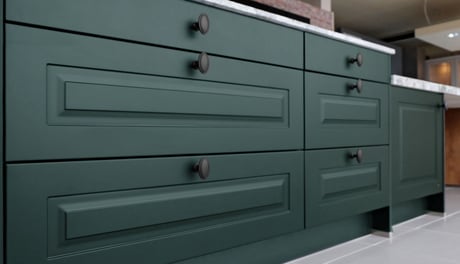
This is an efficient and versatile technique suitable for a wide range of applications, from furniture component wrapping to parts used in the automotive industry.

THE MOST INNOVATIVE FINISHING SOLUTIONS
Discover the most advanced finishing solutions to boost your competitiveness.


Process steps: from glue application to cutting 

More specifically, the thermoforming process can be broken down into several stages. Each is essential to ensure the final product meets quality standards.

It begins with the glue application phase, where a uniform layer of adhesive is spread onto the substrate. Ensuring maximum homogeneity in this step is fundamental, as any inconsistency may result in a weak bond between adhesive and semi-finished sheet, or visual defects in the final product. Once the adhesive is applied, the next stage involves various drying techniques that evaporate all water content, ensuring optimal adhesion.

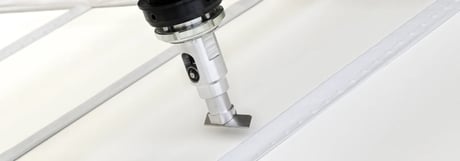
After preparing the substrate, the heated PVC sheet is applied to the surface using a thermoforming press. The press applies both heat and pressure, enabling the film to conform exactly to the contours of the substrate. Final steps include trimming excess material to achieve clean edges and brushing to remove adhesive residue or debris.

Thermoforming process: how does it work in detail?

As previously mentioned, achieving uniformity across the panel is key; otherwise, the risk of defects after film application increases exponentially.

That’s why some recommendations must be kept in mind throughout the thermoforming process, especially during the critical initial phase: edges in particular require five to eight times more glue than flat surfaces.

Once the water in the glue has evaporated through oven drying and the PVC sheet has been applied with a press, it is essential to be precise when removing excess material.

Regardless of whether this is done manually by two operators or handled by an automatic trimming unit (which removes, collects, grinds, and disposes of sheet scraps), the rear of the panels should always be carefully inspected for any glue residue.

Variations and types of thermoforming processes

What has been described so far is a general outline: the thermoforming process is not a fixed, one-size-fits-all formula, but rather an industrial approach that includes different configurations and variants. Each has its own specific characteristics, involving the use of particular techniques to create tailored lines that meet customer demands and production requirements.

Depending on production volume and panel properties, manufacturers can choose from different types of thermoforming processes, such as vacuum forming, pressure forming, and twin-sheet forming.

Vacuum forming is the most common technique, using a vacuum to pull the heated plastic sheet onto the mould, while pressure forming employs air pressure to create more complex shapes and finer details. Twin-sheet forming, finally, makes it possible to produce hollow parts by forming and sealing two sheets together simultaneously.

Each variation offers unique benefits, so manufacturers must choose the solution that best suits their operational needs and order specifications.

The importance of adhesive application in thermoforming

Regardless of the technique used, achieving a high-quality result requires that adhesive is applied correctly – both on the surface and edges of each part – particularly when working in furniture production and wood processing.

In this scenario, one of the processes that demands the most attention and care is the application of PVC sheets to wardrobe doors, drawer fronts and panels, typically made of composite materials such as MDF.

Benefits of the thermoforming process
As outlined, thermoforming processes offer numerous benefits. One key feature making them an increasingly popular choice among manufacturers is their ability to significantly boost production efficiency: the speed at which thermoforming can be performed supports higher output rates and shorter delivery times. The process also improves finish quality, as the ability to minimise tolerances and produce detailed designs results in more visually appealing end products.

Thermoforming also reduces the need for manual labour, as many of the steps mentioned above can be automated, cutting human error and streamlining labour costs.

From an environmental perspective, the process supports companies aiming to lower their carbon footprint by reducing waste through efficient use of raw materials and facilitating the recycling of scrap materials.

In short, thermoforming not only improves production efficiency and product quality, but also aligns with modern environmental standards – making it a smart choice for the finishing industry.

Cefla and thermoforming: an integrated and customised approach

In the field of thermoforming, Cefla Finishing offers complete, integrated solutions that also cover the preliminary processing stages, such as loading the semi-finished panels and brushing/cleaning them. This is followed by all process phases previously described, including final removal of glue residue.

The real added value of Cefla’s offering lies in the customisation of production lines: depending on the customer’s needs, available space and expected production volumes, our engineers will define the best configuration to guarantee maximum productivity.

It’s not just about maximising efficiency in terms of the number of presses to feed: Cefla Finishing’s technological know-how and process expertise are placed at the customer’s disposal to develop synergistic solutions, ensuring precision and consistent application in automating a process that, if properly implemented, can free up operators for higher value-added tasks.

Thermoforming solutions

Spraying machines:

  • iBotic - glue application

Cefla-Finishing_iBotic_09-2021_Side1NOASPIRAZIONE

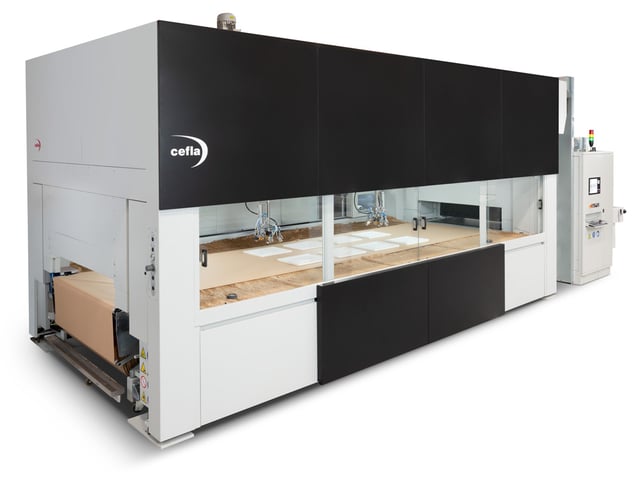
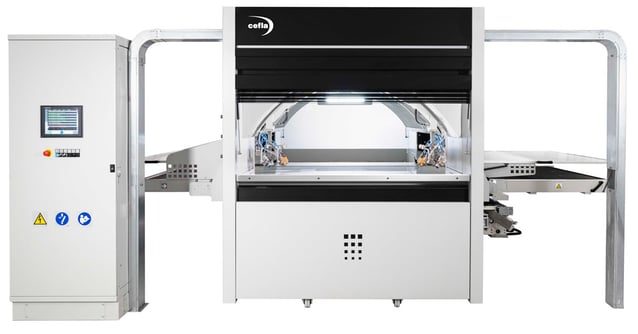
A high-performance five-axis application robot (configurable with one or two arms) to suit different productivity levels. iBotic solves issues related to application consistency, repeatability and operator safety. Most importantly, it ensures precise glue application, considering the difference between panel surfaces and edges. It also avoids glue contamination on the back of the panel.

  • Mito - glue application only for flat surfaces

Cefla-Finishing MITO machine

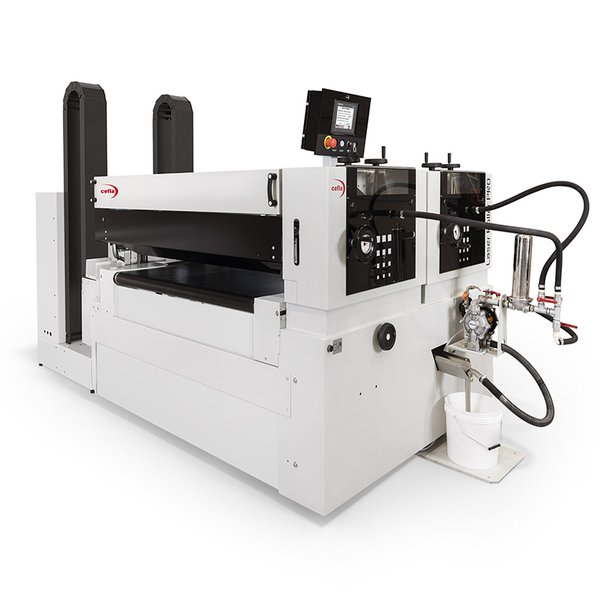
This machine ensures uniform application across the entire surface of the panel and all pieces, making it a first step toward automation for small businesses still applying glue manually. Before feeding the press (third-party equipment), we recommend maintaining a clean, dust-free environment to optimise process and application quality.

Before the press is involved (third party equipment) we recommend maintaining a clean, dust-free environment to optimise the process and application quality.

Drying Technologies

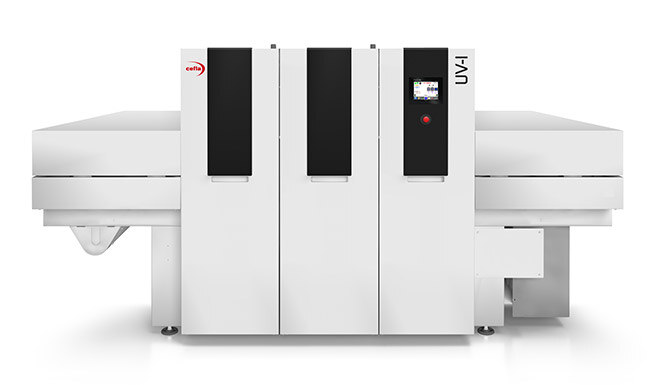
  • Pieffe - hot air drying for edges and flat surfaces

Cefla Finishing pieffe machine

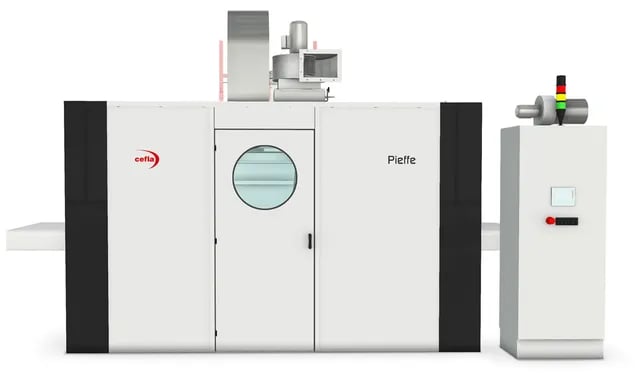
A flexible hot-air oven for glue drying on flat surfaces and edges, ensuring excellent productivity.

  • Aquadry - drying system for water-based glue

Cefla-Finishing Aquadry machine

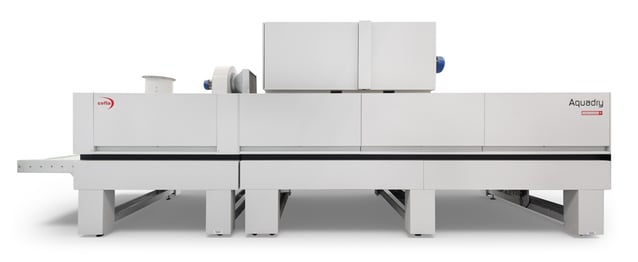
Water must evaporate from the glue before the PVC sheet is applied. This solution handles panels where glue has not been applied to the edges.

Trimming and scrap foil solutions

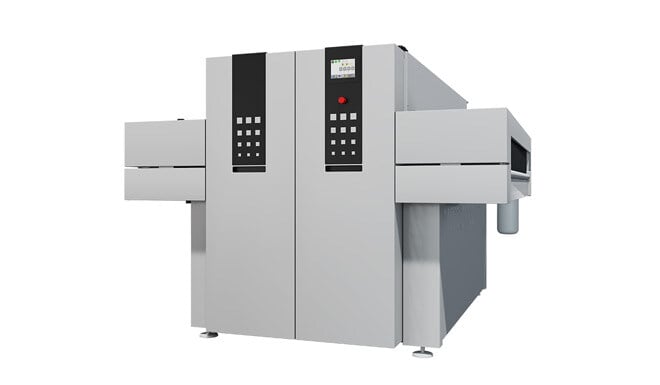
  • Twister – scrap foil removal

Cefla Finishing R-Twister machine

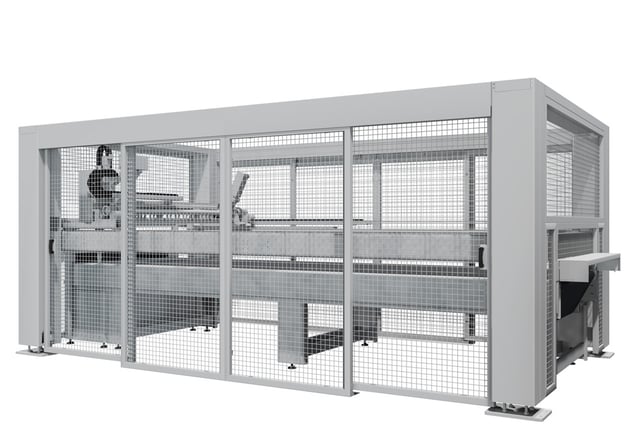
With a compact footprint, this machine grinds and removes scrap film for recycling, helping preserve the environment while optimising the process.

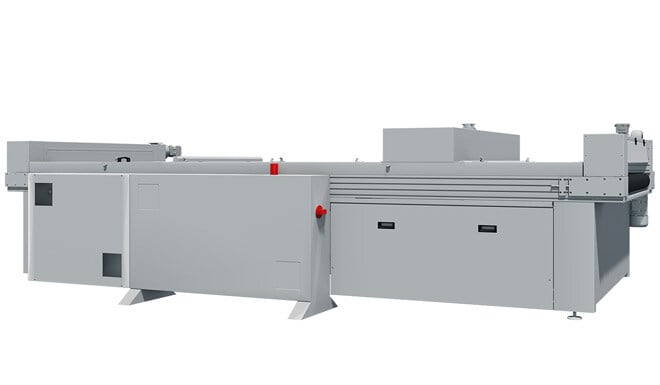
  • Tarcut – trimming solution

Cefla Finishing R-Tarcut machine

Although film trimming is often performed manually, an automatic solution provides higher efficiency and precision (guaranteed by a 3D camera that monitors each operation). Processing speed is also much higher than manual cutting.

Why thermoforming is a smart choice

By now, the value of the thermoforming process should be clear. Compared to other finishing techniques, it stands out as a versatile and efficient method for applying plastic films to substrates, offering significant advantages that improve both productivity and environmental responsibility.

As the manufacturing sector continues to evolve, mastering this process will be crucial for producers who want to stay competitive. And Cefla Finishing will always be there to provide integrated, tailored solutions

LOOKING FOR THE BEST SOLUTION FOR YOUR COATING LINE?


The world of manufacturing is constantly seeking solutions that enable the production of increasingly high-performance products while maximising the ...

Article

cTracker tracking and monitoring software

cTracker tracking and monitoring software

cTracker management and supervision industrial line 4.0

Today’s focus looks at a software solution rather than a machine or finishing technology.
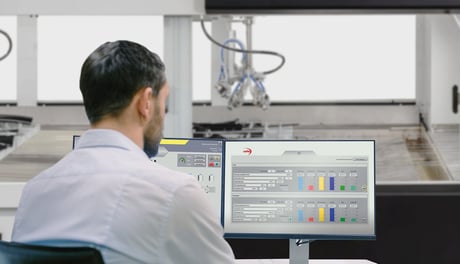
Part of our cSuite software solutions, cTracker is a tracking and monitoring SCADA software which helps operators keep a close eye on production from a single monitor and also assists as part of a service offering by managing alarms and triggering a service request and solution.
 
cTracker is a powerful tool that provides companies with valuable data regarding processes, recipes and production efficiency and also tracks single pieces on a line, helping maintain excellent productivity. 

Who we are talking to:
▸ Companies with finishing lines consisting of several machines
▸ Companies with highly automated finishing lines
▸ Companies requiring tracking capabilities on finishing lines with a high degree of flexibility
▸ Companies wishing to benefit from fast-lane access to remote technological advice
 
Benefits:
✓  Set up and control the entire line via a single monitor for Cefla and 3rd party equipment
✓  Track single pieces to be able to implement changeovers without emptying the line
✓  Gather production data and analyse productivity
✓  Obtain fast assistance with remote service pack enabler
✓  Share production data with company ERP (with cLink) to optimise processing

Learn more about our digital tools and software solutions.

Today’s focus looks at a software solution rather than a machine or finishing technology. Part of our cSuite software solutions, cTracker is a ...

Article

Glass Painting and Decoration: Technologies, Applications and Advantages for Industry

The painting and decoration of glass are processes capable of transforming a noble material into a truly multisensory experience. There are several methods to achieve this transformation, each with distinct steps and characteristics that endow the glass with specific properties.
Greater resistance, more brilliance, and extensive customisation potential: these are usually the reasons why manufacturers constantly seek to improve their glass painting and decoration processes.
To maximise the outcome, however, it's crucial to consider the numerous available technologies and install production lines capable of delivering optimal finishing in line with customer expectations.

Why invest in glass painting and decoration?

Glass painting and decoration are essential to enhancing manufactured products, improving their appearance, and increasing functionality. While this is a generalisation, it holds true across the various applications enabled by this processing technique, which we’ll explore across different industries.
Investing in equipment and expertise for glass painting and decoration means positioning oneself in the construction and furniture markets with a flexible and resilient proposition. This allows companies to adapt to market trends—offering highly customised solutions—and to seize emerging opportunities from previously untapped industrial sectors.

Industrial applications of glass painting and decoration

Let’s explore today’s main applications of glass painting and decoration, highlighting why leading players in the automotive, construction, and furniture industries choose to treat this material.

Automotive

In the automotive sector, glass finishing and painting play a vital role in both aesthetics and safety.
Glass finishing enhances the vehicle's visual appeal by enabling elegant designs and bold tones. Coatings also offer protection against scratches, UV rays, and environmental contaminants, helping glass parts maintain their appearance over time.
Treated and tinted glass increases passenger comfort by reducing glare and heat while ensuring more privacy and safety. Lightweight glass, combined with innovative finishing techniques, also contributes to reducing vehicle weight, thereby improving fuel efficiency and overall performance.

Construction industry

The construction industry benefits from the versatility of glass for a wide range of architectural solutions—from windows and interior partitions to building facades. But it’s not just about looks: special finishing treatments like low-emissivity coatings significantly improve thermal performance, cutting heating and cooling costs.
Painted glass adapts to architectural designs, while laminated and tempered glass enhances safety by offering better resistance to impacts and breakage—crucial for residential and commercial settings alike. Treated smooth glass surfaces are also easier to clean and maintain, reducing long-term maintenance costs for property owners.

Furniture

In the furniture industry, glass painting and decoration techniques have revolutionised how designers create functional and elegant pieces.
Glass can be shaped, coloured, and finished in various ways to craft unique furniture elements that suit a wide range of styles.
Finishing protects glass from scratches and stains, ensuring durability in high-traffic areas. Treated glass components are also less prone to harbour bacteria and are easier to sanitise—ideal for kitchen use.

Glass painting technologies

There are four main technologies used in glass finishing: spray coating, roller coating, screen printing, and digital printing. Each offers unique advantages for enhancing appearance, functionality, and durability.


INNOVATIVE FINISHING SOLUTIONS

Discover advanced finishing solutions to elevate your business.


Spray coating

Spray coating applies lacquer to glass surfaces using a spray gun on coating equipment in an integrated finishing line.
This method ensures even distribution and a smooth, uniform finish—ideal for decorative glass.
Advantages include fast colour changes, a wide range of finishes, and protective features. Most importantly, it shortens production times compared to manual methods, making it suitable for large volumes.

Roller coating

In this method, paint is applied using rollers in an automated in-line process.
It ensures uniform application, particularly suited for architectural use.

This method also provides an even and controlled paint distribution, resulting in the smooth, uniform finish on the glass that is essential for architectural applications.A key benefit is the automatic edge-cleaning effect, eliminating post-coating cleaning and speeding up the tempering process.

Screen printing

This involves using a stencil (or screen) to apply ink to the glass surface.
Perfect for complex multicolour designs, screen printing suits decorative glass, signage, and artistic pieces, also because it is possible to apply multiple layers of ink, so as to obtain depth and consistency, improving the visual appeal of the finished product.

Screen inks are UV-, chemical-, and abrasion-resistant, ensuring durability and colour retention. It’s also highly versatile, applicable to various glass types—tempered, laminated, and more—making it ideal for automotive, architectural, and consumer sectors.

Digital printing

Inkjet technology prints high-resolution graphics directly on the glass.
Ideal for customised and intricate designs, it accommodates diverse patterns, colours, and dimensions, supporting tailored projects.
This technique minimises waste (no stencils or screens needed) and shortens lead times due to rapid set-up.

Glass finishing techniques

In addition to painting, finishing techniques enhance glass’s functionality and safety. The three most common are etching, sandblasting, and film application.

Etching

Etching removes a thin surface layer to create patterns or designs—mechanically, chemically, or via laser for precision.

Sandblasting

Uses abrasives applied at high speeds to texture or smooth glass surfaces, creating uniform finishes or decorative effects.

Film application

Applies a thin vinyl or polymer film to glass for aesthetic or protective purposes.
Protective films enhance resistance to scratches and chemicals, improve energy efficiency, or increase privacy in buildings and vehicles.

Today, special paints can be applied by spray coaters or roller coaters and, once properly dried, form a film directly on the glass—streamlining the process and ensuring high-quality results.

Cefla Finishing solutions for glass painting and decoration

Cefla Finishing has identified key challenges faced by glass manufacturers and, through partnerships with global industry leaders, developed a portfolio of technologies that ensure:

  • high and uniform application quality
  • transfer efficiency
  • ease of use

The range includes roller and spray coating machines, as well as drying solutions.

Cefla Finishing machines feature patented technologies and are engineered for ease of use. The main goal is to maximise efficiency by enabling operators, even those without specialised training, to quickly master the controls and procedures. Cefla Finishing also develops automated lines that cut down on expenses and enhance coating uniformity, which contributes to managing consumption and its associated costs.

Technologies:

  • Framecoater: Coats up to four perimetric sections of a glass sheet, thereby appearing as a frame. Avoids the need for manual coating.
  • Multicoater: Patented roller coating technology with remarkable application capacity allowing high coverage and uniformity.
  • Glasscoater: Easy-to-use roller coating machine suitable for ceramic glazes and organic products. Maximum reliability and application uniformity.
  • Prima Glass: The ready-to-go spray solution to automate your glass decoration process. Extreme flexibility in colour changes.
  • Mito Glass: Reciprocating spray coating machine, easy to use and fit for frequent colour changeovers. Patented plenum accentuates transfer efficiency.
  • Glassoven: Ovens with a consolidate design, made to optimise air circulation and drying efficiency.
  • Glasscool: Cooling tunnel with high-speed air blade ventilation on both sides of glass sheet.
  • Solarcoater: Patented roller coating technology applying anti-reflective coating with over 100 machines installed worldwide.

Looking for the ideal solution for your glass painting line?

The painting and decoration of glass are processes capable of transforming a noble material into a truly multisensory experience. There are several ...

Article

Is vacuum coating an environmentally friendly process?

Is Vacuum Coating An Environmentally Friendly Process?

Vacuum Coating Technology

Vacuum technology is a finishing process that can coat either three or four sides of a profile or linear board and minimizes VOC’s (volatile organic compounds) that negatively affect the ozone. The technology minimizes the amount of wasted coating by continuously recirculating coatings through the system onto parts as they are fed through the system. The application head has a manual adjustment feature that allows the coating thickness to be controlled as it is applied to each part. This feature is typically set before production starts or is included in your product’s “formula.” By way of a 12-inch wide conveyor, the parts automatically exit the application head and enter into the curing or drying unit.

Cefla’s vacuum units are compact, multi-process painting systems. Depending on model, specification and application, systems include sanding, staining/priming/coating, and curing/drying units that allow parts to easily integrate from a secondary process, to finishing, to a finished good ready for shipping – with minimal human interaction. Cefla has Vacuum Finishing Systems for both water-based and 100% solids, for UV, finishing needs.

The CVR and CVS Vacuum Finishing Systems have maximum working widths of 8- to 12-inches and minimum working length of 24 inches, making it ideal for optimizing the production of linear profiles and flat boards including shiplap, which is growing in popularity in North America due to its feature on several DIY and reality television shows. Using vacuum technology, shiplap can be denibbed, coated, and cured or dried in a single pass, then packed and shipped.

Other system features:

  • Low VOC’s for minimized emissions
  • Closed loop system offers maximum transfer efficiency
  • Small footprint
  • One system comprised of multiple processes – no need for different sets of equipment
  • Options for water-based and 100% solid UV coatings
  • Machine-side control panel is easy to use with a touch screen featuring large print and color graphics
  • Compatible with wood, wood-based derivatives, plastic, and metal substrate
  • Made in the USA

These machines are designed exclusively to support the needs of a variety of North American industries, including residential and commercial construction. Contact us today.

Vacuum technology is a finishing process that can coat either three or four sides of a profile or linear board and minimizes VOC’s (volatile organic ...

Article

If digital printing is on your wish list, we’ll help you put it on your shopping list.

If digital printing is on your wish list, we’ll help you put it on your shopping list.

Industrial digital printing solutions are increasingly popular in response to rapidly evolving market demands, especially for flooring specialists. Suited to all floor surfaces, furniture and skirting to glass, laminates or plastics, digital printing techniques enable exciting alternatives and we will be showcasing our latest digital printer at our LAB.

Standing out from the crowd is easy when you have access to some of today’s most innovative digital printing technologies. Ready for you to see and feel thanks to our J-PRINT TD printer, which will be running throughout the trade show, countless embossed surface samples produced before your eyes will persuade you to believe in the huge potential this technology offers for individualisation together with high output rates.
 
Haptic effects and EIR (Embossing In Register) 

J-PRINT TD, performs embossing in register (EIR) and is specially conceived to produce incredibly realistic haptic effects providing tactile feedback. Performed with a resolution of 400 dpi and speeds reaching 50 m/min. the printer uses special inks, ensuring the same surface resistance as you would expect from any high-quality flooring.
 
Whether it’s wood, MDF or cork, you can digitally print and emboss with exceptional 3D quality. Our digital printing solutions will enable you to enter a new dimension in the world of surface finishing, the third dimension.

Check out our digital printing and texturization solutions

Want to know how quickly in the specific case of your company? Contact a Cefla expert and visit the Cefla Finishing Lab to experience, first-hand, all the solutions and technologies that help reduce energy consumption in your finishing processes.

If digital printing is on your wish list, we’ll help you put it on your shopping list. Industrial digital printing solutions are increasingly popular ...

Article

New iBotic, perfecting the best two-arm spray coater on the market.

New iBotic, perfecting the best two-arm spray coater on the market.

iBotic spray coating Robot Cefla Live

15 years after being launched in 2006, iBotic has undergone some major improvements which will maximise your uptime, reduce your operating costs as well as your lacquer and solvent costs, and with a brand new interface and integrated software, allow you to train operators in no time and access key production data directly on the machine or by feeding it into your company ERP.

Despite being a solution which has no rivals currently on the market, with its two spray arms acting totally independently to boost production efficiency and deliver the highest quality coating, iBotic benefits from a series of updates, fine-tuning and additional functions which enhance its appeal as a high-performance machine.

Brand new interface

Thanks to a new HMI with intuitive commands, user-friendly graphics and a software integration to help operators manage the equipment, iBotic is now easy to use with little initial training needed. Moreover, the software includes diagnostic tools, information to support maintenance requirements, valuable production data which can be consulted directly or fed into the company ERP for productivity analyses. 

Zero downtime while changing colour

The key innovation enables on-the-go colour changeovers without interrupting production. While one arm is automatically set aside for cleaning and colour change, the second arm continues to spray workpieces without stopping. This keeps your production running and adds more or less 90 minutes per shift (we assume you avoid thirty 3-minute downtimes for colour changeover on each shift) to your effective production time, accelerating the ROI. Clearly, without production stoppages, you are constantly earning money rather than just changing colours. TIMESKIP also handles cleaning procedures in such a way as to reduce solvent consumption and cut lacquer wastage.

Energy recovery system to reduce operating costs

Our POWERBACK energy recovery system accounts for a 15-20% energy saving. This lowers operating costs and contributes to increasing your overall sustainability, environmentally and economically.

So, whoever thought it would have been difficult to improve iBotic, consider the benefits that are now available: zero downtime for colour changeovers, increased productivity, lower operating costs, less solvent and less lacquer wastage, plus a new HMI to support operators and optimise the process.


Cristian Giovannini

Product Manager | Spray Coating and Drying Technologies

Product development, technologies and machines for spray coating

https://www.linkedin.com/in/cristian-giovannini-9a62271b1/

15 years after being launched in 2006, iBotic has undergone some major improvements which will maximise your uptime, reduce your operating costs as ...

Load more articles

Articles: 54 / 157