Magazine

Here you can find articles on technologies, innovative techniques, and tips to improve the efficiency of your finishing line.

Article

Finishing wooden windows and doors: the current landscape and solutions from Cefla Finishing

For wooden doors and windows, the finish is not merely an aesthetic detail, but the layer that protects the product from moisture, light, and the wear and tear of time: it determines how long a door or window will retain its appearance and performance. For manufacturers, the finish is therefore one of the factors that most significantly affects the product’s value.

Achieving this result consistently, and at the volumes required by industrial production, is what makes the finishing of wooden windows and doors a matter of great importance to the industry.

In this article, we’ll provide a comprehensive overview of the finishing process for wooden windows and doors, leading up to the role that Cefla Finishing plays in this sector.

The challenges of industrial finishing for wooden windows and doors

The industrial finishing of wooden windows and doors involves a number of specific challenges that arise from the combination of the product’s characteristics, the required quality standards, and production schedules.

The first challenge stems from the very shape of the product. A wooden window or door is not a flat surface: it has contoured profiles, multiple sides, edges, rebates, and recesses, and the paint must coat every part evenly. Coating a three-dimensional object of this size completely and evenly is much more complex than coating a flat panel, and requires working on all sides of the piece without leaving any uncovered areas or buildup of product.

Added to this is the nature of the process, which rarely involves just a single step: it consists of multiple coats, each separated by sanding and drying phases. Each additional coat enhances the quality but extends the timeline, increases costs, and multiplies the opportunities for defects to occur. The stakes are high, because the window or door is intended for outdoor use: the finish must withstand moisture, temperature fluctuations, and UV rays for years, leaving very little room for error.

Finally, there is the issue of consistency and efficiency. Quality must remain consistent from part to part and throughout the entire workday, while paint consumption and overspray affect costs and sustainability. All of this must then be balanced with market demands: high volumes, increasingly shorter production runs, customization, and shorter lead times. These are areas where manual coating, which relies on the individual operator’s experience, reveals its most obvious limitations.

To understand where these critical issues are concentrated, it’s worth taking a closer look at how the finishing process for a wooden window or door is structured.

The stages of the finishing process for wooden windows and doors

The finishing process for a wooden window or door is not a single operation, but a series of steps in which each application of the product is followed by a drying period and, when necessary, sanding. There is no absolute standardization of the process: the number and combination of steps vary depending on the type of wood, the finish used, and the country of destination, as well as the desired quality level and final effect.

A typical cycle consists of a sequence of applications:

  1. Surface preparation: lightly sand the raw surface to remove residue and irregularities and create a uniform base to which the paint can adhere.
  2. Application of wood stain: where called for, it provides deep protection for the wood and defines its base color, preparing the surface for subsequent coats.
  3. Applying the primer: builds up thickness and fills in imperfections, leveling the surface and preparing it for the finish coat.
  4. Finishing coat: this is the visible layer that determines the appearance, finish (matte or glossy), and durability of the window or door.

Interwoven with these applications are two recurring operations that run throughout the entire cycle:

  • Complete drying: after each finishing stage, whether applying wood stain or spray coatings, the finished product must be allowed to dry completely.
  • Sanding: performed to achieve a smooth, even surface; it is done as needed, depending on the type of wood and the finish applied.

It is precisely this alternation of application, drying, and sanding that determines the process’s time, cost, and likelihood of defects, and explains why, on an industrial scale, the way each individual phase is managed matters so much.

Cefla Finishing's finishing systems for wooden windows and doors

Managing such a complex sequence on an industrial scale effectively means moving away from treating individual operations as isolated steps and integrating them into a single, coherent production line. This is precisely the field in which Cefla Finishing operates: as one of the world’s leading manufacturers of wood finishing systems, it designs and builds custom coating lines for wooden doors and windows, as well as turnkey solutions tailored to each customer’s product, production volumes, and quality objectives.

A system of this type is not a single machine, but a system that links all the stages of the cycle, preparation, application of the various coats, drying, and handling of the workpiece, into an automated and continuous flow. The configuration varies according to production needs: from the type of window or door (assembled or disassembled) to the range of finishes required, and the production volumes to be handled. It is this modularity that allows the system to be adapted to both manufacturers producing a few hundred custom pieces and those working with large production runs.

Behind every configuration, however, there are two fundamental choices that determine its architecture: the type of line, that is, how the workpiece moves through the workstations, and the application technology, that is, how the paint is actually applied to the workpiece.
Finishing wooden windows and doors

The type of finishing line for windows and doors

The production line is the first element to be defined; it determines how the workpieces are transported through the various processing stations, affecting the geometry of the workpieces that can be processed, the number of sides that can be machined in a single pass, and the overall footprint of the system. For wooden windows and doors, the standard configuration is the overhead production line.

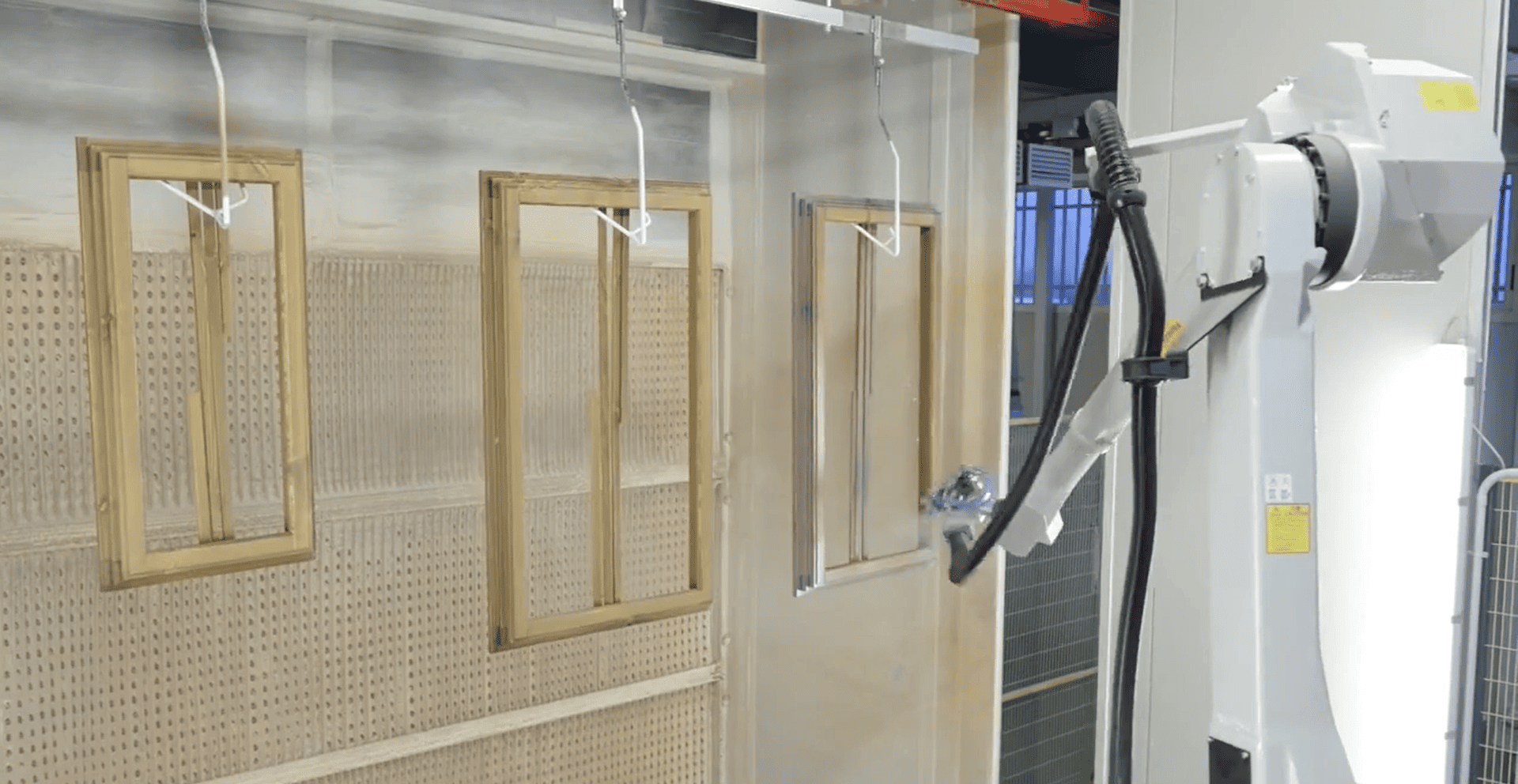
In the chain-type overhead line, parts are suspended from carriers that are pulled along overhead chains, keeping them raised and accessible from all sides. This allows both sides to be coated in a single pass and enables the handling of bulky, three-dimensional items without specific constraints on shape or size, whether assembled or disassembled. This configuration is specifically designed for items such as doors and windows: the ability to suspend the item and access every surface in a single pass directly addresses the challenges related to shape and coverage mentioned at the beginning.

And it is precisely along these lines that the application technology, the second level of the system, comes into play.

Technologies for the automated coating of wooden windows and doors

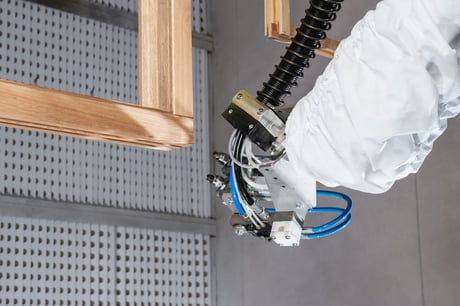
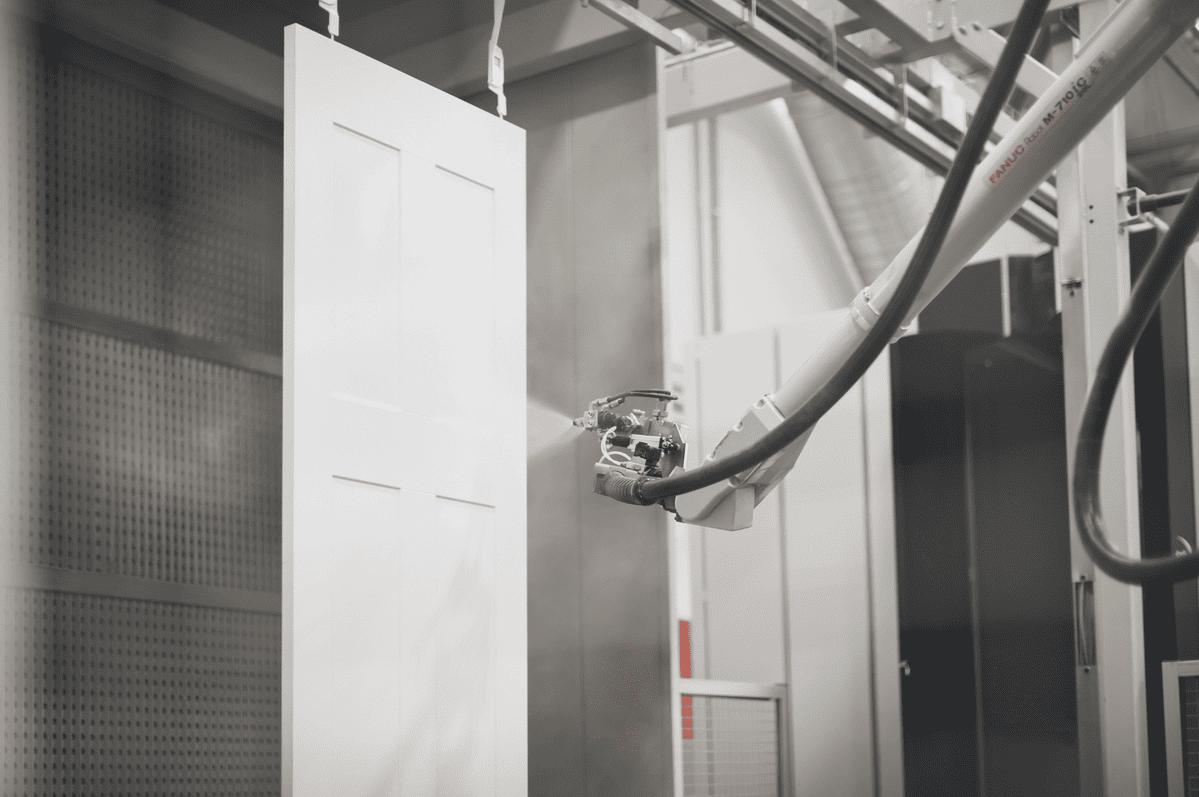
Now that the production line has been defined, the most important question remains: how is the paint actually applied? On the overhead production line, Cefla Finishing’s solution for wooden windows and doors is iGiotto, an anthropomorphic robot that performs spray coating by moving around the suspended workpiece and reaching every surface, including profiles and rebates.

It is guided by cVision, the scanner that works in tandem with the robot. As the workpiece passes by, cVision captures its shape and position via 2D or 3D scanning; the software processes this data and automatically generates the trajectories the robot will use to coat the part optimally. In practice, there’s no need for manual programming for each new item: the system recognizes what’s in front of it and adapts, handling both assembled and disassembled windows in the same way, with no limits on shape or size. This is the true strength of the robotic overhead line, especially for those who produce custom-made items and frequently switch between different types of parts.

iGiotto, in combination with cVision, is at the heart of the solution, but the application technology varies depending on the type of product and production line. On overhead lines, both exterior doors and assembled window frames can be processed: application is handled by iGiotto for spray coating or, alternatively, by the iFlow flowcoating system, which applies impregnating coatings efficiently and uniformly. When working on disassembled parts, however, iGiotto and the Lineflow + Dryflow horizontal flowcoating system (for product application and drying) are used.

It is this combination of production lines, robots, and automated trajectory control that transforms a complex cycle into a manageable industrial process. But what does this mean, in practical terms, in terms of results?

The benefits of process automation

Automating the coating of wooden windows and doors doesn’t simply mean replacing the operator with a machine: it translates into tangible benefits in terms of quality, costs, and production capacity. Here are the main ones:

  • Consistent and repeatable quality: the robot always applies the paint using the same parameters, eliminating variations caused by individual operators and ensuring uniform results on every part throughout the entire workday.
  • Uniform coverage on all surfaces: by applying the coating to the window frame while it is suspended, the product is evenly distributed across every surface, including profiles and rebates. This results in better protection against the elements and improved long-term aesthetic appeal and performance.
  • Optimal use of paint: by dispensing the ideal amount of product, the system reduces waste and overspray, with direct benefits in terms of cost and sustainability.
  • Flexibility in shapes, sizes, and batch sizes: with no limits on shape or size and automatic trajectory generation, the system handles highly variable orders, frequent color changes, and short runs without costly retooling.
  • Productivity and continuity: the automated workflow ensures consistent output over time and reduced setup times, freeing staff from repetitive tasks so they can focus on what adds the most value.

A concrete example comes from Di Canosa, an Italian company that manufactures wooden and wood-aluminum windows and doors. By entrusting the coating phase to Cefla Finishing, the company has adopted a robotic system featuring iGiotto: each window or door frame thus receives a consistent coat of paint on all sides, with uniform coverage that increases its resistance to the elements and preserves its elasticity and appearance over time. As the plant management summarizes, the system coats the windows and doors with the ideal amount of water-based paint in a uniform manner, leaving the company more time to devote to its customers.
Benefits finishing wooden windows and doors

Conclusions and the key role of Cefla Finishing

Finishing wooden windows and doors remains one of the most delicate steps in the production process: it must balance complex shapes, a multi-step process involving multiple coats, and high quality standards with the production volumes and flexibility demanded by the market. This is a challenge that manual labor struggles to meet, but automation makes it possible to address while ensuring consistent quality, long-lasting protection, and production efficiency.

This is where the value of a partner like Cefla Finishing truly shines: not just a single machine, but custom-designed finishing systems for wooden windows and doors, where the choice of production line and application technology, from the iGiotto robot to the cVision scanner, work together to transform a complex process into a manageable and repeatable production workflow. This approach, as demonstrated by those who have adopted it, allows you to raise the bar on quality without sacrificing output. Want to find the coating solution best suited to your wood window and door production? Contact the experts at Cefla Finishing.
For wooden doors and windows, the finish is not merely an aesthetic detail, but the layer that protects the product from moisture, light, and the ...

Article

Everything you need to know about UV digital printing

In the world of surface decoration and finishing, the way an image is transferred onto a material has undergone a long evolution. For decades, traditional techniques required matrices, plates, engraved cylinders, or intermediate steps, with time and cost depending on the size of the print run. However, the gradual digitization of production processes has changed the rules of the game, paving the way for technologies capable of printing directly from a file, without the need to prepare physical media each time.

In this context, UV digital printing has established itself as one of the most versatile and rapidly growing technologies. Its name refers to the unique way in which the ink is cured onto the surface, a principle that sets it apart from other printing techniques and makes it suitable for a wide variety of materials and applications, ranging from visual communications to industrial applications.

Precisely because there is so much talk about it, though not always using the same terminology, it’s worth clarifying exactly what it is, how it works, and in what contexts it is used. In this article, we at Cefla Finishing will take an in-depth look at UV digital printing, from its basic characteristics to its most advanced applications.

What is UV digital printing?

UV digital printing is a direct printing technology that transfers an image onto a surface from a digital file and cures the ink using ultraviolet light. What sets this technology apart is not how the design is applied, but the type of ink used: UV-curable inks, formulated to solidify the moment they are exposed to a UV light source. It is precisely this principle that gives the technology its name.

To understand this correctly, a clarification is helpful, because the terms “digital printing” and “UV digital printing” are often used interchangeably, even though they are not entirely synonymous. Digital printing is the general category: it encompasses all techniques that reproduce an image directly from a file, without plates or stencils, and includes different families such as inkjet printing and laser printing. UV digital printing is a specific application of inkjet technology, distinguished by the use of UV-curable inks and, consequently, their curing via UV lamps. In other words, every UV print is a digital print, but not every digital print is UV: what sets them apart is the chemistry of the ink and the way it is cured.

This characteristic has an important consequence, which explains why UV digital printing is considered a technology in its own right: the ink is neither absorbed by the substrate nor left to air-dry, but transforms from a liquid to a solid almost instantly. This distinctive feature opens up a wide range of application possibilities compared to traditional techniques and makes the technology compatible with a particularly broad range of materials.

How UV printing works

UV printing operates on a principle that is simple in theory but sophisticated in practice: the ink is applied to the surface in liquid form and, immediately afterward, is cured by exposure to ultraviolet light. This transition from liquid to solid, known as polymerization, occurs in a fraction of a second and is at the heart of the entire technology. Unlike techniques that rely on the evaporation of solvents or water for drying, here the ink does not need time to dry: it sets the very instant it is struck by UV rays.

To understand how this result is achieved, it is helpful to look at the three elements that make up the process.

The first are the print heads. These are the components that deposit ink onto the surface, precisely controlling the amount and position of each drop. Image resolution and the accuracy of the result depend on their precision.

The second type is UV-curable inks. These inks are specifically formulated to react to ultraviolet light: they remain liquid until exposed to UV radiation, but as soon as they are exposed, their molecules bond together and the ink cures into a stable, long-lasting layer on the surface.

The third component is the UV lamps. Positioned in line with the print heads, they emit ultraviolet radiation that triggers polymerization. The most widely used technologies today employ UV LED lamps, which operate at low temperatures and with low power consumption, making it possible to process even heat-sensitive materials.

It is the combination of these three elements that defines how UV printing works: the printheads deposit the ink onto the substrate to create the image, the inks remain stable until the desired moment, and the lamps cause them to cure instantly. This process takes place in a single, continuous step, with no waiting time between ink deposition and drying.

How UV printing works

The benefits of UV printing

Instant polymerization is not just a technical feature, it translates into a number of concrete advantages that explain the growing popularity of UV printing. Compared to traditional printing techniques, the main benefits relate to four aspects:

  • Speed and productivity: since the ink cures the moment it is exposed to UV light, no drying time is required between passes. The part is ready to be handled or processed immediately after printing, enabling faster and continuous production cycles.
  • Versatility in materials: UV ink is not absorbed by the substrate but cures on its surface. This makes it possible to print on a very wide range of materials, including plastic, glass, metal, wood, and other substrates, even non-porous ones, that would be difficult to print on using other techniques.
  • Durability and longevity: once cured, the ink forms a stable, compact layer that is more resistant to abrasion, scratches, and external factors. The result is a print that retains its color quality and integrity over time.
  • Sustainability: UV-curable inks are characterized by low emissions of volatile organic compounds (VOCs) compared to many conventional printing technologies, and their seamless integration with Cefla Finishing’s decoration lines makes it possible to print on any substrate, minimizing material waste. In addition, UV LED lamps operate at low temperatures and with low energy consumption, reducing the overall environmental impact of the process.

Taken together, these advantages make UV printing a technology capable of combining speed, quality, and flexibility. It is precisely this combination that explains why, in addition to its best-known applications, UV printing is now also used in production settings where the focus is on finishing large volumes of surfaces.

UV digital printing in the industrial sector

The characteristics we’ve discussed (instant curing, compatibility with many materials, and print durability) become even more significant when UV digital printing moves beyond small-scale customization and enters production processes. Here, it is no longer a matter of decorating individual objects, but of applying images, colors, and designs directly to the surfaces of materials used in products for furniture, construction, packaging, and many other industries.

In the industrial sector, UV digital printing is an advanced solution for surface decoration. Thanks to high-precision print heads and the use of UV-curable inks, it allows for the reproduction of extremely realistic textures and finishes, such as wood, stone, or natural materials, on panels, slabs, edges, and other elements, while maintaining high standards of quality and definition. The surface is not simply colored; it is decorated according to a digital file that can be modified at any time, without the need to prepare cylinders, dies, or specialized decorative papers.

It is precisely this digital nature that represents the most significant competitive advantage for a manufacturing company. Compared to traditional decoration methods, UV digital printing allows for:

  • To combine productivity with customization, handling both large volumes and small batches, down to a single piece, without prohibitive setup costs;
  • Respond quickly to trends by switching from one design to another simply by replacing the file, and drastically reducing the time between the initial idea and the creation of a sample;
  • Reduce inventory and work-in-progress, because it is no longer necessary to store large quantities of decorated materials waiting to be used.

Another aspect that makes this technology particularly well-suited for production is its ability to ensure consistency between different parts of the same product. Starting from a single digital image, the surface of a panel and its edge can be decorated with the exact same pattern, resulting in a perfect match that would be complex and costly to achieve using traditional techniques.

In a market where there is growing demand for increasingly customized products that can be delivered quickly and in varying quantities, UV digital printing offers a practical solution to the needs of modern industrial finishing.

UV digital printing in the industrial sector

Cefla Finishing solutions for UV digital printing

Integrating UV digital printing into a production line doesn’t simply mean adding a printer, it means integrating the technology into a complete finishing process, from the preparation of the raw substrate to the finished, decorated product. This is where Cefla Finishing’s expertise comes into play: the company designs and manufactures industrial digital printing machines and lines based specifically on UV-curable inks.

Our solutions are designed to fit flexibly into a variety of production environments. The printers can be integrated into fully digital or hybrid printing environments, where digital technology coexists with traditional finishing techniques, and are available in single-pass and multi-pass configurations depending on the required volume and quality. In addition, the Cefla Finishing Lab, located in Imola, Charlotte, and Tianjin, allows companies to test the technologies firsthand and identify the configuration best suited to their needs before making any investment decisions.

The J-PRINT line for every application

At the heart of Cefla Finishing’s offering for industrial digital printing is the J-PRINT series, a family of printers designed to integrate into finishing lines and adapt to different materials and applications. Printing is performed using industrial printheads, with modular print bars capable of achieving large print widths and high operating speeds. Among the solutions in the range, the J-PRINT SP is designed to use UV-curable inks and integrate into fully digital or hybrid printing environments: this is where the principle of UV digital printing finds its expression within Cefla Finishing’s product lines.

Within the product line, each solution addresses specific needs depending on the product to be decorated.

Application

Line configuration

J-PRINT Solution

Panels, sheets, and furniture components

Digital or hybrid single-pass

J-PRINT SP: High-definition decoration on large flat surfaces 

Edges

Single-pass digital or hybrid roll-to-roll (R2R)

J-PRINT SP R2R: on-demand decorative edge banding rolls, with preparation, printing, and finishing in a single loading/unloading cycle

Digital or hybrid single-pass

J-PRINT SP EDGE: direct edge printing for extreme JIT

Baseboards and moldings

Digital or hybrid single-pass

J-PRINT SP TS: Reproduces the texture and finish of the floor it will be paired with on the profile

Relief Effects and Textures

Single-pass or hybrid

J-PRINT SP TD: Decorative and tactile printing with realistic 3D effects

Sheets, panels, and components

Digital or hybrid multi-pass

J-PRINT MP: 2D or 3D printing on various materials

The underlying principle across the entire product line is to start with a single digital file to manage the entire decoration process, with the ability to reproduce the same pattern on different parts of the same product and to switch quickly from one design to another. This principle also underpins the most advanced processes: with the Embossing In Register (EIR) technique, for example, the printed decoration is combined with embossed patterns perfectly synchronized with the design, so that a motif such as wood grain is rendered not only visually but also to the touch.

Conclusions and the key role of Cefla Finishing

In conclusion, UV digital printing has established itself as one of the most versatile printing technologies available today: its ability to cure ink instantly, process a wide variety of materials, deliver durable and long-lasting results, and integrate with Cefla Finishing’s finishing lines, which allow for the addition of an extra layer of protection to the design depending on the end use, makes it an effective solution to the needs of a market that demands increasingly customized, high-quality products available quickly. This potential is fully realized when the technology is integrated into production processes and becomes a tool for surface finishing and decoration on an industrial scale.

It is in this context that we at Cefla Finishing offer our expertise. Not simply as a machine supplier, but as a technology partner capable of guiding companies every step of the way: from the design of complete, integrable production lines, to the opportunity to test solutions in our Lab, all the way through to support in fine-tuning the process and preparing print files. This approach transforms the adoption of digital printing into a concrete growth opportunity for those working in industrial finishing.

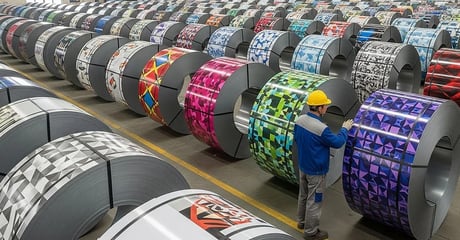
Just how far this technology can go in the manufacturing sector is demonstrated by a concrete example: the Marcegaglia Group’s CROMATICA project, implemented using Cefla Finishing technology. It is a continuous “coil-to-coil” digital printing line that decorates steel in four-color process with a high degree of customization, within a fully automated system. This is an example of how digital surface decoration is now capable of redefining the aesthetic possibilities of materials once considered purely functional.

Would you like to find out how to integrate UV digital printing into your finishing line? Contact our experts: together, we’ll identify the Cefla Finishing solution that best meets your production needs.

In the world of surface decoration and finishing, the way an image is transferred onto a material has undergone a long evolution. For decades, ...

Article

Industrial roll-to-roll digital printing: a comprehensive overview

For those involved in the decoration and finishing of flexible materials on rolls, the recurring question is almost always the same: how can high production volumes be reconciled with a demand for customization that grows year after year?

This is no trivial matter. The market demands shorter runs, ever-changing designs, shorter lead times, and the ability to change graphics without slowing down production. Traditional printing technologies (rotogravure, flexography, screen printing) deliver excellent results for large print runs, but they come with significant setup costs, the need for dedicated cylinders or plates and screens, and minimum run sizes that are difficult to reconcile with an increasingly fragmented market. The result is often a compromise that takes its toll over time: excess inventory of pre-printed material, production downtime due to job changes, or the decision to forego small batches because they are economically unviable.

It is against this backdrop that roll-to-roll digital printing has established itself as one of the most practical solutions, redefining the way the industry approaches the decoration of roll-fed substrates. This technology does not require a choice between productivity and flexibility, but rather aims to combine both.

In this article, we’ll provide a comprehensive overview of roll-to-roll digital printing, leading up to the role that Cefla Finishing plays in this sector.

What is roll-to-roll digital printing?

Roll-to-roll digital printing is a decoration technology in which the material is unwound from a roll, passes through the printing module and, where required, through material preparation and finishing stages, in a continuous stream, and is then rewound or sent on to downstream processes. Unlike printing on individual sheets or panels (sheet-fed or flatbed), the substrate here is flexible and flows without interruption: it is precisely this continuous feed mechanism that defines the process.

The term “digital,” on the other hand, refers to the way the image is transferred onto the substrate. The digital decoration is performed by inkjet printheads that deposit ink drop by drop (drop-on-demand), directly following a graphic file, without the use of cylinders, printing plates and screens, or physical matrices, as is the case with traditional analog technologies. Essentially, the image goes from the file to the material without any mechanical intermediaries, and it can be modified at any time simply by editing the graphic data.

The substrates used are inherently flexible and available in rolls: PVC, ABS, polystyrene, paper, laminates, foils, technical films, and even metal coils. It is the combination of these two elements, the continuous movement of the web and the digital nature of printing, that sets roll-to-roll printing apart from other finishing solutions and positions it as a direct evolution of continuous industrial printing systems.

How industrial roll-to-roll digital printing works

The operating principle is continuous processing: the material never stops but flows at a constant speed beneath a stationary print module. In the most common industrial configurations, known as single-pass, the print heads cover the entire width of the web and do not move laterally; instead, the substrate moves beneath them. Focusing solely on the core printing process and excluding any web preparation and finishing stages, the process comprises the following essential phases: 

  1. Unwinding the roll: the blank material is unwound from an unwinding roller and fed into the line, initiating the continuous process.
  2. Conveyance and tensioning: a series of drive rollers and tensioning devices keeps the web flat and perfectly aligned with the printing path, a condition essential for precise ink deposition.
  3. Ink deposition: in the printing zone, the inkjet printheads release ink droplets according to the graphic file, forming the image directly onto the moving substrate.
  4. Pinning and UV curing: immediately downstream of the printheads, UV or UV-LED lamps fix the ink (pinning) and complete its curing in a matter of seconds, setting the design and preventing the droplets from spreading or mixing with one another. 
  5. In-line quality control: vision systems check color registration, check for clogged nozzles, and detect printing defects as the material moves through the line, without interrupting the flow.
  6. Rewinding or downstream processing: the printed material is rewound onto a reel or sent directly to the next stages, such as cutting, lamination, or finishing.

The key difference from multipass systems, in which the print head moves back and forth on a stationary support, lies precisely here: by eliminating the transverse scanning and feeding the web continuously, the single-pass system achieves significantly higher speeds, on the order of tens of meters per minute.

The advantages of roll-to-roll digital printing

The value of roll-to-roll digital printing becomes particularly clear when compared to traditional analog technologies, where each design requires the creation of a dedicated cylinder or plate. By eliminating this step entirely, roll-to-roll digital printing fundamentally reshapes the economics of continuous decoration.

  • Total flexibility and customization: since the image comes from a file, changing the design simply involves uploading a new graphic file, no new dies, no downtime for setup. This makes it possible to handle different designs in rapid succession, variable data, and customizations that would be unfeasible with analog technologies.
  • The cost-effectiveness of short runs and just-in-time production: with no fixed costs for printing cylinders or setup, even small batches become economically viable. You can print what you need when you need it, eliminating the need for inventory of pre-printed materials and reducing the risk of obsolete stock.
  • Reduction of waste and scrap: by printing only the quantities actually required and eliminating the need for consumables associated with printing plates and screens, the process generates less waste and supports more sustainable production, in line with the industry’s environmental requirements.
  • High productivity for large volumes: in single-pass configurations, continuous web processing allows for speeds in the tens of meters per minute, making this technology suitable not only for small batches but also for the most intensive production cycles.
  • Consistent quality over long runs: inline control and stable material transport ensure uniform results even with large quantities of material, without the registration or color variations typical of extended production runs.
  • Integration into existing lines: the modular design of roll-to-roll systems allows them to be incorporated into plants that are already in operation, supplementing or replacing individual stages without having to redesign the entire line.

In short, roll-to-roll digital printing no longer requires choosing between the flexibility of small batches and the efficiency of high volumes: its competitive advantage lies precisely in its ability to combine the two worlds.

Applications of roll-to-roll digital printing

The versatility of roll-to-roll digital printing translates into a very wide range of applications, spanning sectors that may be quite different from one another but share one common element: the processing of flexible materials on rolls.

In the world of furniture and interior design, technology is used to enhance laminates and panels, decorative papers, panel edging, wall coverings, and flooring such as LVT vinyl, where the ability to faithfully reproduce wood grain, stone textures, and custom patterns is particularly valuable.

In the industrial sector more specifically, roll-to-roll technology is used in the decoration of metal coils, steel and aluminum, intended for the construction, home appliance, and furniture industries, as well as in the printing of flexible packaging and labels and in the finishing of technical films and foils. The common thread running through all these applications is the ability to apply complex and customized designs to large, continuous surfaces consistently and quickly.

Digital printing for edge banding

Among the applications seen in the furniture industry, edge banding deserves a separate discussion. Edge banding is the thin strip that covers the sides of a panel to hide its core and provide aesthetic continuity to the piece of furniture: to look authentic, it must perfectly replicate the pattern of the surface it is paired with.

In the traditional process, the edges are decorated using rotogravure, a technique that requires the engraving of a new set of cylinders for each new design. Every time a new finish is introduced to the market, new cylinders must therefore be developed, with the associated costs and lead times; added to this are potential color variations between batches and the difficulty of precisely matching the edge to the panel, which is often produced on different machines.

Digital printing for edge banding turns this logic on its head. Starting with a scan of the panel’s surface, a graphic file is generated and printed directly onto the edge (made of PVC, ABS, or paper), resulting in precise color matching and pattern continuity that analog techniques struggle to achieve. The advantages are clear: consistent color matching across batches, the ability to produce even a single roll without minimum order quantities, and just-in-time production that reduces inventory of pre-printed edges and minimizes pattern repeats, resulting in a more natural final effect. It is in this context that roll-to-roll digital printing most clearly demonstrates the link between customization and industrial production.

Cefla Finishing machines for roll-to-roll digital printing

As we have seen, roll-to-roll digital printing is now one of the most strategic technologies for the industrial decoration of roll-fed materials. But technology alone is not enough: what makes the difference is the machine that puts it into practice. Feeding a flexible web at speeds of tens of meters per minute while maintaining its flatness and high-precision alignment, controlling high-definition print heads, synchronizing the printing of the color design with the printing of any texture in perfect registration, and integrating all of this into an existing production line are engineering challenges that require expertise, experience, and robust construction. This is why choosing the right partner is crucial: relying on professionals who design and build these systems is what distinguishes a catalog-quality result from a truly industrial-scale outcome.

This is where Cefla Finishing comes in. With the J-PRINT SP Roll to Roll, the company offers a single-pass machine dedicated to digital printing on flexible roll-fed materials, designed to build fully digital industrial printing lines capable of handling flexible batches, customized designs, and high print runs without compromising quality. Key features:

  • Single-pass technology for roll-to-roll printing, with standard working widths ranging from 120 mm to 1,800 mm.
  • Operating speeds of up to 50 m/min and beyond, for maximum productivity in continuous cycles.
  • High-definition industrial DOD printheads, compatible with specialty and UV inks.
  • Integrated pinning and UV/UV-LED curing for immediate drying.
  • Wide range of compatible materials: PVC, ABS, PS, paper, laminates, foil, technical films, and metal coils.
  • A drive and tensioning system that ensures belt stability even at high speeds.
  • Reel change and parameter settings managed by centralized software.
  • Modular architecture, configurable to meet production needs.

Ultimately, roll-to-roll digital printing performs at its best when the technology is paired with the right manufacturing expertise. This is where Cefla Finishing’s value shines through: the ability to integrate the most innovative digital solutions, such as the J-PRINT SP, into hybrid lines that combine digital technology with analog processes honed over decades of experience. This approach provides companies with both the potential of emerging technologies and the reliability of tried-and-true methods, allowing them to choose the combination best suited to each production need on a case-by-case basis. To explore how to integrate this into your production process, contact the Cefla Finishing team!

For those involved in the decoration and finishing of flexible materials on rolls, the recurring question is almost always the same: how can high ...

Article

Customised Solutions for the Finishing of Televisions, Washing Machines and Refrigerators

How to Improve Finishes for Household Appliances

How important are finishes for household appliances? More than one might imagine. Many actually underestimate this aspect. But the truth is that the objects we use every day—such as televisions, washing machines and refrigerators—owe many of their qualities to advanced finishing processes.

High-quality finishes and attractive, durable household appliances form an inseparable combination. Coating solutions make the difference, creating surfaces that are pleasant to the touch, long-lasting and visually impeccable, yet also capable of adapting to modern design requirements. All this without ever compromising functionality.

Why are appliance finishes essential?

Let us consider the plastic parts forming essential elements of everyday objects, such as the bezel of an ultra-flat TV, the handles of refrigerators and ovens, or the porthole of a washing machine.

These are all components with two features in common: they must be aesthetically pleasing and, more importantly, safe and functional.

From this perspective—beyond basic engineering and design—the type of finish makes all the difference in the daily user experience. Handling, grip, perceived solidity and quality, and even the sense of seeing and touching something familiar and pleasant: all derive from the care with which finishes are applied to household appliances.

Objects that withstand the test of time can be recognised immediately. And it is precisely this feeling that most attracts consumers when making their purchasing decisions.

The best technologies for appliance coating

The only way to achieve such results is to rely on advanced spray-coating systems: composite and integrated finishing lines equipped with machinery capable of ensuring consistent quality at every stage of the process.

Cefla Finishing offers two dedicated solutions—iBotic and iGiotto App—which can also be integrated into existing coating lines.

iBotic is a Cartesian spraying robot offering new functionalities to optimise coating operations for appliance components, with tangible economic and production benefits. The machine is ideal for companies dealing with increasing customisation demands, requiring frequent colour changes. What truly sets iBotic apart is its ability to work simultaneously on parts of different shapes and thicknesses, both at a standstill and in motion, in tracking mode, and to autonomously generate ideal spray trajectories through a 2D or 3D reading system.

iGiotto App is the automatic system that combines state-of-the-art coating technologies with the high performance of six-axis anthropomorphic robots. Equipped with cVision 3D, iGiottoApp can accurately detect the position, size and shape of incoming items, autonomously generating spray paths even for heterogeneous pieces with pronounced three-dimensional shapes. In short, everything needed to achieve maximum quality for every appliance component.

THE MOST INNOVATIVE FINISHING SOLUTIONS

Discover new finishing solutions: more effective, more productive and more competitive than those currently used by the industry.


Appliance finishes: every component requires its own treatment

Finishing household appliances may require different treatments to make the product more attractive to the end customer.

Take, for example, washing machine portholes: the part to be coated is the round chrome section surrounding the transparent window.

Chroming requires application on a prepared surface that covers defects and stresses typical of plastic parts produced through injection moulding. These defects—even when small—become highly visible once chrome is applied, especially when deposited in thin layers via PVD (Physical Vapour Deposition). Coating the component prior to chroming isolates the plastic substrate and covers imperfections, achieving significantly better aesthetic results and, above all, consistent long-term quality.

Base coating as preparation for subsequent chroming can be carried out on a Cefla line composed of cleaning and deionisation systems, an Easy-type sprayer, an Ecogel tunnel for paint levelling and a UV oven for final curing.

Cefla also provides all systems needed to prevent surface contamination from airborne dust, ensuring high-quality results.

The advantages of customised coating solutions

At Cefla Finishing, we know that every plant has specific operational needs and production philosophies that evolve over time, beyond the technical parameters required to properly process a given component.

This is why we have developed a modular range of coating solutions. For us, modularity is synonymous with personalisation: machinery and software can be integrated with maximum ease; existing lines can be modified simply by replacing or adding machines to completely change the process, increase productivity, handle batches of different sizes compared to the current plant, or introduce new coating cycles. This allows appliance manufacturers—operating in an increasingly dynamic market—to remain agile and responsive to customer demands.

Cefla: the ideal partner to optimise appliance finishing processes

It should now be clear that finishes for household appliances represent a key element in combining aesthetics and durability, enhancing perceived product quality.

By offering cutting-edge technologies—from reciprocating spray systems like Mito and Easy to robots such as iBotic and iGiottoApp—Cefla Finishing stands out as the ideal partner for implementing reliable, customised coating solutions for household appliances.

Contact us to learn how to continuously improve your finishing process: our experts are ready to interpret your needs and work with your technicians to develop a tailored solution.

LOOKING FOR THE IDEAL SOLUTION FOR YOUR COATING LINE?


How to Improve Finishes for Household Appliances How important are finishes for household appliances? More than one might imagine. Many actually ...

Article

Industrial Spray Coating: The Definitive Guide to Techniques and Equipment

More and more manufacturers are choosing to install industrial spray coating systems within their finishing lines. Precision, flexibility, reliability and efficiency are, after all, the watchwords of a technology that, thanks to automation, can be adapted for a myriad of applications and sectors.

Naturally, to maximise output, it is fundamental to design plants and processes that take into account the unique features of the machinery and to integrate them according to production goals.

But what does it take to plan an evolutionary path that is consistent with your growth strategy? Which solutions are best to adopt to meet the needs of your specific sector?

To answer this question, we have prepared a complete guide to the techniques, equipment and use cases that revolve around the subject of industrial spray coating.

What is industrial spray coating?

Let's start by framing the topic from a technical point of view. Industrial spray coating is a manufacturing process that involves applying liquid or powder coatings to surfaces using specialised spray equipment. Unlike more traditional methods (for example, dip, brush or roller coating), industrial spray coating atomises the lacquer into fine droplets that are then transferred onto the substrates. This achieves rapid, uniform coverage on large and complex surfaces. (To learn more about this topic, we have dedicated an entire White Paper to the subject of painting complex shapes.)

R-LineaIWF Cefla Finishing coating line

Returning to industrial spray coating, the dynamics of this technology vary depending on the application for which it is implemented. In general, spray coatings provide smooth, glossy finishes for a wide range of manufactured goods, from consumer products to vehicle components, to furniture and furnishing accessories. Some coatings are formulated to perform specific functions, such as thermal insulation, electrical conductivity or non-slip properties. But there are even more particular use cases, such as the aerospace industry, as the technique, when applied with suitable materials, offers effective protection against corrosion, wear, chemical exposure and environmental factors, significantly extending the service life of products.

Industrial spray coating is increasingly valued as it supports mass production with consistent results, reduces labour costs and allows for precise control over coating thickness. Its versatility, as we will see, makes it suitable for a wide range of substrates, from metals and plastics to concrete, and for various applications.

DISCOVER THE MOST ADVANCED FINISHING SOLUTIONS
Elevate your competitive edge.

Advantages of industrial spray coating

Industrial spray coating offers numerous advantages over other finishing methods. Firstly, as mentioned, its application versatility makes it possible to easily coat complex geometries, intricate components and large surfaces uniformly, a result that is difficult to achieve, for example, by brushing or dipping. This flexibility is essential for production lines that must handle objects with irregular three-dimensional shapes, such as car body panels and interior elements of motor vehicles.

But, compared to other approaches, spray coating also ensures greater performance in terms of speed and efficiency. The process can indeed be automated, which ensures high productivity and consistent results. Within a custom-designed line, spray painting can rapidly cover large surfaces, drastically reducing delivery times for large batches.

Among the plus points of industrial spray coating, one has to mention the uniformity of the applied material layer; atomisation guarantees a homogenous coating thickness, regardless of the coating material used. And, still on the subject of consumables, the wide range of materials compatible with spray coating – epoxies, polyurethanes, acrylics, zinc-rich primers and powders – allows for the creation of tailor-made solutions based on specific functional requirements:

  • resistance to corrosion and abrasion from chemical agents
  • durability over time, even in conditions that involve exposure to UV rays
  • high-quality tactile and visual properties
  • and finally, robustness

This is thanks to the ability to control the desired thickness with extreme precision, which allows manufacturers to optimise material usage and meet its performance standards.

So, in brief, the advantages offered by industrial spray coating are:

  • Process speed and efficiency
  • Application uniformity on complex surfaces
  • Wide range of applicable materials
  • Thickness control
  • Resistance to wear, UV, and chemical agents
  • Increased durability of treated surfaces


Cefla Finishing PRIMA machine

Common industrial spray coating techniques

Obviously, the choice and correct use of the most appropriate technique are fundamental to achieving the optimum result. Understanding the operating principle of each approach – which naturally has its advantages and disadvantages, and which is therefore more or less suitable for certain applications – is the prerequisite for maximising the performance of the coating materials on the objects to be treated.

Here is a quick reference guide to the most common painting techniques, all of which are covered by Cefla Finishing technologies and machines, with advanced and customisable solutions.

➡️Conventional Air Spray

The most basic technique uses compressed air to atomise the coating material as it exits a spray gun. In its simplicity, it guarantees excellent coverage and is extremely versatile even when using different coating types. The approach, common in general finishing operations, vehicle painting and architectural coatings, has two potential disadvantages: overspray and higher material consumption which, if not properly managed, can lead to unwanted waste.

➡️HVLP (High Volume Low Pressure)

To overcome the limits of conventional spray coating techniques, companies can turn to HVLP systems, which use a high volume of air at low pressure to produce extremely fine droplets with a controlled spray. The technique thus offers superior transfer efficiency and reduces overspray, making it ideal for precision work, furniture finishing and touch-up applications. However, you might experience a slower transfer speed for thicker coatings.

➡️Airless Spray

This approach relies on high-pressure pumps to force the coating through a nozzle without compressed air. It provides rapid coverage for large surfaces, such as industrial tanks or structural steel. The main advantage of airless spray is its high productivity; however, it can produce overspray and may not guarantee optimal finish control.

➡️Air-Assisted Spraying

This procedure, as the name suggests, combines the two aforementioned techniques (airless and conventional), using low-pressure air to further atomise the coating and improve the quality and control of the finish. Machines of this type are suitable for creating coatings that require a smooth, high-quality surface.

➡️Electrostatic Spraying

By electrically charging the coating particles, it is possible to attract them to the surfaces to be treated, ensuring greater transfer efficiency and minimal waste. Electrostatic spraying is therefore ideal for handling objects with complex shapes, such as vehicle panels and large metal structures. The resulting coating is excellent, with a drastic reduction in overspray. The main challenge in implementing this approach is the cost of the equipment and its maintenance.

Types of paints usable in industrial spray coating

The knowledgeable use of various industrial spray coating techniques allows for the adoption of a wide range of coating materials, each suitable for specific applications. Let's see which are the most common:

  • Epoxy paints Known for their excellent chemical and corrosion resistance, epoxies are widely used in protective coatings for pipelines, tanks and concrete structures. They cure to form durable, high-adhesion films.
  • Polyurethane paints Offering excellent abrasion resistance and UV stability, polyurethanes are common in automotive finishes, floor coatings and outdoor equipment. They provide flexible, glossy finishes.
  • Acrylic paints Valued for their ease of application, quick drying and colour retention, acrylic coatings are used in architectural finishes, signage and decorative applications.
  • Alkyds These are traditional oil-based coatings that offer good gloss and ease of application, often used on furniture, machinery and in general industrial applications where aesthetics is important.
  • Zinc-rich primers These materials contain high levels of zinc particles for galvanic protection, preventing corrosion on steel structures, bridges and offshore platforms.
  • Powder coatings (if applicable with electrostatic spraying) Applied via electrostatic spraying, powders derived from polyester, epoxy resin or thermoplastic materials produce durable and environmentally friendly finishes, particularly suitable for domestic appliances, automotive components and heavy machinery.
  • Other special materials Finally, there are special coatings that offer specific properties (non-stick, heat or wear resistance) used in sectors such as the food industry, electronics or in high-temperature environments.

Industrial spray coating equipment

At the heart of an efficient, high-performance line, there is, of course, reliable and robust industrial spray coating equipment, designed to ensure quality and safety within increasingly integrated and automated processes. Here is an overview of the essential components for each of the techniques we have seen so far.

➡️Spray guns

To be selected based on the chosen technique, spray guns are divided into different categories: compressed air guns for conventional methods, HVLP guns for precision work, air-assisted guns, airless guns and finally, electrostatic guns.

➡️Material Feed Systems

We are talking about pumps (piston, diaphragm or centrifugal) and pressure pots, which supply the coating material consistently and at the desired pressure. For dispensing powder coatings, there are specialised feeders capable of ensuring a constant flow.

➡️Hoses

Essential for resisting chemical attack and pressure fluctuations, high-performance hoses connect the pumps to the spray guns.

➡️Nozzles

Depending on the type of application and material used, the guns are equipped with nozzles of different sizes and designs, which influence the spray pattern and material atomisation. Knowing how to choose the correct option is fundamental to obtaining uniform coatings.

➡️Air Preparation Equipment

Compressors, filters and dryers ensure a supply of clean, dry and regulated air, which is essential for achieving consistent spray quality and ensuring the longevity of the equipment.

➡️Surface Preparation Tools

Abrasives, detergents and primers, to be applied to substrates before spraying operations, are fundamental for ensuring optimal adhesion and coating performance.

➡️Spray Booths and Ventilation Systems

These machines not only help to reduce overspray but also to control the fumes generated by spraying, helping to keep work environments safe. Operating in tandem with adequate filtration mechanisms, they minimise the environmental impact and health risks for coating operators.

➡️Personal Protective Equipment

For those working in close contact with industrial spray coating equipment, respirators, gloves, overalls and protective goggles remain essential to avoid contact with particles that are hazardous to the skin and respiratory system.

Coating machine for automotive

Industrial sectors and applications of spray coating

This guide to industrial spray coating can only conclude with an overview of the most popular applications in an ever-growing number of sectors. We are talking about extremely heterogeneous sectors, each with specific requirements, but all distinguished by a common need: to achieve maximum production efficiency without ever compromising on the quality of the finished product, the safety of their employees and eco-sustainability.

While in the automotive sector these techniques have been used for years for painting car bodies and applying clear coats and protective finishes, ensuring both pleasing aesthetics and corrosion resistance, in the aerospace sector, spraying allows aircraft components to be coated with specialised, lightweight and high-performance paints.

The marine industry is also discovering its advantages: the application of antifouling paints and protective coatings helps ships and offshore structures to resist microorganisms and the constant corrosive action of salt water.

Those in the manufacturing industry, on the other hand, use spray painting to apply protective and decorative coatings to machinery, domestic appliances and consumer products, while in the construction sector, the technique is used to coat structural steel and concrete surfaces or fibre cement elements with oxidation-resistant paints and protective layers.

With the aim of obtaining high-quality finishes on wooden and metal furniture, combining durability and pleasing aesthetics, the world of furniture and domestic appliances is also experiencing the benefits of industrial spray coating first-hand.

Then there are use cases that could be defined as extreme, such as applications in the heavy machinery and Oil & Gas sectors: industrial spray coating is currently the best option for creating coatings capable of protecting pipelines, offshore platforms and storage tanks from corrosion and chemical attack. Thanks to the use of zinc-rich primers and epoxy coatings, these treatments help equipment to withstand environmental damage, wear and chemical exposure, even over a very long period of time.

Each of the aforementioned sectors can, of course, only unleash the full potential of industrial spray coating when it designs and implements customised coating solutions, that is, ones capable of adhering to industry standards and the requirements imposed by clients. This is why it is essential to be able to rely on a partner like Cefla Finishing: our offering is constantly evolving, and aims not only to provide the market with a high-level technological supply, but above all to build, together with our customers, solutions capable of successfully tackling new and increasingly challenging use cases.

LOOKING FOR THE IDEAL SOLUTION FOR YOUR COATING LINE?


More and more manufacturers are choosing to install industrial spray coating systems within their finishing lines. Precision, flexibility, ...

Article

Industrial Roller Coating: A Guide to the Most Innovative Technology

In recent years, industrial innovation has revolutionised the concept of surface finishing. Industrial roller coating has established itself as an efficient and versatile technology for companies focused on quality and productivity. This guide explores the advantages, processes, customised solutions, and the latest applications made possible by Cefla Finishing technologies.

What is industrial Roller Coating

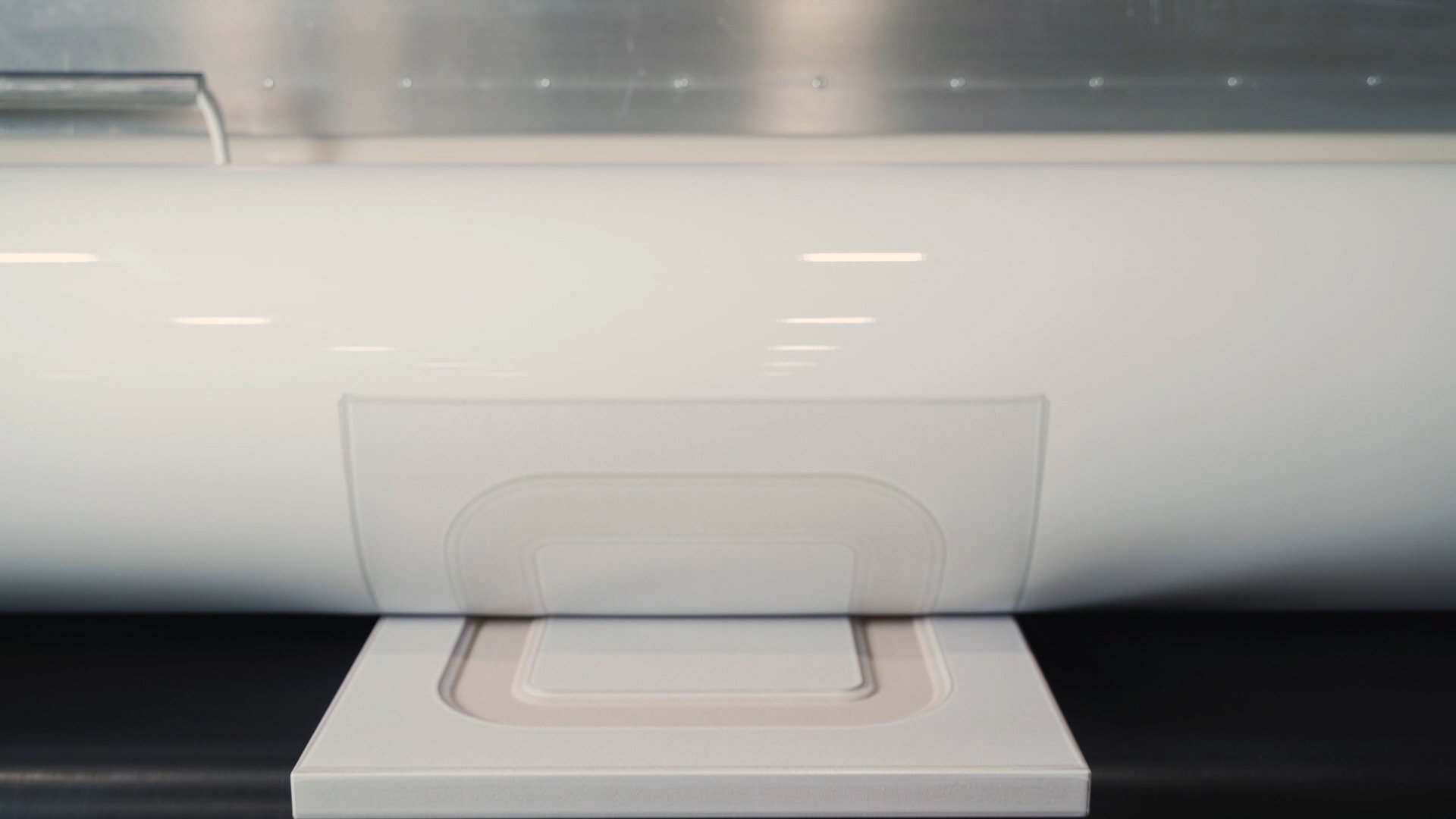
Industrial roller coating is an application technology that employs sets of specialised rollers to apply lacquers or other coatings onto different types of substrates. More than a simple technology, it is a method widely used in production processes to ensure uniform, efficient, and high-quality finishes.

The role played by rollers in industrial coating

As the name suggests, the main component of a roller coating machine is the roller itself, a cylindrical tool designed to rotate and transfer the coating material onto surfaces. Rollers can be covered with different materials such as rubber, polyurethane, sponge, or silicone, each chosen according to the specific requirements of the application. Soft rubber rollers, for example, offer excellent elasticity and adhesion, making them suitable for treating irregular surfaces. Polyurethane rollers, on the other hand, provide durability and chemical resistance, particularly when more aggressive lacquers are used.

The operation of industrial roller coating solutions involves a combination of movements aimed at applying the lacquer and pressing it onto the material to be treated. This synergy produces a smooth and uniform finishing layer, though the result may vary depending on several factors. The type of roller coating material and its surface structure significantly influence the final appearance of the workpiece, which may feature glossy, matt, or textured finishes depending on the chosen solution.

Let us now look more closely at the advantages these techniques offer, and how Cefla Finishing’s innovative solutions — starting from soft rollers — help leading players across various industries position themselves on the market with products of impeccable quality.

The main advantages of correctly implementing industrial roller coating

Industrial roller coating is a technique with deep roots in traditional finishing approaches. Significant technological advances in recent years have revolutionised its role, expanding its uses and significantly increasing the efficiency of the machines.

Firstly, new-generation solutions allow uniform application not only on flat objects, but also on complex or irregular surfaces, reducing material waste and ensuring consistent finish quality by eliminating defects typical of traditional techniques, such as streaks or uneven coating layers, which are costly and time-consuming to correct.

Machines in the past were often unable to apply sufficient pressure to panels during coating. Operators were unable to control the process satisfactorily, and the poor quality of the result was only noticeable at the end. In addition, the application heads did not work on poorly calibrated panels or uneven surfaces. Manual cleaning of the machines was also time-consuming and costly.

Today's solutions overcome these limitations, improving operational performance and increasing application speed without sacrificing quality. Faster processing times translate into higher productivity and reduced labour costs.

Last but not least is the issue of sustainability: the new machines reduce VOC emissions and optimise resources, resulting in lower lacquer usage and energy consumption.

THE MOST INNOVATIVE FINISHING SOLUTIONS
Discover the most advanced finishing solutions to boost competetiveness.

The typical industrial roller coating process: the main stages

The industrial roller coating process involves several stages, each of which is essential for achieving optimal results. A typical line involves six steps:

  1. Initial analysis and machine configuration: understand the material, surface geometry and coating requirements to set the process parameters.
  2. Surface preparation: this may include sanding, cleaning or applying primer for better adhesion and uniformity.
  3. Coating application using rollers: the product is transferred to the substrate using precisely adjusted and calibrated rollers.
  4. Drying: UV ovens, infrared heaters, or drying chambers cure the paint.
  5. Inspection and quality control: visual and instrumental checks ensure the desired thickness and adhesion.
  6. Delivery: coated components are packaged and prepared for shipment or assembly.

Each stage is crucial: incorrect preparation can compromise adhesion, while inadequate polymerisation can lead to premature wear. A well-orchestrated process ensures a durable finish, optimising production and reducing waste.

Roller coating line

How to choose the industrial roller coating solution that best suits your needs

Moving from theory to practice means evaluating various parameters and understanding what upgrades to make to your systems. Choosing the ideal industrial roller coating solution requires a comprehensive analysis of multiple factors.

Knowledge of the operating environment is essential. Applications exposed to high temperatures, humidity or chemicals require specific properties in the coating and rollers. The material to be treated (metal, plastic, wood, composites) determines the choice of roller and coatings. Mechanical loads, operating speed and type of finish influence the selection process.

Budget, machine life, maintenance costs and energy requirements also play a role in the choice: modular solutions help to evolve according to needs.

Other technical criteria: system efficiency, low material consumption, compliance with environmental regulations (e.g. low VOC).

Efficiency, ease of use, accessibility and control of the machine process are also fundamental. The user interface must be intuitive even for inexperienced operators, and maintenance/cleaning operations must be quick.

Finally, real-time or remote monitoring should not be overlooked: constant control, intuitive interfaces and easily controllable functions are required.

Cefla Finishing takes care of every aspect of the design of its solutions, helping each customer to maximise efficiency and optimise resources based on real business needs.

Why customised industrial roller coating solutions make the difference

Standard offerings are not always sufficient for complex industrial applications. Customised roller coating solutions allow you to meet specific operational requirements. A customised approach adapts the line to particular materials, surface geometries and environments.

By developing tailor-made solutions, companies gain better control over the application and reduce waste. A customised roller coating system can optimise thickness on delicate (up to 0.3 mm) or intricate surfaces.

Investing in these solutions also means equipping yourself with future-proof technologies: modular systems can be upgraded as production grows through targeted revamping, ensuring sustainability and operational flexibility even in the medium to long term.

Customised solutions are a strategic choice for those seeking operational excellence, cost rationalisation and technological innovation. Cefla Finishing acts as a consultant and partner, not just a technology supplier.

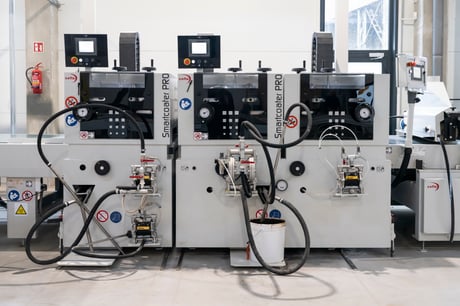
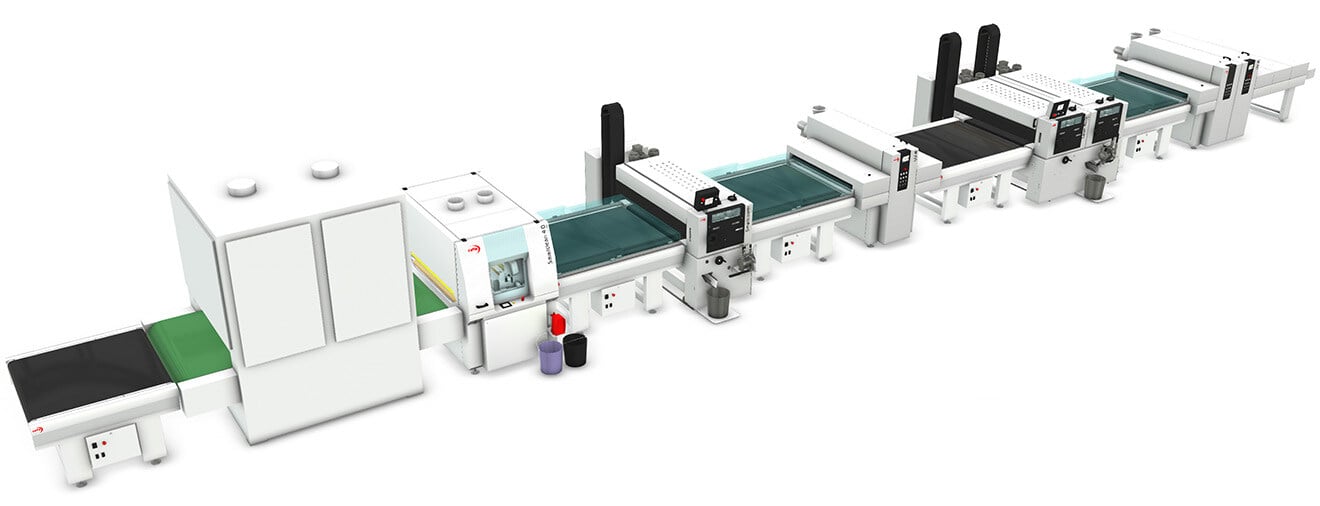
Smartcoater Pro soft roller

Smartcoater PRO: the soft application roller and other innovations that make the difference

Cefla Finishing's expertise and capacity for innovation are embodied in Smartcoater PRO, the industrial roller coating machine designed to meet the needs of modern finishing lines.

Equipped with four screw jacks for a rigid structure, Smartcoater PRO is able to exert greater constant pressure on the panels. The integrable pneumatic floating system allows lateral movement of the application head, compensating for irregularities or poor panel calibration.

The result is uniform coating and a drastic reduction in waste. Thanks to its soft rubber application roller, Smartcoater PRO can also perform operations such as base coat coating on raised panels with shallow grooves, minimising paint consumption compared to traditional spray application while maintaining precision and speed.

With Smartcoater PRO, hybrid lines can be installed: two roller coating stations and a spray coater for the finishing layer. This offers benefits such as:

  • greater transfer efficiency and reduced paint consumption;
  • reduced solvent consumption and lower emissions;
  • fewer steps in the line, with less risk of product damage;
  • improved production speed and shorter delivery times.

Industrial sectors that benefit from specialised roller coating

Advanced technologies such as Smartcoater PRO are extremely versatile and applicable in many sectors:

In the wood industry, precise coating ensures aesthetics and durability for furniture and accessories. In the steel industry, roller coating allows for protective and decorative applications against corrosion and wear. In printing, paper and packaging, uniform applications guarantee print quality and product protection.

In textiles, roller coating adds water resistance and special textures. The automotive and aerospace sectors are also increasingly using this technology to meet safety and performance standards.

Cefla Finishing offers tailor-made solutions for all these markets, providing its expertise for innovation and customisation at the highest levels.

ARE YOU LOOKING FOR THE IDEAL SOLUTION FOR YOUR ROLLER COATING LINE?


In recent years, industrial innovation has revolutionised the concept of surface finishing. Industrial roller coating has established itself as an ...

Load more articles

Articles: 6 / 160