Magazine

Vacuum coating

Article

Smartedge and Smartvacuum: the winning combination for flat panels


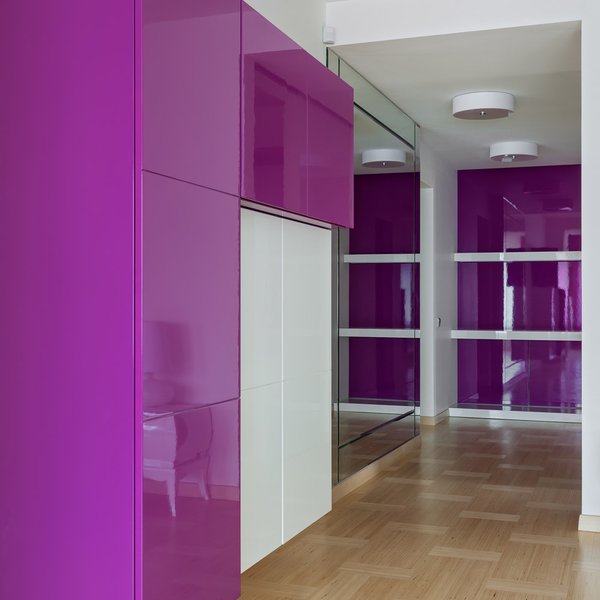
Finding a way to match the finishing quality of your flat surface with the edge, especially when the market is looking for rounded edges and flat surfaces as part of the latest furniture trends, means you need to consider using the same paint and the same technique. Until today, this was just theoretical, but since we introduced Smartvacuum to combine with Smartedge, our vacuum coating solution for edges, it is now a reality.

Vacuum coating: sustainable and cost-efficient

Depending on the production volumes, with vacuum application technologies there are different solutions to coat the surface and edge of a panel. Outputs up to 1500 cabinet doors/shift can be handled with an island-type process dealing with:

  • melamine sanding
  • flat surface coating (Smartvacuum)
  • edge coating (Smartedge)
  • sanding prior to finishing

In-line processes are better for outputs exceeding 3000 cabinet doors/shift and can be either:

  • melamine sanding
  • panel surfaces coated in the Smartvacuum area
  • panel edges coated in a 2-step process with Smartedge
  • sanding prior to finishing

or for 6000 cabinet doors/shift as follows:

  • melamine sanding
  • in-line flat surface coating (Smartvacuum)
  • all 4 panel edges coated using Smartedge
  • sanding prior to finishing

ante

Both Smartvacuum and Smartedge use 100% UV acrylic paints, avoiding release of solvents into the atmosphere. Processing times are reduced compared to alternative application technologies and less space is taken up by these machines.

Focusing on the edge coating process, we have developed patented solutions for Smartedge which are unrivalled on the market. EDGE&GO enables line operators to switch from one edge geometry/thickness to the next in no more than 15 seconds.

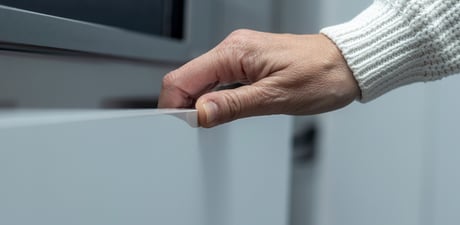
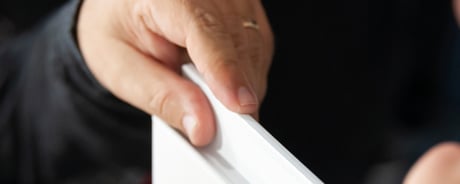
The dual function sanding unit for vertical corners with a radius and the flat section of a J-pull ensures compliance with the original radius and sanding of the excess product at the leading and trailing end of the handle.

The paint removal and panel cleaning unit seals the melamine between the flat part and the edge, recovers excess applied product and creates a perfectly flat panel surface. This prolongs the life of the abrasive paper in contact sanding machines, as wear is homogeneous over the whole surface.

The winning duo

The combination of Smartvacuum and Smartedge finally allows companies to streamline their coating process using the same technique and delivering the same top quality all round. It avoids pollution compared to spraying lacquers with solvents, it speeds up the process, reducing the handling necessities and, above all, cuts costs significantly.

Learn more about Smartvacuum in this webinar

Finding a way to match the finishing quality of your flat surface with the edge, especially when the market is looking for rounded edges and flat ...

Article

Smartvacuum: Vacuum coating technology for primer application on panels


How can vacuum coating technology improve primer application on panels?

Industry professionals know that primer application on wooden panels is typically carried out using one of three methods: roller coating, spray coating or curtain coating. Each approach has its own pros and cons, depending on various factors.

The introduction of vacuum technology helps overcome many of the limitations of traditional systems—without necessarily replacing them entirely—offering new opportunities and benefits, especially for manufacturers of cabinet doors, panels, and bathroom furniture.

How does vacuum coating technology work in primer application on wooden panels?

Vacuum coating technology creates a low-pressure environment to improve the primer application process, ensuring uniform and efficient coating.

During this process, panels are placed inside a vacuum chamber, where air is extracted to lower the pressure around the surfaces. The reduced pressure allows lacquers and primers to penetrate deeper into the wood grain, improving adhesion and minimising the risk of bubbles or imperfections.

Additionally, vacuum technology plays a crucial role in eliminating air bubbles that can cause uneven finishes. This results in a smoother, more uniform coating that enhances both the appearance and durability of the finished product.

THE MOST ADVANCED FINISHING SOLUTIONS


The advantages of vacuum primer application on panels

Any flat panel made of wood or wood-based materials, including those with rounded edges, can be coated using vacuum technology.

This makes it an ideal solution for manufacturers aiming for uniform finishes while minimising imperfections and achieving extremely smooth surfaces. The vacuum process takes place in a controlled environment, reducing the risk of dust contamination. This is the key to higher precision and longer-lasting products.

Compared to spray coating, vacuum coating also results in faster drying times, enabling quicker production cycles and reducing material waste. This innovation not only improves the aesthetic quality of panels, but also improves the operational efficiency of production processes.

The result? Perfectly finished surfaces with minimal material waste and much better final quality.
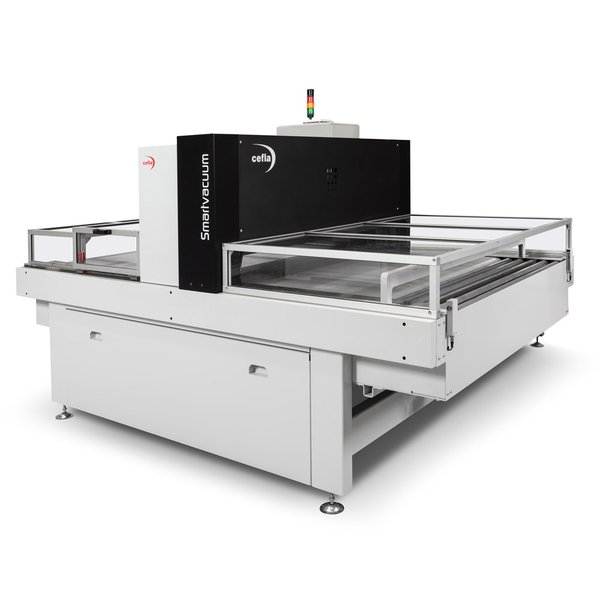
smartvaccum

Smartvacuum: Cefla Finishing’s vacuum coating technology in detail

Given the advantages of vacuum technology, Cefla Finishing has developed a user-friendly solution for processing flat panels with rounded edges, J-Pull versions, and panels with ABS edges.

Smartvacuum is a machine capable of applying 100% UV acrylic lacquer in a single pass, without any physical contact between the application head and the substrate. Thanks to vacuum technology, it deposits between 90 and 140 g/m² of product with extreme precision and uniformity, avoiding build-ups on any part of the panel.

The flash-off phase takes place after primer application and before final drying in a UV-R oven.

The use of 100% solid UV products makes the process more sustainable, and the finish remains more stable over time compared to polyurethane or polyester-based products, also requiring shorter drying times.

A complementary solution to other application techniques

As mentioned, vacuum technology offers numerous advantages over other finishing methods, but this does not mean it should be seen as an exclusive alternative to existing solutions. To truly appreciate its benefits, companies should evaluate their traditional finishing lines and determine the best integration between existing machinery and vacuum technology.

Roller coating lines

Roller coating is one of the most widely used surface finishing techniques for flat panels. The process typically involves:

  • Substrate sanding
  • Primer application for adhesion
  • Three layers of primer applied with single and double application rollers, with intermediate gelling
  • Final drying
  • Sanding of the primer coat, followed by finishing

Curtain coating lines

Curtain coating is performed using machines called curtain coaters. These systems utilise liquid coatings that form a curtain of lacquer that falls onto the moving panel in a uniform fashion, allowing even coating application. The steps typically include:

  • Substrate sanding
  • Primer application for adhesion
  • UV gelling
  • UV primer application using a curtain coater and flash-off tunnel
  • Drying
  • Sanding of the primer coat, followed by finishing

Spray coating lines

Spray coating lines use a closed-loop system for applying polyurethane or polyester-based primers in multiple layers on flat surfaces and edges. This set-up requires extended drying times, as panels must be stabilised at appropriate intervals before sanding and finishing.
Smartvacuum_1471719278

Vacuum application technology: a comparative advantage

When correctly implemented alongside traditional techniques, vacuum technology enhances finishing processes, making them more efficient and sustainable.

The eco-friendly nature of 100% UV acrylic lacquers offers several advantages, reducing material consumption, costs, lead times, handling requirements and equipment footprint.

Additionally, when vacuum application is integrated with traditional methods:

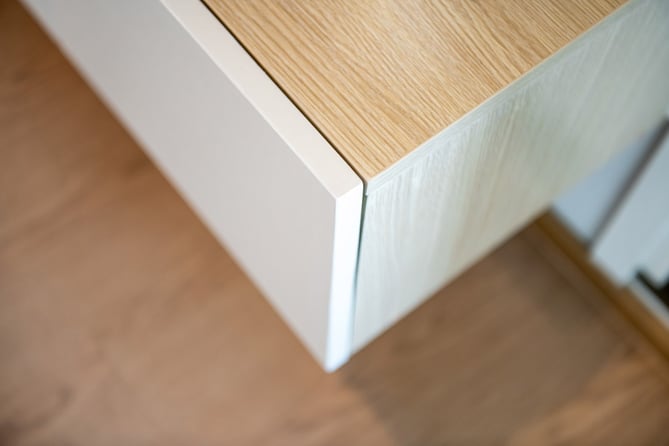
  •  Rounded corners are obtained directly using vacuum coating technology, meaning you only need to sand the flat surfaces after drying
  •  Fewer machines required, meaning less cleaning and lower consumption
  • Lower sanding costs and reduced material waste
  •  Shorter lead times and greater production flexibility
  • Reduced machine footprint
  • Fewer process stages, minimising handling needs

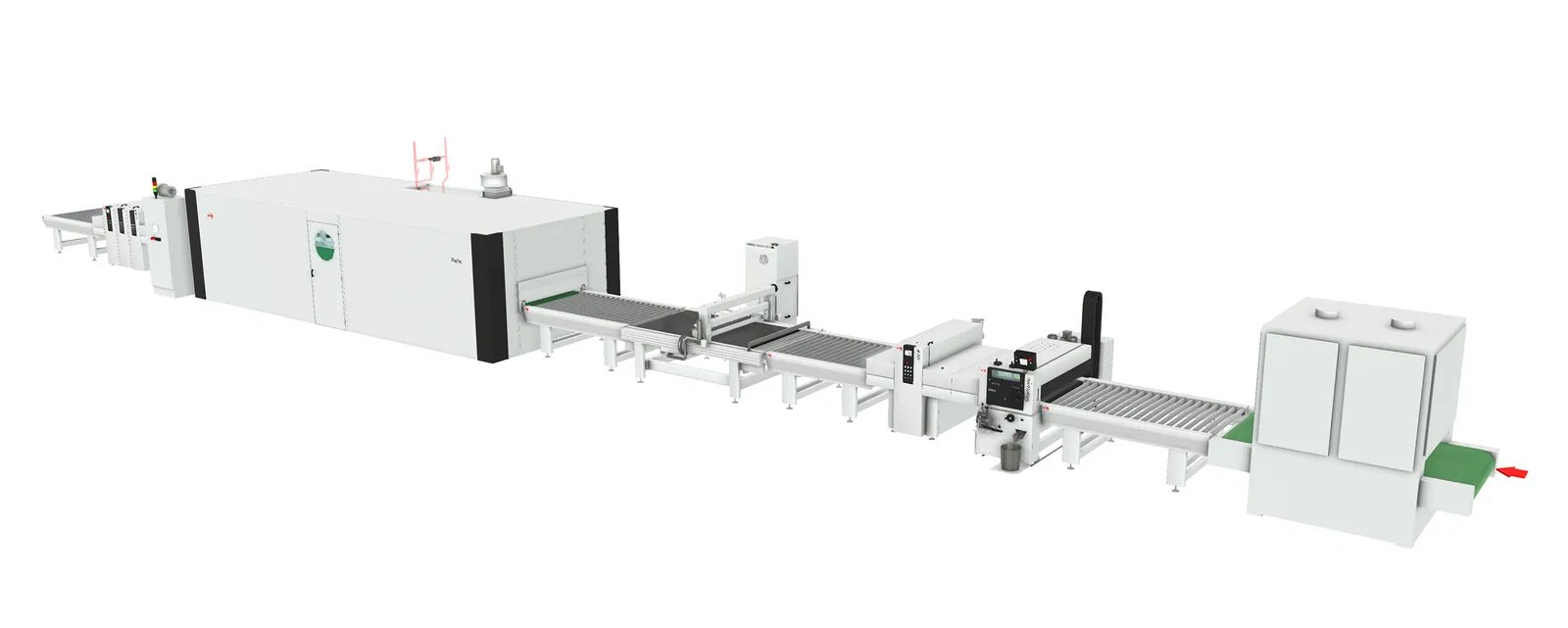
By implementing Cefla Finishing’s Smartvacuum, the finishing line would consist of the following steps:

  • Panel sanding
  • Primer application and gelling
  • Application of 90-140 g/m² of 100% UV product in a single pass
  • 2-5 minutes of flash-off
  • Drying in UV lamp ovens
  • Sanding and matt/gloss finishing as needed, using other known coating techniques
linea di verniciatura

Smartvacuum: the perfect partner for Smartedge

Smartvacuum works best when paired with another Cefla Finishing solution: Smartedge, a machine for edge coating, filling and sanding, configurable with modular options to meet different quality and productivity needs.

The coating application can be performed with a traditional vertical roller, a patented soft vertical roller that automatically adapts to edge shapes without the need for counter-shapes, or using vacuum technology.

Smartedge and Smartvacuum share both technique and lacquer. This ensures optimal continuity between the flat surface and the panel edge.

The result? A smoother finish compared to conventional application techniques, especially on panels with rounded edges. This reduces the number of steps required to process semi-finished products and, most importantly, helps achieve a high-quality final product.

LOOKING FOR THE PERFECT FINISHING LINE SOLUTION?

How can vacuum coating technology improve primer application on panels? Industry professionals know that primer application on wooden panels is ...
Article

Vacuum coating technologies: superior transfer efficiency

One of the key advantages involved in vacuum application technology is the degree of transfer efficiency achieved - almost 100% - meaning close control over lacquer consumption and very little waste – all adding up to significant savings while achieving superb coating quality.

Until recently, this technology was used for edges, in terms of coating, sealing or even waterproofing. Today, we have developed vacuum application solutions for flat panels as well as edges, which can be of all shapes and sizes.

Vacuum coating: flat panels

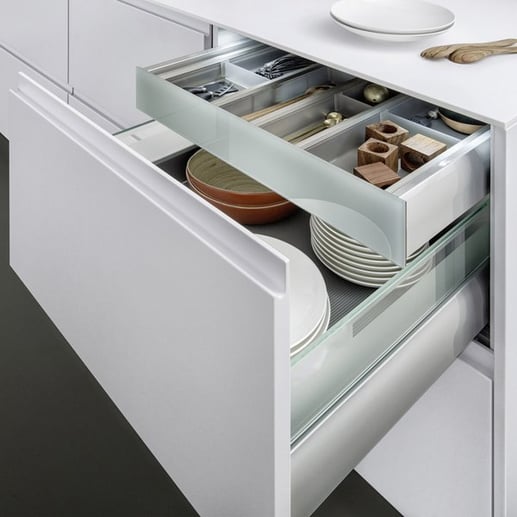
Manufacturers of cabinet doors, panels and bathroom furniture will welcome the recently released vacuum application machine, Smartvacuum. Any wood or wood-based flat panel can be coated using this technology, especially those with rounded edges.

Vacuum application avoids contact between the application head and the substrate. This enables clean, efficient processing using 100% UV acrylic paint in a single pass. Up to 140 g/sqm are deposited homogeneously, thereby avoiding product build-up on any sections of the panel. The process is simple, clean, eco-friendly and cost-efficient. Flash-off is performed after basecoat application and prior to the panel completing its drying in a UV-R oven. Using a 100% solid UV product, this makes it a relatively sustainable process and the coating is more stable over time compared to polyurethane or polyester-based products.

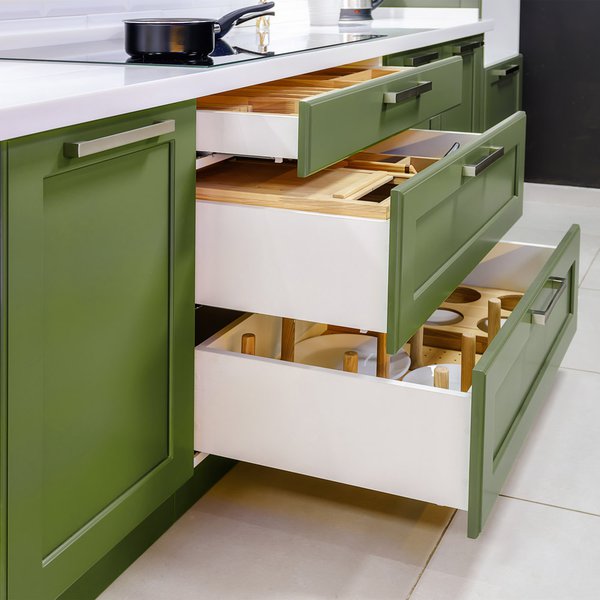
kicthen flat panels

Vacuum application machines: edges

Vacuum application machines for edges have been around for longer, some of which combine sanding operations as a complete solution. We provide 3 different systems according to specific needs.

The perfect match for Smartvacuum is Smartedge, a machine which handles straight and shaped panel edges. The vacuum system will coat any type of edge as the application head adapts to each shape. When fitted with Edge & Go, consisting of an application head with interchangeable straight or shaped slats, changing from one edge shape to the next is accomplished without turning off the vacuum tower. In terms of speed, switching from a straight edge with a 3 mm radius to a J-Pull handle edge, for example, takes less than 15 seconds.

Smartvacuum and Smartedge use the same technique and the same lacquer. That makes it simple to achieve the best junction seam between the flat surface and the edge of the panel.

bordi-vernice

Sealing solutions

Sealing operations are performed to protect the integrity of a product by ensuring the edges are not vulnerable to humidity for example, something which compromises the durability of a panel or other item.

Vacuum systems for the sealing of edges include another machine in our range: Talent is a patented solution for the sealing of the shaped edges of laminated panels, coated with quick-drying water-based products for application on various types of material. Used as a sealing technique for items found in several sectors, including panels, mouldings, fibreglass ceiling panels, polycarbonate sheets, fibre cement tiles and many other materials used in the construction industry, Talent works with water-based coatings, also suitable for UV curing, 100% UV acrylic paints, sealants (wax, paraffin, glue).

Edge impregnation

A solution dedicated to sealing the edges of panels is required when the risk of water penetrating the panel is an issue. In certain instances, cabinet doors, but more frequently panels for flooring applications will need to have their edges well sealed so as to avoid quality decreasing over time. Hybrid implements a patented technique to impregnate the panel edge with a special UV polyurethane glue to protect against humidity and other harmful elements.

Contact us and discuss your needs with a finishing expert.

One of the key advantages involved in vacuum application technology is the degree of transfer efficiency achieved - almost 100% - meaning close ...

Article

Is vacuum coating an environmentally friendly process?

Is Vacuum Coating An Environmentally Friendly Process?

Vacuum Coating Technology

Vacuum technology is a finishing process that can coat either three or four sides of a profile or linear board and minimizes VOC’s (volatile organic compounds) that negatively affect the ozone. The technology minimizes the amount of wasted coating by continuously recirculating coatings through the system onto parts as they are fed through the system. The application head has a manual adjustment feature that allows the coating thickness to be controlled as it is applied to each part. This feature is typically set before production starts or is included in your product’s “formula.” By way of a 12-inch wide conveyor, the parts automatically exit the application head and enter into the curing or drying unit.

Cefla’s vacuum units are compact, multi-process painting systems. Depending on model, specification and application, systems include sanding, staining/priming/coating, and curing/drying units that allow parts to easily integrate from a secondary process, to finishing, to a finished good ready for shipping – with minimal human interaction. Cefla has Vacuum Finishing Systems for both water-based and 100% solids, for UV, finishing needs.

The CVR and CVS Vacuum Finishing Systems have maximum working widths of 8- to 12-inches and minimum working length of 24 inches, making it ideal for optimizing the production of linear profiles and flat boards including shiplap, which is growing in popularity in North America due to its feature on several DIY and reality television shows. Using vacuum technology, shiplap can be denibbed, coated, and cured or dried in a single pass, then packed and shipped.

Other system features:

  • Low VOC’s for minimized emissions
  • Closed loop system offers maximum transfer efficiency
  • Small footprint
  • One system comprised of multiple processes – no need for different sets of equipment
  • Options for water-based and 100% solid UV coatings
  • Machine-side control panel is easy to use with a touch screen featuring large print and color graphics
  • Compatible with wood, wood-based derivatives, plastic, and metal substrate
  • Made in the USA

These machines are designed exclusively to support the needs of a variety of North American industries, including residential and commercial construction. Contact us today.

Vacuum technology is a finishing process that can coat either three or four sides of a profile or linear board and minimizes VOC’s (volatile organic ...

Article

A big job for a small shop: a case for vacuum technology

A big job for a small shop: a case for vacuum technology

Shiplap Is Trending And Cefla's Vaccum Technologies Can Automate The Process

Cefla’s Vacuum Finishing Systems are intended for small- and medium-sized operations.

Available in either a water-based or solvent-based compatible solution, the system has a compact footprint that is ideal for shops with space limitations. The system combines three processes into one system, featuring a denibbing unit, application vacuum coater, and either a drying or curing tunnel based on coating specification. The system allows you to be flexible enough to quickly ramp up to accommodate a large order, or pivot with multiple small orders. Utilizing a 12-inch conveyor, the system moves parts through an application head where a controlled amount of coating is circulated around either three or four sides of each part. The application head has a lever that is manually opened or closed to either increase or decrease the amount of coating that encounters each part. From there, the part is conveyed through a short wave IR drying oven. After exiting the oven, unless there is a desire for the parts to go through another coating process, the parts are ready to pack and ship. The CVR Vacuum Finishing System has an optional denibbing unit; denibbing roughens or smoothens a part to the desired grain.

Additionally, the system is environmentally friendly. There are no VOC's produced from the drying process, meaning your carbon footprint will remain low and there are no permitting or government compliance regulations to monitor. The CVR Vacuum Finishing System has a working width of 8- to 12-inches and optimal working length of 24 inches, making it ideal for optimizing the production of linear profiles and flat boards including shiplap. The popularity of shiplap in the North American market is no secret; it has become quite the star in North America with its feature on several hit reality and DIY (do-it-yourself) television series. Vacuum technology allows shops of any size to automate their finishing process and take advantage of this trendy material.

Other system features include:

  • No VOC’s, no emissions, no permitting
  • Small footprint
  • One system comprised of multiple processes – no need for different sets of equipment
  • Options for water-based and solvent-based coatings
  • Machine-side control panel is easy to use with a touch screen featuring large print and color graphics

Not using water-based coatings? The CVS vacuum coating system has the same footprint as the CVR system, but is compatible with solvent-based coatings and has a standard denibbing unit located before the application head.

These machines are built exclusively to support the North American market by Delle Dedove technologies, also known as DV Systems. Contact us today.

Cefla’s Vacuum Finishing Systems are intended for small- and medium-sized operations. Available in either a water-based or solvent-based compatible ...

Article

How can vacuum finishing technology reduce my cost per-piece on mouldings and linear profiles?

How can vacuum finishing technology reduce my cost per-piece on mouldings and linear profiles?

Shiplap Is Trending And Cefla's Vaccum Technologies Can Automate The Process

Vacuum finishing technology uses an automated process to convey parts through a multi-process finishing system. The system features a vacuum coating unit, also known as the application head, that controls the amount of coating applied on to up to four sides of each part. The control of the application head allows the operator to minimize the amount of spent coating, keeping costs low. Unused coating remains in the coating chamber to be applied to future parts entering the system. Not only does this reduce the cost of your finishing production, it is also environmentally friendly.

Shiplap is a great example of how vacuum coating can automate and optimize overhead cost of a finishing line. It is growing in popularity and increasingly available at retail stores for DIY (do-it-yourself) home remodeling projects. With a vacuum coating system, you can sand, coat, and UV cure up to four sides in a single pass, you can be ready to pack and ship in no time - you can quickly ramp up production for an order of almost any size. Read on for more ways that vacuum coating can help your business reduce cost and streamline the finishing process.

Another cost-reducing feature of vacuum finishing technology – specifically UV curing with the compact CVS Vacuum Finishing System – is the 100% solid UV coatings that are solvent-free and cure through polymerization rather than evaporation. This process emits no VOC’s (volatile organic compounds) that can negatively affect the ozone, meaning there are no overhead costs for permitting, insurance premiums, or government compliance fees. Without these additional operational costs, you will easily see your per-piece cost decrease and margin increase!

Lastly, with this system providing three processes in one, compact system – there is no need to purchase, house, power, and maintain multiple pieces of equipment and obtain the additional labor required to operate them. The CVS Vacuum Finishing System is comprised of sanding, UV Coating, and UV Curing units integrated by a 12-inch-wide conveyor, compatible with solvent-based coatings. If water-based coatings are what's in your wheelhouse, read more about the CVR Vacuum Finishing System here.

The features of vacuum technology are not limited to cost reduction. Other system features include:

  • No VOC’s, no emissions, no permitting
  • Small footprint
  • One system comprised of multiple processes – no need for different sets of equipment
  • Options for water-based and solvent-based coatings
  • Machine-side control panel is easy to use with a touch screen featuring large print and color graphics

These vacuum finishing systems are built exclusively to support the North American market by Delle Dedove technologies, also known as DV Systems. Contact us today.

Vacuum finishing technology uses an automated process to convey parts through a multi-process finishing system. The system features a vacuum coating ...
Articles: 6 / 6