Article

New Elispray: faster, easier to clean, less lacquer consumption


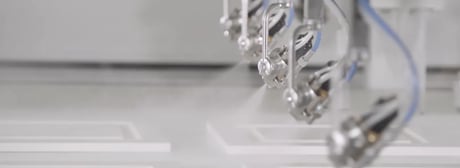
Whereas elliptical spraying techniques ensured high speeds and large volumes in the past, more recent reciprocating solutions have outpaced machines based on a rotary distribution system, especially in face of smaller production batches required by today’s market. Reliability was also an issue which played against the choice of this technology, but today’s redesigned Elispray features new, patented solutions that enable extremely high speeds, excellent transfer efficiency, reliability and reduced lacquer consumption by up to 20%.

Elliptical spray coating: superior transfer efficiency

Several factors have increased the transfer efficiency of the new Elispray. Combining a high-performance spraying booth with high-speed distribution, we have achieved excellent results. Innovations include:

  • double plenum directs overspray where it is needed, settling gradually on the workpieces instead of being forced down
  • belt surface has been increased to maximise overspray recovery
  • new layout of suction areas interferes less with overspray
  • guns operate at lower speeds than a reciprocating machine, making it possible to use lower feed pressures and waste less lacquer
All this saves the filters from dealing with excessive overspray, meaning they will last longer. Cleaning operations are much easier and faster than before.

Reliability ensures minimal maintenance downtime

Elispray features a patented product distribution system on the guns, eliminating aspects that undermined reliability in the past. A rinsing circuit also runs right next to the seals of the lacquer delivery circuit. Conveying water or solvent, it rinses, helps detect leakage points and reduces the working temperature of the joints thereby extending seal life.

The following benefits are obtained:

  • minimises defects and machine downtime caused by localised leakage
  • critical machine components can be monitored while the machine is working to avoid unproductive stoppages
  • allows companies to plan maintenance sessions without needing to react to problems which disrupt production
Also available is a patented line feeding system by means of a rotary pump, eliminating risks connected to the presence of a joint. This results in just one single lacquer circuit compared to the double circuit present on the version with a rotary joint.

Discover more on Elispray in this webinar

Whereas elliptical spraying techniques ensured high speeds and large volumes in the past, more recent reciprocating solutions have outpaced machines ...

Article

Smartvacuum: Vacuum coating technology for primer application on panels


How can vacuum coating technology improve primer application on panels?

Industry professionals know that primer application on wooden panels is typically carried out using one of three methods: roller coating, spray coating or curtain coating. Each approach has its own pros and cons, depending on various factors.

The introduction of vacuum technology helps overcome many of the limitations of traditional systems—without necessarily replacing them entirely—offering new opportunities and benefits, especially for manufacturers of cabinet doors, panels, and bathroom furniture.

How does vacuum coating technology work in primer application on wooden panels?

Vacuum coating technology creates a low-pressure environment to improve the primer application process, ensuring uniform and efficient coating.

During this process, panels are placed inside a vacuum chamber, where air is extracted to lower the pressure around the surfaces. The reduced pressure allows lacquers and primers to penetrate deeper into the wood grain, improving adhesion and minimising the risk of bubbles or imperfections.

Additionally, vacuum technology plays a crucial role in eliminating air bubbles that can cause uneven finishes. This results in a smoother, more uniform coating that enhances both the appearance and durability of the finished product.

THE MOST ADVANCED FINISHING SOLUTIONS


The advantages of vacuum primer application on panels

Any flat panel made of wood or wood-based materials, including those with rounded edges, can be coated using vacuum technology.

This makes it an ideal solution for manufacturers aiming for uniform finishes while minimising imperfections and achieving extremely smooth surfaces. The vacuum process takes place in a controlled environment, reducing the risk of dust contamination. This is the key to higher precision and longer-lasting products.

Compared to spray coating, vacuum coating also results in faster drying times, enabling quicker production cycles and reducing material waste. This innovation not only improves the aesthetic quality of panels, but also improves the operational efficiency of production processes.

The result? Perfectly finished surfaces with minimal material waste and much better final quality.

smartvaccum

Smartvacuum: Cefla Finishing’s vacuum coating technology in detail

Given the advantages of vacuum technology, Cefla Finishing has developed a user-friendly solution for processing flat panels with rounded edges, J-Pull versions, and panels with ABS edges.

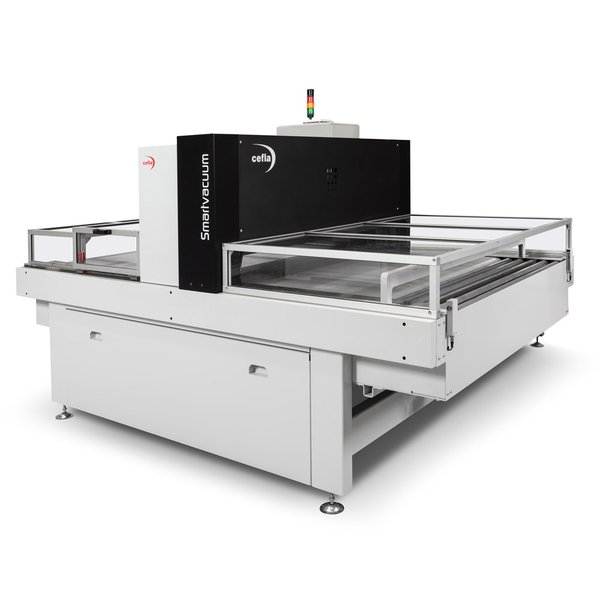
Smartvacuum is a machine capable of applying 100% UV acrylic lacquer in a single pass, without any physical contact between the application head and the substrate. Thanks to vacuum technology, it deposits between 90 and 140 g/m² of product with extreme precision and uniformity, avoiding build-ups on any part of the panel.

The flash-off phase takes place after primer application and before final drying in a UV-R oven.

The use of 100% solid UV products makes the process more sustainable, and the finish remains more stable over time compared to polyurethane or polyester-based products, also requiring shorter drying times.

A complementary solution to other application techniques

As mentioned, vacuum technology offers numerous advantages over other finishing methods, but this does not mean it should be seen as an exclusive alternative to existing solutions. To truly appreciate its benefits, companies should evaluate their traditional finishing lines and determine the best integration between existing machinery and vacuum technology.

Roller coating lines

Roller coating is one of the most widely used surface finishing techniques for flat panels. The process typically involves:

  • Substrate sanding
  • Primer application for adhesion
  • Three layers of primer applied with single and double application rollers, with intermediate gelling
  • Final drying
  • Sanding of the primer coat, followed by finishing

Curtain coating lines

Curtain coating is performed using machines called curtain coaters. These systems utilise liquid coatings that form a curtain of lacquer that falls onto the moving panel in a uniform fashion, allowing even coating application. The steps typically include:

  • Substrate sanding
  • Primer application for adhesion
  • UV gelling
  • UV primer application using a curtain coater and flash-off tunnel
  • Drying
  • Sanding of the primer coat, followed by finishing

Spray coating lines

Spray coating lines use a closed-loop system for applying polyurethane or polyester-based primers in multiple layers on flat surfaces and edges. This set-up requires extended drying times, as panels must be stabilised at appropriate intervals before sanding and finishing.

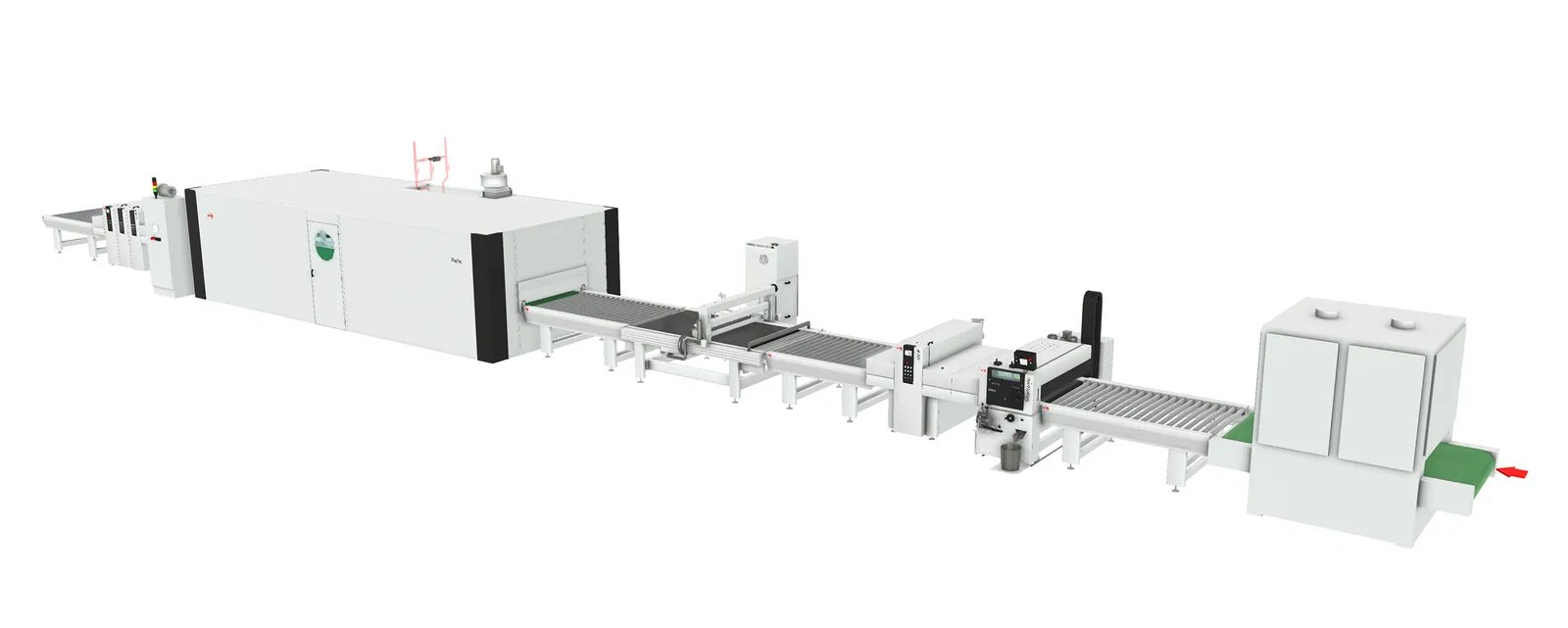
Smartvacuum_1471719278

Vacuum application technology: a comparative advantage

When correctly implemented alongside traditional techniques, vacuum technology enhances finishing processes, making them more efficient and sustainable.

The eco-friendly nature of 100% UV acrylic lacquers offers several advantages, reducing material consumption, costs, lead times, handling requirements and equipment footprint.

Additionally, when vacuum application is integrated with traditional methods:

  •  Rounded corners are obtained directly using vacuum coating technology, meaning you only need to sand the flat surfaces after drying
  •  Fewer machines required, meaning less cleaning and lower consumption
  • Lower sanding costs and reduced material waste
  •  Shorter lead times and greater production flexibility
  • Reduced machine footprint
  • Fewer process stages, minimising handling needs

By implementing Cefla Finishing’s Smartvacuum, the finishing line would consist of the following steps:

  • Panel sanding
  • Primer application and gelling
  • Application of 90-140 g/m² of 100% UV product in a single pass
  • 2-5 minutes of flash-off
  • Drying in UV lamp ovens
  • Sanding and matt/gloss finishing as needed, using other known coating techniques

linea di verniciatura

Smartvacuum: the perfect partner for Smartedge

Smartvacuum works best when paired with another Cefla Finishing solution: Smartedge, a machine for edge coating, filling and sanding, configurable with modular options to meet different quality and productivity needs.

The coating application can be performed with a traditional vertical roller, a patented soft vertical roller that automatically adapts to edge shapes without the need for counter-shapes, or using vacuum technology.

Smartedge and Smartvacuum share both technique and lacquer. This ensures optimal continuity between the flat surface and the panel edge.

The result? A smoother finish compared to conventional application techniques, especially on panels with rounded edges. This reduces the number of steps required to process semi-finished products and, most importantly, helps achieve a high-quality final product.

LOOKING FOR THE PERFECT FINISHING LINE SOLUTION?

How can vacuum coating technology improve primer application on panels? Industry professionals know that primer application on wooden panels is ...

Article

Vacuum coating technologies: superior transfer efficiency

One of the key advantages involved in vacuum application technology is the degree of transfer efficiency achieved - almost 100% - meaning close control over lacquer consumption and very little waste – all adding up to significant savings while achieving superb coating quality.

Until recently, this technology was used for edges, in terms of coating, sealing or even waterproofing. Today, we have developed vacuum application solutions for flat panels as well as edges, which can be of all shapes and sizes.

Vacuum coating: flat panels

Manufacturers of cabinet doors, panels and bathroom furniture will welcome the recently released vacuum application machine, Smartvacuum. Any wood or wood-based flat panel can be coated using this technology, especially those with rounded edges.

Vacuum application avoids contact between the application head and the substrate. This enables clean, efficient processing using 100% UV acrylic paint in a single pass. Up to 140 g/sqm are deposited homogeneously, thereby avoiding product build-up on any sections of the panel. The process is simple, clean, eco-friendly and cost-efficient. Flash-off is performed after basecoat application and prior to the panel completing its drying in a UV-R oven. Using a 100% solid UV product, this makes it a relatively sustainable process and the coating is more stable over time compared to polyurethane or polyester-based products.

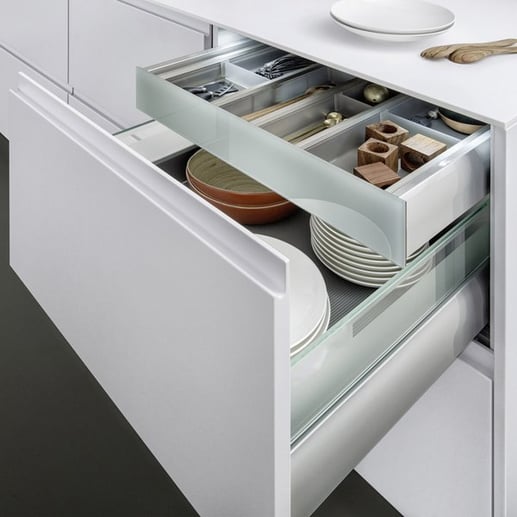
kicthen flat panels

Vacuum application machines: edges

Vacuum application machines for edges have been around for longer, some of which combine sanding operations as a complete solution. We provide 3 different systems according to specific needs.

The perfect match for Smartvacuum is Smartedge, a machine which handles straight and shaped panel edges. The vacuum system will coat any type of edge as the application head adapts to each shape. When fitted with Edge & Go, consisting of an application head with interchangeable straight or shaped slats, changing from one edge shape to the next is accomplished without turning off the vacuum tower. In terms of speed, switching from a straight edge with a 3 mm radius to a J-Pull handle edge, for example, takes less than 15 seconds.

Smartvacuum and Smartedge use the same technique and the same lacquer. That makes it simple to achieve the best junction seam between the flat surface and the edge of the panel.

bordi-vernice

Sealing solutions

Sealing operations are performed to protect the integrity of a product by ensuring the edges are not vulnerable to humidity for example, something which compromises the durability of a panel or other item.

Vacuum systems for the sealing of edges include another machine in our range: Talent is a patented solution for the sealing of the shaped edges of laminated panels, coated with quick-drying water-based products for application on various types of material. Used as a sealing technique for items found in several sectors, including panels, mouldings, fibreglass ceiling panels, polycarbonate sheets, fibre cement tiles and many other materials used in the construction industry, Talent works with water-based coatings, also suitable for UV curing, 100% UV acrylic paints, sealants (wax, paraffin, glue).

Edge impregnation

A solution dedicated to sealing the edges of panels is required when the risk of water penetrating the panel is an issue. In certain instances, cabinet doors, but more frequently panels for flooring applications will need to have their edges well sealed so as to avoid quality decreasing over time. Hybrid implements a patented technique to impregnate the panel edge with a special UV polyurethane glue to protect against humidity and other harmful elements.

Contact us and discuss your needs with a finishing expert.

One of the key advantages involved in vacuum application technology is the degree of transfer efficiency achieved - almost 100% - meaning close ...

Article

New soft roller: hard-core benefits

Roller coating technologies have evolved significantly over the last two decades and the recent introduction of a new soft application roller onto the finishing industry’s most advanced roller coating equipment, Smartcoater PRO, has brought about several benefits, enabling companies to achieve important savings especially with regard to the coating of raised panels, such as kitchen cabinet doors.


Smartcoater PRO is built with 4 screw jacks which ensure a rigid, stable structure for the application roller which applies constant, firm pressure to panels transiting through the machine. Thanks to the pneumatic floating system which can be integrated, the application head moves side to side, following irregularities and compensating for poorly calibrated flat panels. This enables coating consistency and reduces the chance of rejects if quality standards are not reached.

Featuring the latest innovation, a soft rubber application roller, Smartcoater PRO acquires even more interesting capabilities: roller coating raised panels.

Smartcoater PRO

The benefits, one by one

Apart from facilitating a continuous production flow without the need to stop for non-calibrated panels, in general terms there are numerous benefits ranging from production capacity and efficiency to reduced costs and environmental benefits.

Until recently, base coats and top coats were applied to raised panels using spray coating equipment. This usually means three-phase coating with sanding operations between the two base coats and manual intervention, loading and unloading at each step of the process.

Thanks to the soft roller on Smartcoater PRO, the coating process for raised panels is shortened. The ability to apply a base coat to grooves up to 10 mm in depth on a raised panel allows companies to install hybrid finishing lines made up of two roller coating stations and a spray coating machine for the top coat. Here are some of the many benefits:

  • transfer efficiency on the roller coaters is superior, thereby reducing lacquer consumption
  • absence of an intermediate sanding operation between base coats means lower operating costs, fewer abrasives, less manual labour connected with this operation
  • with less lacquer consumption comes a drop in solvent consumption, leading to lower emissions as well as lower direct solvent costs
  • fewer passes through the line – just 2 instead of 3 – limits the handling operations which in turn reduces the risks of damage to finished products
  • fewer passes also speed up production and reduce lead times

Production speeds increase in all instances

Whereas base coats for a matt finish may only need one application layer on a roller coater, followed by the spray coater for the top coat, it is advisable to apply 2 layers of the base coat for a glossy finish. This is made possible by using two Smartcoaters in a row on the hybrid line. Whichever scenario, time is reduced either by reducing the number of base coats (matt finish) or implementing consecutive base coat application which applies a second layer prior to the top coat.

Roller coating: sustainability and savings

Of course, it takes more than a soft rubber roller to generate significant savings and increase the overall sustainability of the coating process. The engineering skills and laboratory tests run to investigate all production scenarios have led to a system which is unmatched in terms of its quality and sustainability.

Savings on lacquer consumption range between 3 and 25% in terms of the quantity used (consequently affecting solvent quantity as well) and this represents anything up to 1 euro per square metre.

Less solvent means lower costs, but also leads to a healthier working environment for operators and fewer worries about harmful emissions affecting the planet.

The new level of efficiency also reduces the workload to employees with fewer handling necessities involved.

In conclusion, the soft roller increases production capacity, reduces processing times, saves money and respects the environment.

So soft that it’s hard to beat!

Find out more about our roller coating solutions

Roller coating technologies have evolved significantly over the last two decades and the recent introduction of a new soft application roller onto ...

Article

The most sustainable way to achieve top-quality, high-gloss surfaces

If it weren’t for over 100 lines installed worldwide using our Laser Roller, it would be acceptable to assume that the best way to achieve a glossy surface finish was either using a curtain coater or a spray coating machine. But when we introduced the laser-engraved application roller and fitted it (when required) to our roller coater range, the results revealed a number of benefits. Since then, our customers using the Laser Roller can boast coating quality and above all sustainability.


Benefits of the Laser Roller for high-gloss finishes

Clearly a solution exclusively for flat panels, but of any size according to the roller coating equipment it is fitted to, the Laser Roller applies a large quantity of lacquer (up to 45 g/sqm) without leaving any traces or defects that are found typically on roller coated surfaces. Compared to spray coaters or curtain coaters, the main advantage is that with a Laser Roller you are making a sustainable choice. This technique allows you to use 100% acrylic UV lacquers with only solid residue.

We also do exactly the opposite, so if you are interested in a deep matt finish, please visit this page for full details.

Which substrates can I coat with a Laser Roller?

In addition to wood and its derivatives, substrate materials that are coated using a Laser Roller include PMMA, glass and fibre cement. The high-gloss finish enhances the aesthetic qualities of any substrate and can be achieved with consistent quality and with less environmental impact than most other coating techniques.

Laser Roller – the machine dedicated to high-gloss finishes

More than an engraved application roller, the Laser Roller is also a complete roller coating machine which can be integrated into a finishing line to achieve specifically high-gloss surface finishing. Ensuring top performance, the quality obtained on the Laser Roller equipment is consistently in line with the most demanding objectives for high-gloss finishes.

laser rollerUse our expertise to solve your needs

Cefla Finishing has developed countless solutions using roller coating technologies. These range from innovative roller coating equipment to the Smartcoater PRO which can be equipped to handle slightly raised panels as well as poorly calibrated panels. Together with the laser-engraved application roller, we also fit optional systems to adapt the machinery and the line to your real needs, taking into account your objectives and the products you are handling.

You can even fix an appointment with one of our roller coating experts and visit our laboratory to run tests using your lacquers and your products.

Contact us and our team will examine your requirement.

If it weren’t for over 100 lines installed worldwide using our Laser Roller, it would be acceptable to assume that the best way to achieve a glossy ...

Article

Excimer technology: innovative UV finishing for matt surfaces

Incredibly matt surfaces, pleasing to the eye, pleasant to the touch and resistant to scratches and light: this is what excimer technology and UV finishing make possible. After looking in depth at the benefits of UV LED curing, in this article we explore the new frontiers for the treatment and finishing of flat and raised panels.

These are extremely innovative solutions, and it is no surprise that many, even within the industry, are not familiar with the meaning of the very term excimer.
The first goal of this article is therefore to explain what excimer finishing means. It will then be easier to describe its characteristics and benefits, before reviewing the machines that enable this process.

What excimers are and what “excimers” mean in UV finishing

Etymology first: the term excimer derives from “excited dimer”, that is, an excited dimer, a molecule composed of two sub-units (atoms or simpler molecules) that exists only in an excited electronic state and not in the ground state.

In the context of finishing and, in particular, in curing processes, these molecules are used to create high-quality coated products. How? By means of short-wave ultraviolet (UV) light sources inside a specially designed environment, typically an oven.

Unlike conventional UV lamps, which emit a broad spectrum of UV radiation, excimer lamps produce highly focused monochromatic UV light at specific wavelengths, generally between 172 and 222 nanometres.

When the UV light of an excimer lamp irradiates a liquid lacquer layer, it triggers rapid surface photopolymerisation of the resin, creating a resistant and durable surface. The specific wavelength of excimer UV radiation produces controlled energy transfer, enabling modifications at a superficial level without affecting the underlying substrate.

ExcimerMatt-1

It is precisely this capability that makes excimers particularly suited to curing processes. With excimer finishing, it is possible to create matt finishes, textured effects, or surface ripples with minimal heat generation.

The machines that exploit this curing technique, in particular UV ovens, are also suitable for evenly matting three-dimensional products, typically doors and panels.

THE MOST INNOVATIVE FINISHING SOLUTIONS
Discover how highly advanced finishing solutions can enhance your competitiveness.

Excimer technology: benefits and applications in UV finishing

Excimer technology offers several benefits: first of all, it meets the need to reduce energy costs and the environmental impact of processing. This is thanks to the efficiency ensured by short-wave UV curing, which requires limited electricity and does not involve the use of traditional matting agents. In addition, UV lamps generate fewer volatile organic compounds and reduce ozone formation to a minimum. Moreover, the rapid surface curing reduces production times, resulting in lower process and labour costs

The high-energy monochromatic UV light of excimer lamps ensures complete curing of the lacquer layer, producing uniform surfaces that are entirely free of gloss or shine.

Then there is the matter of resistance: excimer curing transforms the resins used for coating into fine networks that increase product longevity, protecting them against scratches and chemical aggression. A key advantage for manufacturers of furniture and interior design elements that must combine aesthetics with durability.

More generally, excimer UV techniques are ideal for creating high-end furniture, interior panels, and customised decorative surfaces: the precision of the technology makes it suitable for processing objects with complex designs and structured textures, products where uniform finishing and tactile qualities are a key selling point for end customers.

Excimer finishing process: how it works

So how does the excimer matting process actually work, and what stages make it possible to obtain attractive, durable, abrasion-resistant surfaces without the need for additional chemical agents?

The excimer finishing process consists of several stages, each designed to achieve, as an overall result, a perfectly matt finish with distinctive sensory properties.

Excimer liquid lacquer is usually applied using roller techniques: after being coated, the products are transported into specially designed ovens and subjected to a short-wave UV curing procedure in an oxygen-free environment. This condition is essential, as oxygen would inhibit the curing process.

At this stage, UV photons penetrate the surface of the lacquer: this is the step that triggers the surface curing process of the excimer liquid, which, as it dries, reduces its volume. The rapid exposure minimises heat build-up. The effect is usually the creation of micro-folds of varying thickness, which in turn deform the surface.

The final appearance of the surface depends on the paint formulation and process parameters: this transformation is invisible to the naked eye, but sufficient to deflect light instead of diffusing it, generating a matt visual effect and a very pleasant tactile sensation.

The process ends with the hardening phase of the lacquer layer, usually achieved again by irradiation with a UV dryer.

Excimer oven technology for high-quality matt surfaces

We know that the market increasingly values the sensory aspects of home décor items. The tactile component, in particular, is becoming crucial in choosing furnishings. Soft-touch finishes are therefore gaining prominence: not only do they make contact with the object more pleasant, but they also increase surface resistance to scratches and wear.

To achieve this type of finish, manufacturers need a solution that effectively treats all sides and edges of their products, maximising quality and reducing costs wherever possible. Excimer ovens, capable of processing more complex objects than simple flat panels, are therefore ideal for producing high-quality matt surfaces.

What results do excimer ovens achieve?

Let us be more specific and analyse the results that can be achieved with conventional excimer ovens: the machines, as mentioned, work on flat panels through a short-wave UV curing process in an oxygen-free environment.

To produce high-performance soft-touch surfaces, the lacquer must be treated in such a way as to reach a very high level of mattness, no more than 5 gloss (on a scale ranging from 0 to 100 gloss). This step is essential to achieve another increasingly popular effect, the so-called  "fingerprint-proof" effect: thanks to the light rippling of the surfaces, excimer technology effectively prevents fingerprint marks from forming.

This is exactly what Cefla Finishing’s line allows, dedicated to companies wishing to harness all the advantages of excimer technology.

IMG-UVR

UV-R: the integrated solution ensuring maximum versatility

UV-R for instance, is a UV curing oven that integrates into a single body all the machine’s elements: conveyor, UV body, and electrical panel. It represents the ideal solution for those seeking versatility and ease of use, without compromising on guaranteed quality of the final result.

IMG-Exydry

Exydry: the future of excimer ovens

For those aiming even higher, there is Exydry, perfect for working on 3D products, which typically must feature matt, resistant edges as well as surfaces. The result of an in-house R&D project, Cefla Finishing’s Exydry is an innovative solution that achieves the matt effect thanks to treatment before full cross-linking, easily reaching values below 5 gloss.

Despite these characteristics, the surface resistance of panels treated and cured in Exydry is extremely high. Furthermore, the nitrogen used to remove oxygen from the X, Y, and Z axes of a shaped panel is significantly less than that required by conventional excimer ovens.

Exydry: How does it work?

With several patented technologies, this innovative system can process, for example, doors coated by oscillating sprayers or robots. The design enables a continuous flow of shaped panels through the oven, removing all oxygen without ever stopping production.
The key benefits, as mentioned, go beyond better finishing quality and the ability to achieve it on three-dimensional objects: they also include reduced production costs, especially thanks to optimised nitrogen consumption.

UV-I-Fronte-X3

UV-I: sustainable UV curing with fewer photoinitiators

On the path towards increasingly sustainable finishing, UV-I represents a technological breakthrough. A solution that combines high performance with environmental awareness: UV-I merges UV curing and sustainability.

This innovative oven uses UV curing in an inert environment, significantly reducing oxygen during the curing phase. The result is more efficient cross-linking even with fewer photoinitiators, improving operator safety and reducing the environmental impact of the chemicals used.

UV-I also minimises the use of mercury-containing UV lamps, while maintaining high curing performance. Thanks to controlled use of nitrogen, the process becomes more energy-efficient, bringing tangible benefits in terms of consumption and sustainability.

This technology perfectly matches today’s market needs, offering a compact, safe, and eco-friendly solution, in line with the latest European regulations and the expectations of environmentally responsible companies.

forno di polimerizzazione UV iCure

UV iCure: the first mercury-free technology

Finally, still in the field of sustainable innovation, Cefla Finishing’s latest development is UV iCure, the first completely mercury-free UV curing technology, capable of maintaining the same performance as traditional solutions.

The system is designed to comply with European directives on hazardous substances and to effectively replace lamps containing heavy metals, without requiring manufacturers to change the types of lacquers currently in use.

UV-iCure combines excimer and UV LED lamps with optimised wavelengths, in an inert environment, ensuring excellent curing performance without the use of mercury. The absence of fans and the use of water cooling prevent heat transfer to coating and substrate, while the immediate on/off effect reduces start-up times and simplifies system management, eliminating the need for mechanical shutters.

The result is a more compact, safe, and accessible solution compared to electron beam technologies, ensuring top quality and maximum sustainability, making UV-iCure a strategic choice for those wishing to innovate while respecting the environment and regulations.

Learn more on our page dedicated to replacing mercury lamps and in the white paper "From UV-R to UVl LED."

WHITE PAPER: FROM UV-R TO UV LED
A practical guide to replacing traditional mercury vapor UV-R ovens with high-efficiency, sustainable UV LED solutions.

Excimer matting technology: why choose Cefla Finishing

With 60 years of experience in the design and manufacture of finishing systems, Cefla Finishing is the partner of hundreds of companies worldwide. We provide tailor-made solutions, designed to integrate seamlessly into existing production processes, with a particular focus on the most innovative technologies such as excimer finishing.

We offer customers the expertise of a team of specialists able to identify the most suitable technologies to meet each need, working above all to integrate new machines into existing processes. After analysing the product, requirements, and business goals, we collaborate with our clients to define a customised roadmap for system development, which can also be tested beforehand at one of Cefla Finishing’s finishing laboratories.

LOOKING FOR THE IDEAL COATING LINE SOLUTION?

Incredibly matt surfaces, pleasing to the eye, pleasant to the touch and resistant to scratches and light: this is what excimer technology and UV ...

Load more articles

Articles: 48 / 157