Magazine

Industrial energy efficiency

Article

Production process optimization: Cefla Finishing solutions

Production process optimization plays a pivotal role in improving cost efficiency, reducing waste and boosting product quality. Manufacturers in the finishing sector can - by implementing advanced technologies such as integrated coating lines, robotics and digital printing - streamline workflows, minimise bottlenecks and achieve greater processing precision.

First of all, we need to clarify something: the principles and tools of so-called lean manufacturing will only generate the anticipated benefits if there is a broad, cohesive strategy, of which the technological aspect is just the tip of the iceberg.

To take quality to the next level, it’s simply not enough to purchase the latest-generation machines. In addition to identifying and eliminating low-added-value activities - with a view to shortening time-to-market without losing control of operating costs - it’s necessary to adopt sustainable practices such as recycling waste materials and using eco-friendly finishing agents. Strengthened relationships with suppliers and employees are equally vital. Additionally, investment in training promotes a culture of continuous improvement, allowing the industry to respond flexibly to market demand and truly benefit from innovation.

What is production process optimization?

Any organisation intent on optimizing its production processes needs to prioritise along three lines: eliminating inefficiencies, reducing costs and improving quality
In the finishing industry, the most innovative companies have already drawn up and followed ‘roadmaps’ with three main branches: specialised coating processes, automation and digital printing.

Optimizing spray coating processes, for example, largely involves implementing recirculation and rotation systems on the production lines. At a stroke, this approach diverts skilled labour away from menial tasks and reduces the risk of inefficiencies and bottlenecks. Cost reduction, instead, is achieved by installing machines with fast yet simple colour changeover systems that continue to deliver the same high performance without increasing energy or material consumption.

It’s also possible to deploy systems that introduce roller coating techniques. The latter combine excellent manufacturing flexibility - the result of an extremely wide range of applications and good consistency - with minimal solvent emissions thanks to the use of products that, in 95% of cases, have high dry residues (UV). The outcome? High-efficiency lines that retrieve all unused product, allow fast colour changeovers and employ semi-automatic roller cleaning systems that have the further advantage of containing running costs.

Overhead and floor-mounted lines are perfect for managing production batches that require limited worker intervention. They’re also well suited to small orders, which involve frequent changes to colours and processes. All this stems from simplified programming of the coating machines, which feature tools that constantly monitor coating delivery. This prevents waste and reduces the rejection rate among products leaving the line.

Lastly - again with a view to optimizing production processes - there’s the still little-explored area of industrial digital printing, ideal for customising products or handling extremely limited production runs. 

Applying modern digital printing techniques to object decoration doesn’t just let manufacturers deliver products more quickly: it also reduces the need for stock, minimising warehousing requirements and streamlining supply chains.

THE MOST INNOVATIVE FINISHING SOLUTIONS
Discover how highly advanced finishing solutions can sharpen your competitiveness.

Reducing waste and optimizing resources

Optimizing essentially means making the best of scarce resources (time and skills being paramount), reducing material waste (coatings and consumables) and achieving efficient energy management.

As we see it, digital printing has yet to gain its rightful place as a production process optimizer. Compared to traditional decoration systems, in fact, industrial digital printing can play a crucial role in reducing waste as it does not require:

  • engraved roller changeovers, which waste time and reduce productivity;
  • ink changeovers, which require the disposal of cleaning waste;
  • different decorative papers for each decoration, with the risk of stock becoming obsolescent (and then having to be disposed of).

Energy efficiency and sustainability in production processes

The topic of waste reduction goes hand in hand with that of energy efficiency which is, in turn, an integral part of a manufacturing policy that aims to meet increasingly ambitious sustainability requirements.

All Cefla Finishing solutions are designed to deliver efficiency and sustainability and every Cefla-branded machine or software plays a crucial role in doing so. More specifically, let’s see which patents translate this philosophy into reality.

FCS (Fast Colour Switch) system

Implemented on the Easy oscillating elliptic sprayer, the Fast Colour Switch system can drastically reduce colour changeover times to below 30 seconds (compared to the 150-180 seconds required by traditional methods). This means significant savings in terms of time - up to 30 minutes a day or 2-3 hours a week - and energy, eliminating the need for frequent machine restarts.

Advanced matt finishing

Market demand for deep matt surfaces with soft-touch effects is on the rise. By using UV inks/lacquers and excimer dryers that consume little oxygen, such as the Exydry-Z oven, manufacturers can obtain advanced scratch-resistant, anti-fingerprint matt finishes sustainably.

Roller coating: also available for raised panels

Smartcoater PRO is perfect for reducing lacquer consumption and improving energy efficiency. Raised panel finishing normally requires spray coating, which uses more lacquer. Equipped with a soft rubber applicator roller, Smartcoater PRO performs precision handling of panels with grooves of up to 10 mm, ensuring lower lacquer consumption, fewer manipulations and shorter time to market. To handle thin coatings, Smartcoater PRO incorporates an original, specially designed roller system that can, in turn, be expanded to include lacquer washing and retrieval solutions.

Technologies that reduce machine downtime

Cefla has several solutions that reduce machine stoppages and downtime, one being the Cartesian interpolated-axes iBotic spraying robot, available with one or two arms. Equipped with the Timeskip device, iBotic allows fast, seamless colour changeovers. While one robot arm continues spraying, the other moves to a dedicated colour changeover area, ensuring zero downtime. 
iGiotto instead, enables rapid colour changes with limited lacquer consumption: in practice, colour changeover occurs as one bar enters the booth and the other just-coated one exits. Precise iGiotto trajectories ensure coating application follows the shape of the workpiece: compared to reciprocating, manual application systems, this results in less filter consumption. 
An equally vital tool is iFlow, which can be equipped with rapid colour changeover systems that minimise wash water consumption. All coating booths feature devices that save energy when they’re not actually working. What’s more, an exhaust air recirculation system is available to reduce heat consumption.
Last but not least comes Lineflow, a horizontal door/window preservative application machine designed to reduce air consumption significantly.

The importance of automation in manufacturing

Integrating all these technologies into a resilient, flexible, efficient supply chain means automating processes, reducing human intervention where possible, minimising errors and decreasing downtime.

Let's now dive deeper and identify the impact that each of the solutions highlighted above might have in the context of an automated finishing line. 
With regard to digital printing, automation involves a transformation of the process, not just simple ‘handling’. By integrating the decorating machine into the production planning system, in fact, it’s possible to obtain information on the decoration ‘print queue’ directly from the IT system. This provides highly detailed real-time feedback and lets you control working conditions during the production of individual products.

When it comes to spray and roller coating, however, the advantages of automation are to be found in the handling systems, calibrated to match both productivity and the different processes performed by the various machines on the line.

Lastly, on overhead and floor-mounted lines, the advantages stem from the flexibility of the handling which - thanks to automatic systems - maximises the effectively available space. In fact, it’s possible to arrange product finishing zones in such a way as to converge everything needed to complete the coating process into a single workflow.

Of course, all this is only possible if the ‘ecosystem’ has the real-time instructions needed to control the entire process, step by step. In short, what we’re talking about is information exchange between lines and control systems. Ultimately, therefore, the effectiveness of automation depends on the ability of the machines to generate, send and receive data by communicating with the ERP and the PLM software.

This is why Cefla Finishing has created solutions that can be natively integrated with the company’s ERP systems: output data is logged and exportable to monitor cycle times, with the number of coated pieces sub-divided by colour and by time spent in the drying oven, bar by bar, support by support.

Process-optimizing technology and innovation

Production processes can be optimized by deploying trailblazing technology that revolutionises the way companies work. Just think of the growing weight of applications based on Artificial Intelligence (AI) and the Internet of Things (IoT).

AI helps us improve data quality and refine the forecasting capacity of production systems over time; the IoT, instead, is proving to be a valuable ally for the advanced digitalization of production processes, allowing, for example, manufacturers to create finishing plant ‘digital twins’.

This, in fact, is exactly what the cutting-edge Cefla Finishing software, cCloner, does: it manages line layout and lacquer, heat and electricity consumption. Processing times are calculated on the basis of a production process simulation: this not only lets users identify potential issues but also lets them calculate the total coated surface area managed by a single line.

With cTracker, instead, users can monitor the entire production chain from a single workstation, modifying parameters to make real-time changes to thickness and colour. Used in tandem with cLink, the system can collect inputs and upload them on the company management system to optimize production and reduce consumption.

But what if you’re unable to follow the processes in person at the facility? No problem: the web-based cMaster application gives you immediate access to machine and line data from anywhere in the world via any Internet-connected device.

The benefits of automation and digitalization

At this point it's clear how automated, digitalized production processes can boost productivity, improve product quality and reduce overall operating costs.

Smooth integration of automated systems means manufacturers can perform more efficient, real-time monitoring of lines. In turn, systems (or individual machines) can be dynamically adapted to changing production scenarios or new energy efficiency requirements, without compromising supply chain performance.

Machine-generated data is used to run predictive analyses of line capacity and implement continuous improvement practices along the entire value chain, keeping it upgraded and agile.

This flexibility - combined with enhanced safety and fast returns on investment - is the core benefit of an effective industrial automation strategy.

Employee involvement and continuous training

As mentioned, production process optimization doesn’t just concern technological development: above all, it has to do with people. Despite the common misunderstanding that automation seeks to reduce human resources, the truth is that it actually aims to reallocate them to higher-added-value tasks, leaving more repetitive duties that require no human skill to the machines.

That’s why it’s vital to focus on a cultural, organisational transformation that goes beyond the adoption of new technologies and digital processes to involve everyone in the company. This not only ensures a smoother transition towards a logic of higher production efficiency, it also makes everyone aware of the real benefits this new approach has to offer: such a transformation is a must if we’re to break down the natural resistance to change and promote an informed acceptance of the proposed innovations.

At Cefla Finishing, we’re aware of how delicate that transition can be. That’s why we provide our customers with the skills and professionalism needed to support them, at every stage of the plant life-cycle: from design to technical assistance, from training to change management.

Looking for a production process optimization strategy that’ll help you get the best from your company's resources? Contact our experts!

LOOKING FOR THE IDEAL COATING LINE SOLUTION?

Production process optimization plays a pivotal role in improving cost efficiency, reducing waste and boosting product quality. Manufacturers in the ...

Article

Gain hours of production time with self-programming spraying robots

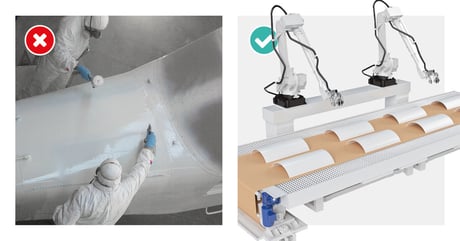
Once a company moves from manual spraying to automation, many workpieces will require the operator to program the spraying software carefully, so that coating is performed correctly, consistently, and without leaving uncoated surfaces or using excessive quantities of paint.

The more complex the geometry, the more complicated the programming phase will be, requiring hours or even days of trial and error stages and fine-tuning of the movements that will ensure a quality finish. If you have ever faced this issue, be aware that a spraying robot that programs itself allows you to save all the programming time and effort, delivering the results you want and improving your production capacity.

The reason for a robot and the decisions you need to make.

A spraying robot has a huge advantage over a human operator: it never gets tired or sick and always sprays the same way, from the start to the end of a shift. However, you need an expert to instruct the robot and program it for each new production run.
Most people will accept this as a fact, but it is not entirely true. With our spraying robots, it’s your decision: teach the robot or make it learn on its own.

Would you like to enhance your production with smart automation?
Download our report now and discover how to achieve consistent quality and efficiency in your company.

Self-programming capabilities save everyone’s time and your money.

An expert will spend hours determining the single movements that a robot needs to accomplish in a precise sequence. When developing our equipment and software, we knew how important it was to create a solution in which the robot was able to learn and teach itself. This involved 3D reading barriers, optimisation of trajectories, speeds, quantities, opening and closing of spray nozzles etc. To summarise what our robots do: they process data and translate it into immediate action, and may conserve this knowledge forever.

Cefla-Finishing_iBotic

Flexibility is not a challenge for these robots.

Cartesian spraying robots and anthropomorphic spraying robots fitted with 2D and 3D reading barriers and the appropriate software will allow for flexible production, increasing your efficiency, the quality of the product and time to market; especially where small volumes and huge variety are requested.

Moreover, this degree of intelligent automation enhances your company’s sustainability.

LOOKING FOR THE IDEAL COATING LINE SOLUTION?
Once a company moves from manual spraying to automation, many workpieces will require the operator to program the spraying software carefully, so ...

Article

How to decrease production costs in the manufacturing industry

The manufacturing world is currently investigating ways to decrease production costs and increase productivity. The integration of automation technologies has helped the industry gradually evolve over the past few decades, with the introduction of sensors and robotic technology reducing the number of human workers needed on production lines. A Moody's survey on the margins of 24 industrial giants with credit ratings of A or higher found that the average margin (before interest, taxes, depreciation and amortisation) had risen to 16.4% last year, up from 13.1% in 2013, a result achieved through targeted actions in the field of automation.

Today, however, the pace at which this transformation is occurring is accelerating, and radical changes in the way in which manufacturing plants operate are expected by the end of the decade. This is revealed by a McKinsey report. The consulting firm estimates that the industrial automation market will be globally worth 115 billion dollars (around 108 billion euro) by 2025, with a very fast growth in the segment of cloud-based software and industrial Internet of Things (IIoT)
platforms.  

What are production costs?

More specifically, what are the production processes that could be the targets of an industrial automation strategy aimed at reducing the spending? To understand how to reduce production costs, it is first of all necessary to clarify the difference between fixed costs and variable costs.

Fixed costs do not depend on production volumes - in other words, they remain constant regardless of the quantity produced and include, for example, the rent of facilities, the salaries of employees, utilities, insurance, taxes and so on.

Variable costs, on the other hand, rise and fall as a function of the production volume. In manufacturing, variable costs include raw materials, overtime, sales commissions, transportation, and the efficiency of production processes.

And it is precisely on this last aspect that we should focus in order to obtain the greatest benefits from the introduction of innovative technologies. 
We at Cefla Finishing are well aware of this, and this is why we continue to make the most of the experience gained in various segments of the manufacturing sector, in order to develop ultra-efficient finishing lines, chosen by companies world-wide to cut the costs related to some of the most delicate phases of the production process. You can find some real-life examples in our Case Studies.

THE MOST INNOVATIVE FINISHING SOLUTIONS
Discover how highly advanced finishing solutions can elevate your competitiveness.

Obviously, by investing in technology and innovation. Basically, there are four lines of action that we follow to help companies determine how to reduce production costs. Our solutions aim to:

  • how to reduce production costs. 
  • optimise production processes;
  • reduce waste;
  • increase the efficiency of the systems;
  • encourage the introduction of innovative technologies that act as catalysts for these objectives.
ordinarydesigner_industrial_plant._professional_photo._sustaina_67c4c054-c4f1-471b-acca-2b058da9f8c8

Optimise production processes

Naturally, every company that is wondering how to cut production costs must evaluate its own specific needs: the automation process should be gradual and personalised, including, for example, the introduction of machinery that can help the transition from manual operations to entirely software-managed production cycles. The implementation of semi-automated processes, with lines that minimise labour requirements, is one of the ways to make such a radical change less impacting.

Our oscillating spray coater with one or two arms Prima EVO perfectly embodies this line of thinking: it can be used as a stand-alone machine, not requiring the installation of complex systems, and managed by one or two operators for manual loading and unloading of the work pieces. But it can also be easily integrated into complete and higher-output lines.

Reduce waste

A solution like Prima EVO also allows actions to be taken in other specific areas which are critically conducive to reducing variable costs. We are referring to improved control of the materials used, with a consequent reduction of waste, especially as far as lacquer is concerned: by optimising the amount of consumables necessary to complete finishing operations, this machine allows significant savings to be obtained as early as in the medium term, with a fast return on investment. To reduce energy costs, we suggest the adoption of low-consumption techniques applied to machinery such as our UV oven UV-R. It is a compact, versatile and efficient plug & play solution, which can be easily integrated into complex finishing lines, too.  

Increase system efficiency

Optimising production processes and reducing waste is of little use if the overall efficiency of the system cannot be improved. Precisely with this in mind, at the latest edition of the Ligna show in Hannover we launched a range of solutions that help companies to carry out colour changes without having to stop production. Managed by a special software and a system which controls the equipment’s mixing valves, colour changeover requires less than 30 seconds compared to the standard 2 to 3 minutes usually needed today.

In particular, the FCS (Fast Color Switch) system installed on our Easy spray coater aroused considerable interest: visitors discovered that, if standard work shifts and colour changes are considered, FCS is able to reduce downtime by at least 30 minutes per day. This translates into a productivity increase of 2-3 hours per week.

The advantages of technology and innovation

The real advantages of Industry 4.0 and 5.0, however, derive from the integration of these platforms into IoT ecosystems: our software and connectivity solutions allow to not only evaluate and enhance production performance but also work without having to stop any processes and even by receiving remote support in case of slowdowns or bottlenecks.

Leveraging this expertise, we have created a complete package of services – called for good reason Ubiquo – which combines applications for machine monitoring, technical service and consultancy, available both on site and remotely. A combination of solutions spanning the physical, digital and virtual worlds, designed to continuously maximise the productivity of Cefla lines wherever they are located.

Cefla Finishing_Panoramica LAB_19-02-2020_001-1

A laboratory to experiment with and reduce production costs

For us, moving from theory to practice means asking our customers to experience these and many other solutions first-hand at our Cefla Finishing Lab: a proper technological hub where over one hundred Cefla Finishing machines can be seen in operation and entire processes and production lines can be created and tested, sharing experiences, business objectives and new opportunities to meet specific needs. And there's more: visiting our Cefla Finishing Lab also means having a chance to identify the most suitable configuration parameters for specific cases and calculating the ROI after the investments made to support 4.0- and 5.0-oriented process evolution. 

So what are you waiting for? If you are wondering how to cut the production costs of your manufacturing company, come and find out all about the ideal machinery and services for your business: you will be able to explore all the innovative features developed by Cefla Finishing, and evaluate and customise each solution with the help of experts.

LOOKING FOR THE IDEAL SOLUTION FOR YOUR COATING LINE?

The manufacturing world is currently investigating ways to decrease production costs and increase productivity. The integration of automation ...

Article

Window finishing: efficient, customisable production lines


In sectors such as construction and furnishing, innovative, high-efficiency finishing processes are essential to ensure high-quality products. This article is intended for industrial window manufacturers looking for cutting-edge solutions to improve the quality and efficiency of their window production and coating processes. We’ll explore innovative techniques for finishing already-assembled windows (focusing on solutions such as overhead lines and cutting-edge Cefla Finishing technologies) and unassembled windows (analysing the potential of horizontal, vertical and hybrid lines).
 

What techniques are used in industrial window finishing?

In talking about window finishing, it’s vital to address the issue of tool and process customisation. Regardless of whether the windows are already assembled or whether operations are performed on individual components prior to assembly, it’s essential to have machines that can be integrated into a finishing line that meets the specific needs of the production chain. Only by adopting this approach can we boost production efficiency, providing not just economic benefits but also, above all, greater final product quality.
 

Industrial finishing of assembled windows

Let's start by looking at options for finishing already-assembled windows. Overhead lines offer one of the most effective solutions for treating assembled window frames. With this configuration, in fact, the chain has a closed-loop design, development of which depends on productivity and the required coating cycle. The lines are connected to each other via switching points that are automatically activated during the cycle, creating standard and/or alternative circuits.

More specifically, with regard to the Cefla Finishing range, we suggest a configuration built around two key elements: iFlow to control the impregnation phase and iGiotto to complete the finish with spray coating.

The iFlow unit is mounted on rails, without any connections to the overhead workpiece hooking line: for this reason it can easily be placed offline for cleaning and maintenance purposes. It features a sole high-capacity pneumatic pump for loading, unloading and recirculation to ensure even impregnation on the pieces.

iGiotto, instead, is a complete coating system consisting of a high-performance articulated robot, specially designed to coat large items. This is a state-of-the-art window and door frame coating system: moreover, it can be used to coat any complex shape.
 
Both machines can be integrated into a line that includes, for example, elevator systems, reading barriers, and drying solutions, giving rise to an extended ‘ecosystem’ that can draw on all the window finishing solutions Cefla Finishing has to offer.

Finishing unassembled windows

For not-yet-assembled frames, the process can, instead, be performed on horizontal, vertical or even hybrid lines. Depending on window finishing requirements, Cefla Finishing provides machines specifically designed to enable impregnation and drying processes that will meet the needs of any production plant.

The advantages of horizontal lines

Let's start with manufacturers who prefer to finish their windows on horizontal lines. An integrated line that handles parts horizontally offers a specific advantage: sanding is performed efficiently by the equipment and no manual intermediate sanding is required when the pieces are subsequently positioned on the vertical line for spray coating.

The horizontal line proposed by Cefla Finishing uses Lineflow and Dryflow, in addition to sealing solutions such as Talent.

Lineflow is a machine for the horizontal application of impregnating or intermediate coatings. Compared to an overhead line, horizontal execution lets the pieces remain on the line for the subsequent brushing and coating stages. The pieces can be assembled at a later time: this means the weight can be lifted with ease and only a light brushing of the profile is needed. In this process, the wood grain is better stabilized, improving subsequent spray coating stages on the overhead line.

Used in combination with LineFlow, the DryFlow oven improves the drying efficiency of water-based coatings and significantly reduces evaporation times: this is thanks to the high-speed hot air flow and product modularity, which allow for flexible selection of holding times, with short maturing/drying phases and extremely easy control.

Last but not least comes Talent. a patented vacuum-type sealing solution that uses fast-drying water-based products and is suitable for application on various types of materials.

Why choose vertical lines?

However, some manufacturers prefer to use vertical lines for unassembled frames. This is a space-efficient solution, as it lets you hang more workpieces-in-progress on the line than would be possible with pre-assembled frames.

To start the process, iFlow controls the impregnation phase using the ‘flow coating’ application system, essential for in-depth wood protection and colouring. This is followed by a drying phase in a high-airspeed oven with controlled temperature and humidity. Subsequent applications are performed by iGiotto, the articulated robot that uses pre-set spraying trajectories, either programmed or automatically established by a 2D or 3D reading barrier. The iGiotto consistently applies the desired coating quantity; this is then dried in a high-airspeed oven with controlled temperature and humidity. Manual sanding usually precedes application of the transparent water-based finish.

Cefla Finishing and window finishing solutions

Modularity, flexibility, efficiency and high performance are the hallmarks of a range designed to meet every window coating requirement. What’s more, years of experience gained all over the world have allowed us to respond to extremely diverse, highly specific needs: just think of the different climates in the countries where Cefla Finishing operates, and the level of knowledge needed to treat the huge variety of woods with which windows are made on different markets.

Hence our mission: to customise our machines down to the last parameter so we can meet the specific needs of every single company. Come and test your products and coatings on our machines at the world’s largest finishing lab, here in Imola, Italy. This will help us define the ideal characteristics of the lines to be developed and installed, ensuring perfect processing:  just what your business needs.
In sectors such as construction and furnishing, innovative, high-efficiency finishing processes are essential to ensure high-quality products. This ...

Article

Industrial Energy Efficiency: the key is in the finish

 
In the current industrial setting, energy efficiency has emerged as a priority in sustainable development policies.
This fact is highlighted by the Energy Efficiency Report 2023, which shows that Italy invested around 12.79 billion euros in energy efficiency in 2022. Out of this amount, 2.19 billion were allocated to the industrial sector, an increase of 13.8% compared to the previous year.
 
While this growth reflects a welcome post-pandemic recovery, the importance of pushing ahead with the adoption of innovative solutions in order to reach the 2030 energy efficiency targets cannot be overstated.
 
In this context, advanced finishing technologies have a key role to play in modernising industry. This is because they allow companies to improve their market position and comply with standards while, crucially, embracing more sustainable manufacturing practices. Cefla Finishing is a leading developer of such technologies, which not only respond to the burgeoning demand for efficiency and lessened environmental impact but also open up new opportunities for innovation and competitiveness in a range of sectors.
 
 
THE MOST INNOVATIVE FINISHING SOLUTIONS
It doesn't matter which industry you’re in: if you want to lead it, these solutions are a must.
 

Industrial energy efficiency: innovative Cefla finishing solutions can make a huge difference

Finishing processes are applied on a vast range of products: from sunglasses to saucepans, from furniture to cars. Innovative finishing techniques don't only allow companies in numerous sectors to improve their market position, respond to increasingly stringent regulations and boost profits: they also let entire industries embrace more sustainable techniques and lower their environmental impact.
 
IMG-EfficienzaEnergetica-1080x607-1
At Cefla Finishing we develop new technologies to address the energy efficiency and sustainability challenges facing manufacturing companies all over the world. We belong to an international multi-business group with 1,900 employees worldwide: the group’s mission is to create value over time via solutions that combine performance and sustainability, business- and environmental-friendliness, productivity and quality.
 
Our finishing solutions are employed in all kinds of fields, from the furniture industry to construction, from automotive to aerospace, from durable goods to packaging. These cutting-edge techniques are applicable on any type of product or surface: wood and its derivatives, glass, plastic, fibre cement, ceramic, composite materials and metal. 

Our solutions include integrated lines, stand-alone machines, industrial digital printers, plus service packages and software solutions that help companies achieve their business goals by making full use of technological innovation and unmatched finishing expertise

Finishing solutions to raise energy efficiency and productivity

The market is always evolving. Trends change all the time, as do requests from end users and the brands that delegate production. However, there’s one increasingly crucial aspect that promises to be a constant in the future: process sustainability, both in terms of economic performance and environmental impact. 
 
IMG-EfficienzaEnergetica-1080x607-2
From this perspective, cutting-edge finishing solutions offer tools that can radically transform the futures of countless companies worldwide while having a positive impact on the broader socio-economic fabric. Cefla Finishing solutions stand out for their capacity to optimise energy and production efficiency, reduce downtimes and enhance operational flexibility. Let's look at some of the most significant technologies for raising industrial efficiency.

FCS (Fast Colour Switch) system

Implemented on the Easy oscillating spray coater, the revolutionary FCS system drastically reduces colour changeover times to less than 30 seconds, as opposed to the 150-180 seconds that traditional methods require. This means significant savings in terms of time - up to 30 minutes a day or 2-3 hours a week - and energy.

Advanced Matt Finishes

Matt finishes provide added value in terms of surface durability and sustainability. Using UV products/coatings and excimer ovens with low nitrogen consumption such as the Exydry-Z, manufacturers can create super-matt finishes with soft-touch, anti-scratch and anti-fingerprint effects that are sustainable and in great demand.

Roller coating also for shaped panels

Smartcoater PRO is an ingenious roller coating machine designed to reduce coating consumption and improve energy efficiency. Finishing shaped panels would normally require greater quantities of spray-applied coating. Equipped with a soft rubber applicator roller, Smartcoater PRO can flawlessly manage panels with grooves of up to 10 mm, lowering coating consumption, reducing the required number of handling tasks and getting the product to market faster.

Technologies that reduce machine downtime

The iBotic Cartesian interpolated-axes spraying robot, with one or two arms, is just one of several solutions that reduce machine downtimes. Featuring the TIMESKIP device, iBotic enables fast, seamless colour changeovers. While one robot arm continues spraying, the other moves to a zone dedicated to colour changeovers, ensuring zero downtime. This makes it an ideal tool for achieving energy sustainability and company profitability in countless sectors.

Industrial Digital Printing

Industrial digital printing is a cutting-edge technology that’s gaining ground in a vast range of industries. It provides manufacturers with huge scope for customisation, lets them produce small batches sustainably and reduces production and energy costs significantly. CROMATICA offers a perfect example: this latest technological innovation from the Marcegaglia Group is revolutionizing the use of pre-painted metal in the construction industry.I

Industrial energy efficiency: how to rise to the challenge?

In conclusion, the challenges concerning industrial energy efficiency require commitment and targeted investment in ground-breaking technologies. Addressing this change is not merely a question of improving productivity and sustainability. It also gives companies a valuable opportunity to stand out on the market and effectively respond to the growing demand for environmental responsibility. 

The perfect innovation partner will be one that offers not just state-of-the-art solutions to achieve goals but one that also provides continuous assistance, training and targeted services. This approach ensures that the introduction of new technology will create a lasting competitive advantage. It means industry can build a successful future where energy efficiency and sustainability go hand in hand with business growth and innovation.

With an international network of finishing experts sharing skills in a vast range of industries, we’re a hive of technological excellence, a trusted supplier and a partner ready to help you achieve your energy efficiency and business goals.
 
 
ARE YOU LOOKING FOR THE IDEAL SOLUTION FOR YOUR PAINTING LINE?


In the current industrial setting, energy efficiency has emerged as a priority in sustainable development policies. This fact is highlighted by the ...
Articles: 5 / 5