Article

Finishing Lab test day

Finishing Lab test day

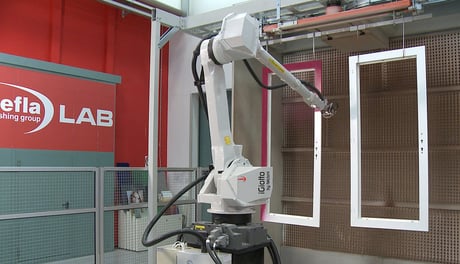
Spray coating tests LAB

Test day in the LAB.
Substrate: CABINET DOOR, shaped, FOR LAMINATED PVC KITCHEN               
Machines used: SmartSand - iBotic - Aquadry - UV-R

Preparation

LAB tests have been exciting, challenging events for over 20 years. There is a lot of preparation involved, both due to customer expectations and to make sure that the same line conditions requested by the customer are actually recreated. On the actual day of the test with the customer - an activity that we hope to be able to resume in a live format as soon as possible, and with which we have already experimented digitally earlier year - these operations will be preceded by a short briefing session, upon the customer's arrival at Cefla Finishing, to bring all the professionals involved up to speed, from sales to technical experts.
We bring all the equipment that will be needed for finishing checks near the machine - including scales and various instruments such as a pyrometer, cross cut, UV Map and glossmeter, to name just the main ones.
After setting up the work area near the machines, with all the necessary precautions and considering the layout of the line, it is time to decide how the test will be carried out. From starting up the machine, to defining the various manual operations on the machine - such as movement of the axes and opening of the guns. Some customers love to watch these operations and, intrigued by the skilful, knowledgeable actions of us technicians, already ask their first questions, while others prefer to patiently wait instead for the first coated piece out of the line.

Working recipe for shaped door cabinet

Then it's time to choose the work recipe, that is, the programming of a sequence of tasks and activities: how the robot must operate, and what it will have perform on the workpieces.
This is where experience comes into play and the following steps, among others, are decided:

  1. processing of the piece edge, working speed, required nozzle distance from the edge
  2. embossed part machining, speed, distance
  3. flat panel machining, type of working trajectory (x or y), distance

Each recipe created refers to a specific product and, to use the recipe, it is enough to activate it before starting the cycle and feeding the workpiece. The different configurable recipes are always linked to the type of workpiece or to the coating cycle (primer or finish).

An overview

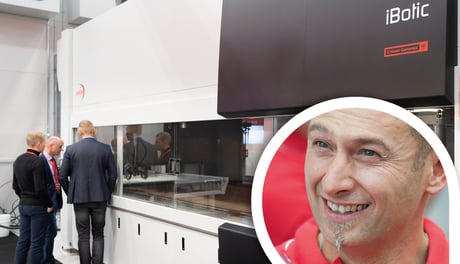
It is not time to start yet: first, the machine as a whole must be examined. In the case of iBotic, we are faced with a high-performing system of considerable industrial complexity, starting with the filtration system with water curtains and a turret for the removal of paint particles, called the "Scrubber", and ending with the "Skimmer Big Bag" , where the separation of solid residues from water takes place (aided by flocculating additives), all the way to the spraying equipment, including spray-gun support arms, with live testing of how easy it is to replace the arm, the type of guns and the number of circuits etc.. We then install the nozzles and prepare the paint for loading to the machine.

Start of sanding operations

We are ready for the first sanding operation of our shaped cabinet door with Smartsand, to then go back to iBotic and carry out our first UV White Primer application. After the usual weight check (130 gr/m2) a test door is fed through.

The right coverage

It is now time for the first inspection by the customer who checks the right coating coverage and, as far as the edges are concerned, also checks the quantity. Edges are vertical, therefore the biggest risk is dripping - a defect mainly linked to the thickness of the paint coat applied, or, in certain cases, also to the product formulation.

Flash-off and drying

The whole cycle is run and supervised starting from the very first shaped door: the workpiece now enters the oven (Aquadry) for flash-off, i.e. the evaporation of the solvent component.
These products require approximately 8 minutes.
The next step is the UV-R oven and since this is a pigmented coat, a first gallium lamp followed by a second mercury lamp are needed for drying.

Visual assessment and tactile inspection

At the outlet from the UV-R oven, a first (visual) assessment of the workpiece is carried out, looking for any pitting, edge pulling and halos.
The next step is a tactile inspection to verify drying. I am sure you are aware of the typical gesture of tapping the coat film with your fingernail to check its hardness and adhesion? I am referring to exactly that.

Action parameters as may be required

If problems are encountered, appropriate corrections are made by adjusting the various parameters involved:

  • changing the product formulation
  • changing machine parameters such as speed, product/air pressures, gun height, number or type of strokes,
  • adjustment of flash-off parameters (air speed, air temperature, hold times)
  • changing drying parameters (number of lamps, lamp power).

Successful outcome of the checks: all the pieces can be coated

All OK! We can now coat all the workpieces with the primer, before moving on to the next phase of mixed (automatic an manual) sanding, typical of shaped items.
The customer has several different types of paint and shades. Once mixed, we load them to the machine following the same procedures used for the primer.

Other evaluations

At the outlet from the UV-R oven, other evaluations are performed, such as an appreciation of the degree of finish in all its parts (flat part, embossed part and edges) and checks with the glossmeter to verify that the degree of opacity is in line with the customer's brief.

Machine cleanness is also a plus

Once paint finishing is completed, we usually clean the machine, showing the right procedure to the customer.

Final debriefing and test report

The test often ends with a final debrief meeting to discuss the results obtained and any changes to be introduced, for example, in the initial layout. At the end of the day, everything is duly reported in a report compiled by us technicians and in which we describe in detail the work performed, to ensure the most efficient task sharing between the Sales Manager, Sales Engineering, Lay out adjustment, and Service (which will use it mainly during the start-up phase).


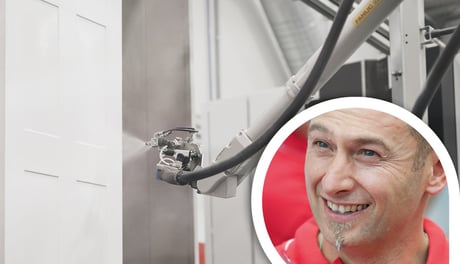
 

Eduard Raffini

LAB Application Manager

Test specialist and Coordinator of the Cefla Finishing HQ LAB

https://www.linkedin.com/in/eduard-raffini/

Test day in the LAB. Substrate: CABINET DOOR, shaped, FOR LAMINATED PVC KITCHEN Machines used: SmartSand - iBotic - Aquadry - UV-R Preparation LAB ...

Article

Innovation and sustainability go hand in hand

Innovation and sustainability go hand in hand

Solar panels roller coating

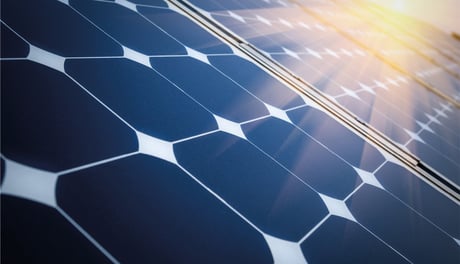
In a green industry which has yet to stop growing (CAGR of over 20% forecast for the coming 5 years) solar panels depend on specially conceived nano coating technologies to ensure maximum performance and efficiency. One key aspect regards the uniformity of an extremely thin layer of anti-reflective coating; we’re talking nanometres. As anti-reflective coatings are expensive, the application needs to be precise and uniform to maintain consumption to what is strictly necessary.

At Cefla Finishing, we have developed a process in our Laboratory which involves a machine applying an extremely thin layer of coating in one single application, the innovative Solarcoater. This machine has been designed to apply liquid coatings or protective layers in tiny quantities than are measured only in nanometres. Following this step, panels are dried in a special oven which adapts perfectly to coatings of almost any chemical composition.

There are a number of ways to resolve the need for solar panel coating. According to your specific needs, our technical experts will devise an economically viable, tailored solution, which aims to achieve your goals in terms of product quality and production efficiency.

Contact us and discuss your needs with a finishing expert.

In a green industry which has yet to stop growing (CAGR of over 20% forecast for the coming 5 years) solar panels depend on specially conceived nano ...

Article

Roller coating technology

Roller coating technology

Furniture roller coating

Today, we focus on roller coating on all flat surfaces. If the panels have flat surfaces that present a sharp edge, the lacquers are normally applied by roller coaters and/or curtain coaters, to obtain finishes with any degree of gloss.

Our customers are demanding innovation. They want to be in control of the process, of performance, versatility of their production line. They demand maximum flexibility for different products and wish to manage the process in terms of productivity and applied lacquer quantities. They opt for easy-to-use equipment, enabling them to see the rollers, the lacquer and the scraper blades.

They are careful to limit consumables, in terms of the amount of lacquer applied and a reduction in solvents used for cleaning, but also by reducing the time required for cleaning operations.

Who we are talking to:
▸ Manufacturers of cabinet doors
▸ Manufacturers of flooring
▸ Manufacturers of doors and panels in general

Materials processed:
▸ Wood and derivatives
▸ Glass
▸ Cork
▸ Plastic
▸ Fibre cement

Benefits:
▸ Optimum flexibility to cope with different needs and performance levels
▸ Automatic systems and controls to manage the coating process
▸ Saving time on cleaning procedures

Find out more about our roller coating solutions.

Today, we focus on roller coating on all flat surfaces. If the panels have flat surfaces that present a sharp edge, the lacquers are normally applied ...

Article

FLEXPRO Patent

FLEXPRO Patent

Drying different sized pieces in a vertical oven without compromising production efficiency

Everyone knows how efficient drying is inside a FIFO oven such as OMNIDRY, our vertical oven. The issue some companies regularly face occurs when a minority of pieces are significantly larger than the majority of pieces transiting the oven. What normally happens? These oversize pieces will be removed manually from the production circuit and will undergo the drying process elsewhere, in another oven, taking longer. Clearly, this issue concerns companies whose finishing capabilities allow them to handle much larger pieces.

A patented solution overcomes the need for two drying options

FLEXPRO is a patented system built into the version of OMNIDRY featuring 3 chambers. Without penalising productivity in any way, this system enables much larger pieces to enter the same oven and be dried without interrupting the process. Space is created exactly when and where it is required to accommodate the piece without reducing the oven’s overall capacity. This allows companies to exploit the high-speed drying process ensured by a typical FIFO oven and avoids the need to find another solution and twice as much floorspace.

One of its kind, with no compromise

Other ovens either favour productivity and exclude any form of flexibility, or vice versa. OMNIDRY with FLEXPRO accepts no compromise, just efficient production together with full flexibility. For companies handling more or less 10% larger pieces in their daily production, FLEXPRO saves money, saves space and saves them from stopping each time a large piece reaches the drying stage.

Watch this video to appreciate the practical solution we have developed.


Cristian Giovannini

Product Manager | Spray Coating and Drying Technologies

Product development, technologies and machines for spray coating

https://www.linkedin.com/in/cristian-giovannini-9a62271b1/

Drying different sized pieces in a vertical oven without compromising production efficiency Everyone knows how efficient drying is inside a FIFO oven ...

Article

Advanced industry 4.0 tools to drive your performance beyond the future

Advanced industry 4.0 tools to drive your performance beyond the future

Industry 4.0 is the biggest revolution since the industrial revolution and is happening at such a speed that today’s businesses and factories that fully grasp the importance of efficiency, supervision and personalized service will be the ones who exploit the technological opportunities offered by our new suite of digital tools.

None

Industry 4.0 is the biggest revolution since the industrial revolution and is happening at such a speed that today’s businesses and factories that fully grasp the importance of efficiency, supervision and personalized service will be the ones who exploit the technological opportunities offered by our new suite of digital tools.

Have you ever wanted to assess exactly what would happen before implementing a new production line?

Our cCloner software will enable you to check line logistics, assess loading and unloading stations, analyze the production flow and decide how to handle servicing operations. Our experts use this tool to clone your imagination in 3D, so to speak, and with the magic of modern-day mechatronics it’s possible to tweak all the details of up to 100 different machines, adjusting parameters to optimize production efficiency before you start, when things change or when you need to simulate a sequence of working days.

Learn more about our digital tools and software solutions.

Industry 4.0 is the biggest revolution since the industrial revolution and is happening at such a speed that today’s businesses and factories that ...

Article

How to decorate sidings with a simple process that does the entire job

How to decorate sidings with a simple process that does the entire job

Siding spray coating

The exterior of a building can be embellished with any number of techniques. Sidings represent a simple solution, easily applied and a way of protecting the structure itself. The sidings might just be rectangular slats, but the more creative you get, the more you need to set up a finishing process with the appropriate equipment. We at Cefla Finishing have responded to many requests and the knowledge and experience gathered around the world enables us to tailor each integrated line we design to best suit a customer’s needs. This is one of many line set-ups using spray coating equipment and a vertical oven for additional flexibility.

After initial surface coating at a rate of 90-100 g/sqm in a spray coater such as Easy, a pigmented, bi-component, water-based topcoat can be applied before drying in a vertical oven Omnidry for 45  min. at 60°C. Where required, the grout lines, which add a special visual effect to a decorative siding, can be coated in a darker tone using an anthropomorphic painting robot iGiottoApp. This coat of single-component, water-based varnish can be applied at a rate of 35-40 g/sqm prior to a seven-minute drying stage in Aquadry.

This is just one way of approaching the task of decorating sidings. Let us know what your specific needs are and our process engineers will research a tailored solution to bring you added efficiency, ensure improved surface enhancement quality and keep a close eye on your paint consumption.

Contact us and discuss your needs with a finishing expert!

The exterior of a building can be embellished with any number of techniques. Sidings represent a simple solution, easily applied and a way of ...

Load more articles

Articles: 66 / 157