
Article
iGiotto: overhead coating lines with high-performance anthropomorphic robots
Not all coating robots are the same. Achieving uniform, high-quality results while maximising productivity and minimising downtime means implementing overhead lines equipped with high-performance anthropomorphic robotic systems.
Oscillating spray coaters are not always capable of properly finishing complex three-dimensional objects, despite their high efficiency rates. In these cases, the solution offered by an overhead line equipped with an anthropomorphic robot makes it possible to achieve high performance, excellent quality, and a wide range of options and customisations.
The advantages of automatic coating plants
Let’s start with the most obvious considerations, derived from comparing automatic coating plants with traditional coating processes.
Operators are well aware that a manual approach does not allow full control over the paint application process and production capacity. Above all, for a number of reasons largely linked to the human factor, this philosophy does not guarantee consistent quality.
Using a coating robot for window frames, doors or complex three-dimensional objects instead allows you to promptly meet the four main needs of those who own and manage a finishing plant:
- Save time when switching from one operation to another
- Improve coating quality, even along complex trajectories
- Reduce material and energy consumption
- Increase productivity
An anthropomorphic coating robot does not completely replace human activity. In the coating process of windows, doors and three-dimensional objects such as disassembled chairs or musical instruments, for example, the coating robot still requires an operator to manage and monitor the various stages of the process. Moreover, the heaviest and most repetitive work is entirely handled by the machines.
Thanks to software developed by Cefla, the machine performs (automatically and repeatedly, based on the programme launched) all trajectories required to carry out coating operations with extreme precision. This, essentially, is what makes it possible to reduce manual activities that limit production efficiency.
In other words, a high-performance anthropomorphic coating robot eliminates at the root problems related to time loss, paint waste, and inconsistent quality and productivity levels. And by optimising process flows, it also helps to reduce energy consumption.
THE MOST INNOVATIVE FINISHING SOLUTIONS
Discover the most advanced finishing solutions to enhance your competitiveness.

Robotic systems for automatic finishing: advantages and technologies
Robotic systems therefore represent a fundamental evolution in finishing processes. They can guarantee precision, uniformity and repeatability in complex applications, in different use cases and regardless of the size of the plants in which they operate.
Based on digital technologies, standard components and integrated, modular solutions, robotic coating lines are also distinguished by another great advantage: they can be designed, installed and modified with a modular and flexible approach. This allows production schemes to be optimised dynamically, meeting the personalisation needs of both large and small customers.
Automatic coating plants: customised solutions for every requirement
Naturally, when we talk about customisation, we do not refer only to customers’ preferences. Manufacturers themselves increasingly need automatic systems capable of adapting to new use cases and to the constant drive for innovation, which today mainly focuses on efficiency and sustainability.
In this regard, overhead coating lines equipped with anthropomorphic robots are the ideal choice for building multifunctional systems that can be quickly reconfigured to seize new business opportunities or enter high-potential niche markets. The ability to differentiate one’s offering is indeed becoming a critical success factor in an increasingly challenging competitive environment.
iGiotto: the highest coating quality without manual programming
Let us now go into greater detail and highlight how anthropomorphic coating robots differ from traditional automation solutions.
Automatic coating plants generally require manual programming. In the presence of complex geometric shapes, the machine must be manually programmed to ensure that its spraying axes move correctly around the workpieces. This means that the coating robot – which “learns” to move by replicating the gestures (and related inaccuracies) dictated by manual programming piece by piece – cannot always achieve the optimal result.
There are also automatic coating plants that allow point-to-point programming via dedicated software. This helps reduce the margin of error but still requires skilled users to handle robot programming. Yet we are still far from the optimum when it comes to guaranteeing quality finishes on complex 3D objects.
Therefore, if the goal is to combine high repeatability, low paint consumption and reduced application times without ever compromising on a flawless result, a self-generating anthropomorphic coating robot represents a strategic choice. Furthermore, it allows the carbon footprint to be reduced through lower energy consumption and the use of eco-friendly materials.
Industrial coating plants: energy saving and productivity
Investing in a next-generation robotic plant guarantees immediate and incremental advantages compared to the use of more traditional techniques (even automated ones), and certainly in comparison with manual spray coating of complex 3D objects or frames. Consider the following aspects regarding programming, precision and flexibility.
- PROGRAMMING. Some automation solutions allow the robot to be programmed manually, physically guiding the spray arms around the complex geometric shape. In this way, the machine learns to move and replicates the movements piece by piece. It is also possible to program point-to-point trajectories using offline software, but for each batch it will be necessary to manually enter the data into the software to obtain the required parameters.
- PRECISION. In addition to the cost of a specialised operator, the manual spraying of window frames often produces fluctuating performance and uneven paint thickness. Paint consumption frequently exceeds the optimal quantity by 15–30%, leading to frequent filter replacements and high disposal costs.
- FLEXIBILITY. Production batches are often small in size or require significant customisation. Operators must therefore stop the line for colour changes or to reprogram the trajectories. All this negatively affects production efficiency and causes costly downtime.
Anthropomorphic coating robot and cVision 3D reading barrier: the winning combination
Overcoming these limits means adopting a solution such as iGiotto by Cefla Finishing. But what exactly is iGiotto? How does it work?
We are talking about an automatic spray coating plant for water-based and solvent-based products — a true ecosystem built around an anthropomorphic coating robot designed to process both large wooden objects, such as doors and frames, and complex-shaped workpieces made from materials other than wood.
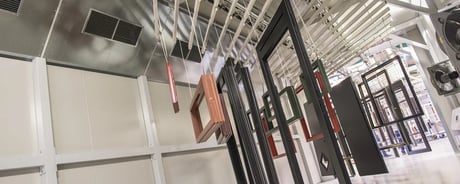
The products travel along the overhead lines, exiting the spraying area to enter a drying tunnel before being divided into batches. The constant speed and distance between the guns and the product optimise paint consumption and guarantee uniform coating.
From an environmental point of view, this translates into a significant improvement in sustainability KPIs, with reduced consumption and less waste.
This is also thanks to the integration with cVision, the 3D reading barrier (also developed by Cefla Finishing), capable of automatically generating trajectories for complex shapes. The combination of iGiotto and cVision enables a fully automated coating process even in the presence of objects with complex geometries. It improves finishing quality and consistency, reduces consumable material usage, and increases overall plant efficiency.
In particular, thanks to a next-generation scanning system, cVision can acquire the positions, dimensions and shapes of items in transit with unprecedented precision. The software then processes the 3D image of the workpiece to be coated and determines the best trajectories.
The combined action of this ultra-high-resolution reading system allows iGiotto to automatically generate precise working programmes based on the “families” of objects organised in its database. cVision therefore eliminates the need to manually set up an anthropomorphic coating robot. There is no longer any need to define trajectories by hand, as everything is automated. This results in considerable time savings (at least 50%) and ensures optimal parameters and consistent coating quality from the first to the last piece.
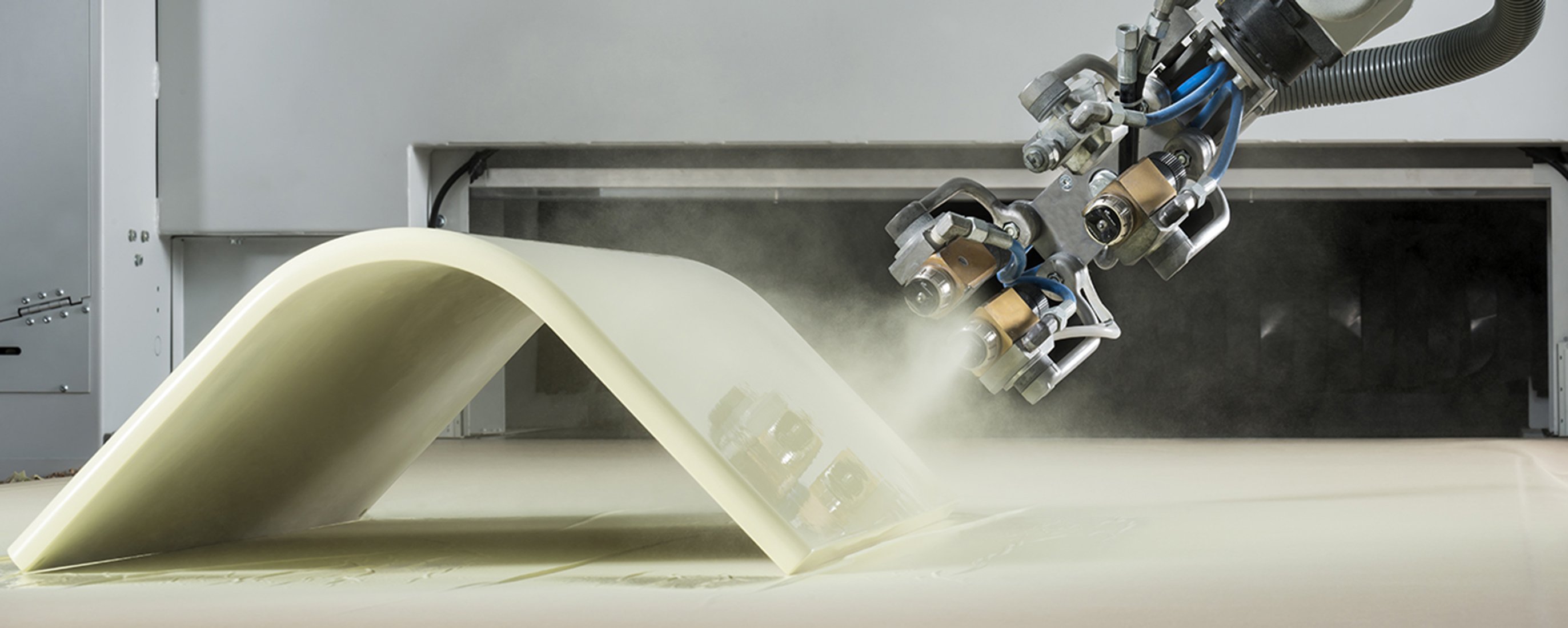
The iGiotto coating robot, for its part, takes advantage of the accuracy of predefined trajectories to optimise spraying using a dual-gun wrist. This provides significant paint savings while guaranteeing the best possible quality and consistency. Colour changes also take place without ever stopping the equipment, even when switching between different products, thereby eliminating downtime. Finally, when new workpieces enter the overhead line, the software ensures that iGiotto can move from one item to another and from one colour to another without interrupting production.
Optimising door coating with a three-gun wrist
The use of a three-gun wrist (optional) is a recently introduced approach and is proving particularly effective in door coating operations. The system improves production efficiency compared to the traditional two-gun wrist: for spraying the front side of the door, only a single pass is required. This avoids crossover trajectories, enabling lines equipped with anthropomorphic robots such as iGiotto to save approximately 40% in processing time.
Low-consumption coating lines: a sustainable future
Modern coating lines are revolutionising the production process through the integration of advanced technologies that significantly reduce paint waste and energy consumption.
Thanks to the use of automated systems and real-time trajectory monitoring, as we have seen, these lines optimise paint application, ensuring precise colour mixing and minimal overspray.
However, even more can be done to further reduce the environmental impact of coating lines equipped with anthropomorphic robots. Closed-cycle systems, for example, reuse excess paint, while intelligent sensors adjust energy output based on actual production requirements, avoiding unnecessary power consumption.
Moreover, the use of water-based formulations and coatings with low volatile organic compound (VOC) content not only enhances environmental safety but also helps to reduce energy requirements during drying and curing processes.
Adopted within an integrated approach, all these solutions help to reduce the impact of finishing operations and represent a significant step towards ever-greater sustainability in the coating sector. With its innovations, Cefla Finishing stands alongside companies seeking to lead this transformation.
LOOKING FOR THE IDEAL SOLUTION FOR YOUR COATING LINE?