Article

LIGNA 2025: Cefla's Innovations for Wood Coating

The LIGNA 2025 trade fair, scheduled from May 26 to 30 in Hannover, reaffirms its position as a key event in the woodworking and surface finishing industry. With a wide range of innovations, this year’s edition aims to meet the market’s increasingly pressing demands.

LIGNA 2025: a Special Edition celebrating its 50th Anniversary

The 2025 edition of LIGNA will be especially significant for the wood industry, as the trade fair celebrates its 50th anniversary. An anniversary we at Cefla Finishing share, having been a permanent exhibitor since the very first edition. This milestone event promises to be extraordinary—not only due to the occasion, but also because of the high level of participation.

According to Christian Pfeiffer, Senior Vice President Sales at Deutsche Messe AG, over 1,200 exhibitors are already confirmed, occupying a total exhibition area of 112,000 square metres. This represents a strong sign of commitment in a challenging economic context, highlighting LIGNA’s role as a key event for the industry.

Once again, the trade fair will maintain its strong international character, with around two-thirds of exhibitors and over 50% of expected visitors coming from abroad.

Italy, in particular, continues to see LIGNA as the primary launch pad into international markets. The confirmed presence of leading companies such as Cefla Finishing brings with it major innovations—more necessary than ever in today’s market.

The Three Key Themes of LIGNA 2025

The 2025 edition will revolve around three main themes, reflecting the sector’s current challenges and opportunities:

  1. LIGNA.CONNECTIVITY – focusing on digital integration for increasingly interconnected production
  2. LIGNA.SUSTAINABLE PRODUCTION – centred on strategies for a more sustainable industry
  3. LIGNA.ENGINEERED WOOD – dedicated to new solutions for engineered wood materials

These central themes underscore LIGNA’s commitment to addressing the industry’s most urgent issues—from digitalization to circular economy—by offering concrete solutions for companies of all sizes, from small craft businesses to large industrial groups.

The importance of LIGNA 2025 for the Finishing Industry
LIGNA 2025 is shaping up to be an unmissable event for the wood coating sector, offering an unparalleled showcase of the latest innovations and technologies.

The trade fair will place special emphasis on surface finishing technologies, with an entire hall (Hall 17) dedicated to this segment—and Cefla Finishing front and centre at stand F45.

Visitors will be able to explore the latest coating solutions, set to revolutionize the industry in terms of efficiency, sustainability, and the quality of the finished product.

For professionals in the field, LIGNA 2025 will represent a unique opportunity to engage with the latest trends, discover new application techniques, and understand how innovation in coating can help improve both product quality and production efficiency.
For this reason, Cefla is offering free tickets to attend the event.

Discover Cefla Finishing at LIGNA and get your Free Entry Pass

Request your ticket

Cefla Finishing’s Innovations at LIGNA 2025

Cefla Finishing is set to amaze visitors to LIGNA 2025 with a range of brand-new innovations, aimed at transforming the sector. Our goal is to blend efficiency, sustainability, and quality.

Values such as sustainability, productivity, flexibility, simplicity, consistency, responsiveness, and precision are at the heart of the innovations we’ll showcase. These principles have driven our R&D efforts, enabling companies to enhance both production processes and final product quality.

Each week leading up to the trade fair, we’ll unveil a previously unreleased innovation on our social channels. If you haven’t already, follow Cefla Finishing on LinkedIn, Facebook, Instagram, and X.

Stay tuned for exclusive previews—and to see them live, make sure to claim your LIGNA ticket now.

Networking Opportunities: Events you won’t want to miss at the trade fair

Attending LIGNA 2025 isn’t just about discovering the latest market innovations, it’s also an opportunity to forge new partnerships and strengthen existing ones. For Cefla’s extensive, international team—made up of specialists and technicians—LIGNA is a unique occasion to meet all stakeholders, as well as potential new partners.

Some of these partnerships will also fuel the events hosted at Cefla Finishing’s booth. Our Speaker Corner will feature presentations and talks by partners throughout the fair.

Combined with informal networking moments that naturally arise during the event, these activities make LIGNA 2025 a must for anyone in the woodworking industry. Meeting experts, exploring new partnerships, and engaging with global peers makes visiting the fair—and our booth—a valuable investment for your professional and business future.

Challenges and Opportunities for the Wood Industry: a glimpse into the future

LIGNA 2025 is also a moment for strategic reflection on the challenges ahead for the wood industry. Key issues include adopting more sustainable practices, adapting to climate change (which affects raw material availability and quality), and responding to the growing demand for customized, high-value products.

At the same time, technological innovation and digitalization bring new opportunities. Sustainability continues to be a key pillar for the future of the sector, with a growing emphasis on circular economy models and resource efficiency.

Companies are being called to rethink their production processes, transforming current challenges into opportunities for renewal and growth—thanks in large part to the technological innovation led by Cefla Finishing.

Discover More and get your Free Entry Pass to LIGNA

Request your ticket

The LIGNA 2025 trade fair, scheduled from May 26 to 30 in Hannover, reaffirms its position as a key event in the woodworking and surface finishing ...

Article

Optical Treatment for Solar Panels: Which Process is the Best?


In an industrial scenario that is increasingly “going green” by continuing to invest in solutions capable of reducing the carbon footprint of business operations, solar panels are today a key technology. Today's complex and advanced systems designed to guarantee top performance and maximum efficiency deserve the best finishing technologies.

Just think of the role played by the thin layer of anti-reflective coating (commonly shortened to ARC). It is an optical coating applied to solar panels in minimal quantities, such as to be considered nanometric applications. This treatment improves the efficiency of the solar panel as less light is lost through reflection. Just think that with this treatment 3% to 4% more energy is supplied - by capturing the light that would otherwise be lost through reflection. These optical gains can help recover any capacity lost due to normal module degradation. We already mentioned that anti-reflective finishes are nanometric applications: for this reason, the treatment must be applied so as to ensure the highest possible uniformity.

In this feature we will review different types of solar panel, and then focus on advanced optical treatment solutions for solar panels, developed based on Cefla Finishing's expertise.


Innovation and sustainability in solar panels: advanced technologies and energy efficiency

The solar panel market offers a diverse range of technologies suitable for several applications - from residential rooftops to large solar parks. Understanding the characteristics and benefits of the different types of solar panel (monocrystalline, polycrystalline, thin-film and bifacial) is essential in order to make informed investment decisions.

Below is an overview of the current range configuration, showing the intended use and benefits of each product.

THE MOST INNOVATIVE FINISHING SOLUTIONS
Discover how highly advanced finishing solutions can sharpen your competitiveness.


Types of solar panel and their applications

Solar panels, the main technology using photovoltaic energy, can feature different structures and materials, each with distinct characteristics suited to many types of application.

Monocrystalline solar panels

Monocrystalline solar panels, for example, have a single continuous crystalline structure, usually silicon. They are easily recognisable as they are uniformly dark in colour with rounded edges, which indicates the high degree of purity of the material used in the production process.

This type of solution ensures the highest efficiency rates, often exceeding 20%. This makes them ideal for situations where roof space is limited. Thanks to their long life (often exceeding 25 years), microcrystalline solar panels are highly suitable for installation in urban environments and particularly on the roofs of residential buildings.

Polycrystalline solar panels

Polycrystalline panels are made up of multiple silicon crystals fused together. Precisely because of this type of processing, which generates multiple crystalline structures, these panels have a characteristically blue spotted appearance.

Generally, these panels are cheaper to produce than monocrystalline panels, but their efficiency rates are also lower and generally range between 15% and 20%: these values, while being not as high as monocrystalline panel ones, are still suitable for many applications.

In fact, thanks to their lower cost, these panels are often used in large-scale solar projects with particularly large surface areas and are highly in demand for covering fields or for remote installations.

Amorphous silicon modules

While also less efficient than monocrystalline panels, amorphous silicon modules are extremely flexible. Solar panels of this type are an excellent solution for creating photovoltaic systems in areas where solar radiation is weaker due to unfavourable climatic conditions - maximising the output from high temperatures or diffused light. From an aesthetic point of view, they stand out for their uniformly dark colour, while in terms of performance they offer versatility and lightness. Thanks to their low production costs and other characteristics, they are ideal for implementing highly verticalised applications, particularly in the architectural field.

Thin film panels

Amorphous silicon is also used to make thin-film panels by coating an underlying surface with a thin layer of photovoltaic material (cadmium telluride and copper indium gallium selenide in addition to silicon). This approach provides flexibility and lightness and makes thin-film panels the ideal solution for covering structures with non-linear shapes. They generally perform better in low-light conditions than the other panels listed above and are therefore used in conjunction with building components such as windows and roofs.

Advanced optical treatment of solar panels in the Cefla Finishing LAB

Regardless of the type of solar panel and application, the use of photovoltaic energy offers companies numerous advantages: energy savings, tax incentives, energy self-sufficiency, increased company value and improved sustainability reputation. To maximise these benefits, however, it is essential to be able to rely on quality products, capable not only of offering excellent performance whenever and in whichever way they are used, but also of maintaining this standard of performance over time. In other words, solar panels need to have a finish that's up to the task.

In our Cefla Finishing LAB, we have developed an ad hoc process, which includes the application of ARC using a very special roller machine called Solarcoater, able to guarantee excellent uniformity in the application of the ARC layer which, as we said before, is measurable in nanometres .

After application, the glass panel is fed through a drying oven to cause the ARC material to completely evaporate before the glass is tempered. It should be noted that there are two types of ARC, and the most common one requires glass tempering to permanently fix the coating. The other less common type only requires fixing of the coating at high temperature in the ovens.

Cefla Finishing and ARC application on solar panels

With its 60 years of experience in creating industrial finishing solutions, Cefla Finishing has developed an innovative range of machines for the application of ARC on solar panels.

Thanks to the industry-specific expertise of a team of specialists able to identify the most suitable technologies to meet any need, we can analyse the product, requirements and business objectives of manufacturers with a view to starting a long-term relationship based on a personalised roadmap.

LOOKING FOR THE IDEAL COATING LINE SOLUTION?

None
  
In an industrial scenario that is increasingly “going green” by continuing to invest in solutions capable of reducing the carbon footprint of ...

Article

Production process optimization: Cefla Finishing solutions

Production process optimization plays a pivotal role in improving cost efficiency, reducing waste and boosting product quality. Manufacturers in the finishing sector can - by implementing advanced technologies such as integrated coating lines, robotics and digital printing - streamline workflows, minimise bottlenecks and achieve greater processing precision.

First of all, we need to clarify something: the principles and tools of so-called lean manufacturing will only generate the anticipated benefits if there is a broad, cohesive strategy, of which the technological aspect is just the tip of the iceberg.

To take quality to the next level, it’s simply not enough to purchase the latest-generation machines. In addition to identifying and eliminating low-added-value activities - with a view to shortening time-to-market without losing control of operating costs - it’s necessary to adopt sustainable practices such as recycling waste materials and using eco-friendly finishing agents. Strengthened relationships with suppliers and employees are equally vital. Additionally, investment in training promotes a culture of continuous improvement, allowing the industry to respond flexibly to market demand and truly benefit from innovation.

What is production process optimization?

Any organisation intent on optimizing its production processes needs to prioritise along three lines: eliminating inefficiencies, reducing costs and improving quality
In the finishing industry, the most innovative companies have already drawn up and followed ‘roadmaps’ with three main branches: specialised coating processes, automation and digital printing.

Optimizing spray coating processes, for example, largely involves implementing recirculation and rotation systems on the production lines. At a stroke, this approach diverts skilled labour away from menial tasks and reduces the risk of inefficiencies and bottlenecks. Cost reduction, instead, is achieved by installing machines with fast yet simple colour changeover systems that continue to deliver the same high performance without increasing energy or material consumption.

It’s also possible to deploy systems that introduce roller coating techniques. The latter combine excellent manufacturing flexibility - the result of an extremely wide range of applications and good consistency - with minimal solvent emissions thanks to the use of products that, in 95% of cases, have high dry residues (UV). The outcome? High-efficiency lines that retrieve all unused product, allow fast colour changeovers and employ semi-automatic roller cleaning systems that have the further advantage of containing running costs.

Overhead and floor-mounted lines are perfect for managing production batches that require limited worker intervention. They’re also well suited to small orders, which involve frequent changes to colours and processes. All this stems from simplified programming of the coating machines, which feature tools that constantly monitor coating delivery. This prevents waste and reduces the rejection rate among products leaving the line.

Lastly - again with a view to optimizing production processes - there’s the still little-explored area of industrial digital printing, ideal for customising products or handling extremely limited production runs. 

Applying modern digital printing techniques to object decoration doesn’t just let manufacturers deliver products more quickly: it also reduces the need for stock, minimising warehousing requirements and streamlining supply chains.

THE MOST INNOVATIVE FINISHING SOLUTIONS
Discover how highly advanced finishing solutions can sharpen your competitiveness.

Reducing waste and optimizing resources

Optimizing essentially means making the best of scarce resources (time and skills being paramount), reducing material waste (coatings and consumables) and achieving efficient energy management.

As we see it, digital printing has yet to gain its rightful place as a production process optimizer. Compared to traditional decoration systems, in fact, industrial digital printing can play a crucial role in reducing waste as it does not require:

  • engraved roller changeovers, which waste time and reduce productivity;
  • ink changeovers, which require the disposal of cleaning waste;
  • different decorative papers for each decoration, with the risk of stock becoming obsolescent (and then having to be disposed of).

Energy efficiency and sustainability in production processes

The topic of waste reduction goes hand in hand with that of energy efficiency which is, in turn, an integral part of a manufacturing policy that aims to meet increasingly ambitious sustainability requirements.

All Cefla Finishing solutions are designed to deliver efficiency and sustainability and every Cefla-branded machine or software plays a crucial role in doing so. More specifically, let’s see which patents translate this philosophy into reality.

FCS (Fast Colour Switch) system

Implemented on the Easy oscillating elliptic sprayer, the Fast Colour Switch system can drastically reduce colour changeover times to below 30 seconds (compared to the 150-180 seconds required by traditional methods). This means significant savings in terms of time - up to 30 minutes a day or 2-3 hours a week - and energy, eliminating the need for frequent machine restarts.

Advanced matt finishing

Market demand for deep matt surfaces with soft-touch effects is on the rise. By using UV inks/lacquers and excimer dryers that consume little oxygen, such as the Exydry-Z oven, manufacturers can obtain advanced scratch-resistant, anti-fingerprint matt finishes sustainably.

Roller coating: also available for raised panels

Smartcoater PRO is perfect for reducing lacquer consumption and improving energy efficiency. Raised panel finishing normally requires spray coating, which uses more lacquer. Equipped with a soft rubber applicator roller, Smartcoater PRO performs precision handling of panels with grooves of up to 10 mm, ensuring lower lacquer consumption, fewer manipulations and shorter time to market. To handle thin coatings, Smartcoater PRO incorporates an original, specially designed roller system that can, in turn, be expanded to include lacquer washing and retrieval solutions.

Technologies that reduce machine downtime

Cefla has several solutions that reduce machine stoppages and downtime, one being the Cartesian interpolated-axes iBotic spraying robot, available with one or two arms. Equipped with the Timeskip device, iBotic allows fast, seamless colour changeovers. While one robot arm continues spraying, the other moves to a dedicated colour changeover area, ensuring zero downtime. 
iGiotto instead, enables rapid colour changes with limited lacquer consumption: in practice, colour changeover occurs as one bar enters the booth and the other just-coated one exits. Precise iGiotto trajectories ensure coating application follows the shape of the workpiece: compared to reciprocating, manual application systems, this results in less filter consumption. 
An equally vital tool is iFlow, which can be equipped with rapid colour changeover systems that minimise wash water consumption. All coating booths feature devices that save energy when they’re not actually working. What’s more, an exhaust air recirculation system is available to reduce heat consumption.
Last but not least comes Lineflow, a horizontal door/window preservative application machine designed to reduce air consumption significantly.

The importance of automation in manufacturing

Integrating all these technologies into a resilient, flexible, efficient supply chain means automating processes, reducing human intervention where possible, minimising errors and decreasing downtime.

Let's now dive deeper and identify the impact that each of the solutions highlighted above might have in the context of an automated finishing line. 
With regard to digital printing, automation involves a transformation of the process, not just simple ‘handling’. By integrating the decorating machine into the production planning system, in fact, it’s possible to obtain information on the decoration ‘print queue’ directly from the IT system. This provides highly detailed real-time feedback and lets you control working conditions during the production of individual products.

When it comes to spray and roller coating, however, the advantages of automation are to be found in the handling systems, calibrated to match both productivity and the different processes performed by the various machines on the line.

Lastly, on overhead and floor-mounted lines, the advantages stem from the flexibility of the handling which - thanks to automatic systems - maximises the effectively available space. In fact, it’s possible to arrange product finishing zones in such a way as to converge everything needed to complete the coating process into a single workflow.

Of course, all this is only possible if the ‘ecosystem’ has the real-time instructions needed to control the entire process, step by step. In short, what we’re talking about is information exchange between lines and control systems. Ultimately, therefore, the effectiveness of automation depends on the ability of the machines to generate, send and receive data by communicating with the ERP and the PLM software.

This is why Cefla Finishing has created solutions that can be natively integrated with the company’s ERP systems: output data is logged and exportable to monitor cycle times, with the number of coated pieces sub-divided by colour and by time spent in the drying oven, bar by bar, support by support.

Process-optimizing technology and innovation

Production processes can be optimized by deploying trailblazing technology that revolutionises the way companies work. Just think of the growing weight of applications based on Artificial Intelligence (AI) and the Internet of Things (IoT).

AI helps us improve data quality and refine the forecasting capacity of production systems over time; the IoT, instead, is proving to be a valuable ally for the advanced digitalization of production processes, allowing, for example, manufacturers to create finishing plant ‘digital twins’.

This, in fact, is exactly what the cutting-edge Cefla Finishing software, cCloner, does: it manages line layout and lacquer, heat and electricity consumption. Processing times are calculated on the basis of a production process simulation: this not only lets users identify potential issues but also lets them calculate the total coated surface area managed by a single line.

With cTracker, instead, users can monitor the entire production chain from a single workstation, modifying parameters to make real-time changes to thickness and colour. Used in tandem with cLink, the system can collect inputs and upload them on the company management system to optimize production and reduce consumption.

But what if you’re unable to follow the processes in person at the facility? No problem: the web-based cMaster application gives you immediate access to machine and line data from anywhere in the world via any Internet-connected device.

The benefits of automation and digitalization

At this point it's clear how automated, digitalized production processes can boost productivity, improve product quality and reduce overall operating costs.

Smooth integration of automated systems means manufacturers can perform more efficient, real-time monitoring of lines. In turn, systems (or individual machines) can be dynamically adapted to changing production scenarios or new energy efficiency requirements, without compromising supply chain performance.

Machine-generated data is used to run predictive analyses of line capacity and implement continuous improvement practices along the entire value chain, keeping it upgraded and agile.

This flexibility - combined with enhanced safety and fast returns on investment - is the core benefit of an effective industrial automation strategy.

Employee involvement and continuous training

As mentioned, production process optimization doesn’t just concern technological development: above all, it has to do with people. Despite the common misunderstanding that automation seeks to reduce human resources, the truth is that it actually aims to reallocate them to higher-added-value tasks, leaving more repetitive duties that require no human skill to the machines.

That’s why it’s vital to focus on a cultural, organisational transformation that goes beyond the adoption of new technologies and digital processes to involve everyone in the company. This not only ensures a smoother transition towards a logic of higher production efficiency, it also makes everyone aware of the real benefits this new approach has to offer: such a transformation is a must if we’re to break down the natural resistance to change and promote an informed acceptance of the proposed innovations.

At Cefla Finishing, we’re aware of how delicate that transition can be. That’s why we provide our customers with the skills and professionalism needed to support them, at every stage of the plant life-cycle: from design to technical assistance, from training to change management.

Looking for a production process optimization strategy that’ll help you get the best from your company's resources? Contact our experts!

LOOKING FOR THE IDEAL COATING LINE SOLUTION?

Production process optimization plays a pivotal role in improving cost efficiency, reducing waste and boosting product quality. Manufacturers in the ...

Article

Gain hours of production time with self-programming spraying robots

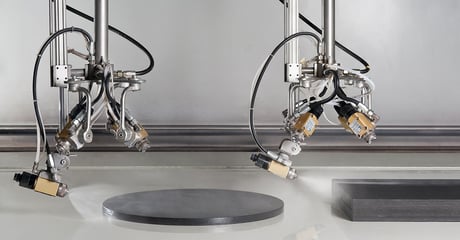
Once a company moves from manual spraying to automation, many workpieces will require the operator to program the spraying software carefully, so that coating is performed correctly, consistently, and without leaving uncoated surfaces or using excessive quantities of paint.

The more complex the geometry, the more complicated the programming phase will be, requiring hours or even days of trial and error stages and fine-tuning of the movements that will ensure a quality finish. If you have ever faced this issue, be aware that a spraying robot that programs itself allows you to save all the programming time and effort, delivering the results you want and improving your production capacity.

The reason for a robot and the decisions you need to make.

A spraying robot has a huge advantage over a human operator: it never gets tired or sick and always sprays the same way, from the start to the end of a shift. However, you need an expert to instruct the robot and program it for each new production run.
Most people will accept this as a fact, but it is not entirely true. With our spraying robots, it’s your decision: teach the robot or make it learn on its own.

Would you like to enhance your production with smart automation?
Download our report now and discover how to achieve consistent quality and efficiency in your company.

Self-programming capabilities save everyone’s time and your money.

An expert will spend hours determining the single movements that a robot needs to accomplish in a precise sequence. When developing our equipment and software, we knew how important it was to create a solution in which the robot was able to learn and teach itself. This involved 3D reading barriers, optimisation of trajectories, speeds, quantities, opening and closing of spray nozzles etc. To summarise what our robots do: they process data and translate it into immediate action, and may conserve this knowledge forever.

Cefla-Finishing_iBotic

Flexibility is not a challenge for these robots.

Cartesian spraying robots and anthropomorphic spraying robots fitted with 2D and 3D reading barriers and the appropriate software will allow for flexible production, increasing your efficiency, the quality of the product and time to market; especially where small volumes and huge variety are requested.

Moreover, this degree of intelligent automation enhances your company’s sustainability.

LOOKING FOR THE IDEAL COATING LINE SOLUTION?

Once a company moves from manual spraying to automation, many workpieces will require the operator to program the spraying software carefully, so ...

Article

Industrial automation systems: advantages and applications

Industrial automation systems have transformed modern production lines by leveraging cutting-edge technologies such as robotics and AI and by using the Internet of Things to incorporate sensor networks and data analysis platforms.

How many times have you wondered how you can reduce production costs and boost your company’s productivity? The automation revolution offers just the answers you’ve been looking for: lower labour costs, less human error, streamlined operations and improved precision.

Industrial automation systems are designed to work continuously. They can also be reprogrammed to meet changing production requirements and so ensure optimal use of resources at all times. Companies that implement them properly experience higher productivity and efficiency and obtain higher output volumes per unit of time, without compromising quality. This doesn’t just reduce overall operating costs: it also sharpens the company’s competitiveness on an increasingly challenging global market.

How do industrial automation systems work?

Modern industrial automation is a union of mechanical manufacturing and IT systems. Known as Computer Integrated Manufacturing (CIM), this industrial model unites - within a unified infrastructure - all the production processes with the automation equipment and with the IT management systems. This is where data sharing - on which each function depends - occurs, using a pyramid-like, hierarchical communication logic.

At the base of this ‘pyramid’ is the so-called ‘field’, that is, the processes to be controlled, where all the execution data measuring sensors are located. The next level is ‘control’. This is the realm of the regulators and actuators that, via the PLC (Programmable Logic Controller) and DCS (Distributed Control System), process the field-generated data and assimilate it with production goal parameters. Moving up, we come to the ‘supervision’ layer. Using computers and remote SCADA (Supervisory Control And Data Acquisition) monitoring systems, this level coordinates the underlying operations. At the tip of the pyramid we have the ‘enterprise’ level where we find management teams and other decision-making corporate bodies.

While each level requires that industrial automation systems perform data acquisition, processing and transfer functions, the CIM pyramid model has a vertical framework: commands are transmitted from top to bottom, information is transmitted from bottom to top.

And it’s on the basis of this integrated, interdependent logic that Cefla Finishing has created automation solutions for advanced coating and finishing lines.

THE MOST INNOVATIVE FINISHING SOLUTIONS
Discover how highly advanced finishing solutions can sharpen your competitiveness.

ordinarydesigner_environment_modern_furniture_factory_clean_and_398e152e-2d9b-4128-b4c8-b0cb2694e772

Types of industrial automation systems

In the coating sector, automation processes can be divided into two main families:

  • Automation of the technological process (sanding, cleaning, application, drying)
  • Automation of the line or the handling of the items to be coated (loading/unloading, overturning, conveying and transfer systems, etc.)

A further classification can be added to these two categories. Industrial automation can, in fact, be rigid or flexible. The former usually deals with process, assembly and verification tasks, while the second concerns control of materials and products (i.e. logistics and machines that are free to move). Then there’s the third way: programmable automation.

At present, Cefla Finishing is able to help manufacturing companies set up automated lines by providing internally developed machines and patented technologies to meet all their finishing requirements; while this does not directly include loading/unloading systems, the development of customised end-to-end solutions is ensured by close collaboration with highly qualified partners.

Before going into a detailed analysis of the advantages of industrial automation systems, let's focus for a moment on the opportunities offered by the market and the product ranges Cefla Finishing has developed for each one of them.

Rigid automation

Rigid automation systems are ideal for large-scale production with fixed operating sequences. These solutions are mainly used in the Packaging sector, especially the ‘pick and place’ sector.

Flexible automation

Flexible automation, instead, concerns highly configurable systems that are well suited to managing the diversified production scenarios that finishing and coating companies habitually manage.

In this area, Cefla provides comprehensive line automation solutions (cTracker, Smart thick, cViewer) that allow end customers to reconfigure the entire line easily and effectively to match the required type of processing.

ictech-ctrackerblogcover_jpg__1200x690_q85_crop_subsampling-2

Programmable automation

Last but not least, programmable automation involves the implementation of batch production systems, which require frequent reconfigurations.

This is a Cefla Finishing speciality: the machines designed to automate the finishing and coating processes control local set-up recipes that allow easy reconfiguration according to the type of product the customer wishes to finish.

For example, if the sprayers operate according to specific coating recipes, so too will the ovens during the different drying phases.
In essence, manufacturers can - based on the type of product to be finished - set and save all the machine set-up parameters to guarantee optimal final results, with the advantage of being able to recall each setting to speed up line reconfiguration as production lots gradually change.

READ ALSO:
Cefla technologies that deliver industrial energy savings
Industrial Energy Efficiency: the key is in the finish

Advantages of industrial automation

Automation provides the finishing sector with a host of benefits. First of all, it makes production safer. Where work involves dangerous materials or is physically taxing, the toughest tasks can be performed by robots, exposing workers to less risk.

However, as everyone knows, the main reason why manufacturers invest in automation is that these technologies reduce operating costs significantly. A well-designed system that automates coating and finishing processes reduces downtime, speeds up deliveries and minimises unexpected breakdowns/stops in production and logistics processes.

Nothing clarifies the concept better than a practical example: Cefla Finishing sprayers are, for instance, equipped with vision and air intake systems that reduce the amount of wasted lacquer. Customers can also take advantage of further mechanisms that retrieve the portion of product not actually applied on the piece during spraying and, where possible, reuse it to perfect the work. These solutions, then, increase coating uniformity and consistency, improving final results and generating significant savings by reducing product consumption and waste disposal costs. Furthermore, automating such tasks leads to clearly better plant safety by preventing workers from coming into contact with potentially harmful substances.

Workers’ quality of life also benefits from greater personal satisfaction: introducing industrial automation systems lets companies free their personnel from monotonous, repetitive tasks and employ them in more strategic or higher-added-value activities.

Key technologies in industrial automation

To deliver the above-illustrated advantages, it’s essential to properly orchestrate all the technological components onto which industrial automation systems are grafted. As mentioned, in the field it will be necessary to leverage IIoT (Industrial Internet of Things) solutions that allow real-time collection and distribution of data from the production lines: data essential for enabling monitoring and control via human-machine interfaces (HMIs) and more complex solutions such as SCADAs.

Cefla Finishing has developed a machine pool that’s controlled by PLC and HMI. This lets customers interconnect an entire line or individual machines with IoT systems. Where required, it’s also possible to export data directly to the cloud.

Practical applications in industry

More specifically, the aforementioned cTracker offers the best solution on the market for automatic control of both the technological process and line automation. The solution lets you programme batch processing cycles - such as colours, number of passes and line speed - directly from the office. Thanks to an internally developed algorithm, cTracker collects information on batches, simplifying machine settings to match production needs. This happens without having to empty or stop the line at each batch changeover and without having to use physical on-piece tracking systems.

A concrete example is provided by our client Finver: thanks to the finishing line we implemented, it is possible to anticipate colour changes, resulting in an annual savings of 25,000€ on paint costs while also reducing disposal costs.

To conclude, with today’s state-of-the art technologies, the opportunities that industrial automation systems offer the finishing sector are virtually endless. The best way to fully understand how your company can benefit from the industrial automation systems developed by Cefla Finishing? Simply visit us and see the potential of our technology for yourself. Just contact us and ask one of our experts for advice!

LOOKING FOR THE IDEAL COATING LINE SOLUTION?

Industrial automation systems have transformed modern production lines by leveraging cutting-edge technologies such as robotics and AI and by using ...

Article

Automotive component production: finishing processes

Finishing has always been an essential part of the automotive component production cycle. The application of lacquers and protective layers ensure that sheet metal, plastic inserts and gaskets perform to their full potential, giving the vehicle outstanding visual appeal and ensuring parts are durable and high-performance regardless of the material used to make them.

Needless to say, a wide range of applications and technologies are used to manufacture automotive components. They vary according to the purpose for which the various parts are designed, but they all share the same need: they must be made and coated quickly and efficiently, without ever compromising quality, especially as regards surface finishes. This article explores the tools and processes that can be used to maximise results and also takes a look at the most ground-breaking methods.

Which finishing processes are used to produce automotive components?

Whatever the type of treated part - bodywork sheeting, gaskets, plastic inserts or mechanical components - an automotive component production line involves finishing processes of varying complexity. For example, finishing vehicle interior parts is usually a 3-stage process that might need to be repeated to achieve the desired final result.

Pre-treatment

The first step is pre-treatment. This involves cleaning and preparing the surface of the component. Popular techniques include deionization and micro-cleaning with plasma flaming.

Deionization involves blowing in ionized air and extraction to eliminate the static electricity: this is essential as it stops dust settling on the piece before coating. In addition to these technologies, Cefla Finishing has designed and developed the Mito CO2 cleaning station - which has a carbon dioxide snow cleaning surface preparation function - to help automotive component manufacturers perform this task to perfection. This solution is especially recommended for vehicle interior parts: approximately 90% of such products have, in fact, a shiny ‘piano black’ finish of the highest quality.

Cefla Finishing_Mito CO2_21-04-2016_003

Plasma applications are particularly useful for reducing surface tension. This facilitates lacquer adhesion and flow.

Moreover, flaming also improves adhesion on certain tricky materials and allows better wetting of liquids on smooth parts, minimising surface tension (which reduces piece wettability, making it difficult to coat).

Coating

The second step is coating. This involves applying primer, lacquers and any other coats of specific materials needed to perfect the finish. In this specific area, Cefla Finishing offers a vast range of solutions.

These span from the Prima oscillating spray coater, a machine for the continuous spraying of raised panels of any type, to Mito, the P and B versions of which also provide dry filtration, paper/belt conveying and overspray elimination.

The iBotic machines are advanced robots with a sophisticated set of axes that ensure unrivalled productivity and absolute precision.

automotive-blogcover-2_jpg__1200x690_q85_crop_subsampling-2

Another jewel in the Cefla crown is the six-axis articulated iGiotto robot: this innovative integrated system for the automatic spraying of small-to-medium lots features the best vision and spraying technologies, applying them to large Cartesian dimensions.

Drying or flash-off

The final phase is drying. This aims to harden the applied coatings by evaporating the thinners and subsequently curing the resin contained in the lacquer. Drying usually takes place in ovens (often arranged sequentially along the finishing line in different configurations), cooling tunnels and hot air storage modules. The term ‘flash-off’ refers to a drying process that does not result in complete hardening of the lacquer so that the next layer can adhere better.

With the Ecogel line, Cefla Finishing provides laminar-air ovens with a slat or belt conveyor. In their combined (air/UV lamp) configuration, these machines are perfect for evaporating solvents from lacquers quickly, before they’re dried with UV rays.

Moving on to drum ovens, the Aquadry line is designed for companies that want fast flash-off and drying processes. What’s more, the technology associated with this type of solution constitutes the most efficient drying system for water-based dyes and lacquers. The Aquadry RLA range, instead, consists of drum cooling tunnels with high-speed air blades, with a belt or slat conveyor. The architecture is highly effective thanks to the high levels of heat exchange that stem from the high air speed.

Then there’s PIEFFE, the flexible multi-level hot air storage module designed for flash-off and/or drying cycles with laminar-flow hot air. Hold times vary according to the speed of the finishing line and the number of trays.

Completing the range are the Omnidry Rack and Belt vertical ovens - configured to minimise the required floor space and ensure excellent capacity - and tunnel ovens with UV irradiation for raised panels.

THE MOST INNOVATIVE FINISHING SOLUTIONS
Discover how highly advanced finishing solutions can enhance your competitiveness.

How to select the right type of finish

Choosing the right finish for the various types of automotive component means taking into consideration a wide range of factors: the material used to make the part, the setting it’s likely to be used in, plus the technical and aesthetic requirements of the vehicle on which it’s fitted.

Hence the need for a partner who does not have an excessively vertical approach to the functional-technological aspects of finishing processes but, rather, one who also knows how to assess the aims of the process and come up with properly tailored solutions.

Automotive-Header

Finishing technologies for automotive components

Of course, the technologies themselves are fundamental. However, to obtain an excellent result it’s equally essential to know how best to combine them according to the type of material to be treated and, above all, the component to be produced. That’s why Cefla Finishing goes beyond the design and development of efficient, precision machines to focus on consultancy.

For example, we provided a German customer - who needed to set up a new coating line as part of their car dashboard/console production process - with a solution tailored to their stated needs: the components produced by the new line would have to be completely defect-free as, once ready, they would be shipped directly to the vehicle assembly lines.

To deliver the required performance, then, the line was configured as follows:

  1. Line loading with manual cleaning and air-jet/deionization
  2. Cleaning with CO2 and air-jet/deionization
  3. Spray coating with Cartesian robot
  4. Lacquer flow, flash-off
  5. IR and UV oven for first drying
  6. Vertical oven for final drying
  7. Line unloading and quality control

Automotive component production: the materials used in finishing

High-precision machines need to be matched with top-quality materials. Hence Cefla Finishing’s entry into strategic partnerships with the major lacquer and coating suppliers.

Thanks to an in-depth understanding of consumables and their characteristics, solutions provided to customers can be configured to optimise both the consumption and yield of the materials. In automotive component production, that means:

  • Lacquers (water-based and solvent-based): resin and pigment-based, available in different finishes and colours
  • Primers: used to improve adhesion of the lacquer to the surface of the component
  • Anti-rust coatings: to protect components from corrosion
  • Lubricant coatings: to reduce friction and wear

Future trends in automotive component finishing

This is the present. But what about the future of automotive component finishing? Well, one of the key trends in the sector is the use of low-bake lacquers, which can be dried at lower temperatures than their traditional counterparts. To be specific, about 80/90 °C as opposed to 140/160 °C.

Specialised producers of automotive components are also increasingly focused on systems that automate the coating process, such as systems with robotic stations that use dry-type lacquer filtration mechanisms.

Market developments aside, one thing is certain: companies operating in this extremely competitive sector must always ensure their customers - car makers - can count on productivity, quality and efficiency.

And that’s where flatbed systems - a Cefla-developed solution for the ultra-efficient finishing of automotive components - come into play.

Advantages of flatbed systems

But how do flatbed systems differ from traditional lines? The latter tend to be the right choice when you need to coat large 3D parts: bumpers are a good example of an item best treated using these lines.

However, when items are smaller (up to 30 cm high), flat lines, or flatbeds, are decidedly more flexible and efficient. The technology is therefore particularly suitable for vehicle interiors, which have numerous components that require a high-quality process.

The flatbed lines implemented by Cefla Finishing include a robotic system with a scanner to detect pieces that involve minimal programming. Each booth can host up to two different robots. This boosts the processing speed or the coating circuit, with users able to select between intelligent or continuous spraying, depending on the shape of the objects.

Flatbed lines can handle different, even mixed, parts on simplified masks: such masks only need to be rectangular with a flat frame and, of course, they need to hold the parts in position. This approach also makes manual cleaning faster and simpler during loading and quality control.

Note also that this is a modular system (also available with cTracker and cLink line supervision software): it can easily be expanded by adding other standard machines without having to make any substantial modifications. Yet another reason, then, why flatbed lines maximise conveyance flexibility: there's no need for step movements as on traditional lines because each machine can act independently.

cTracker_Panel control 02_Ceflafinishing

Adopting a flatbed solution provides tangible, measurable advantages:

  • Compact operation, resulting in less consumption and reduced exhaust air flow
  • An easier-to-manage process, with consequent labour and energy savings
  • Lower cost per coated part

Why choose Cefla Finishing to optimise automotive component production?

The automotive component manufacturing sector is constantly evolving: technology is progressing at a blistering pace, with digitalization paving the way for new, innovative finishing solutions.

Nevertheless, we’re still talking about a complex, delicate process that is crucial to vehicle quality and performance: so nothing can be left to chance. This is why it’s vital to team up with a technological partner with skills that go beyond the technology itself: a partner able to deliver high-performance products, continuous innovation, expert assistance and a commitment to joint research and development. That partner is Cefla Finishing.

If you’d like to see what we can do for your business, and experience the effectiveness of our solutions for yourself, contact us: we’ll put you in touch with one of our experts.

LOOKING FOR THE IDEAL SOLUTION FOR YOUR COATING LINE?

Finishing has always been an essential part of the automotive component production cycle. The application of lacquers and protective layers ensure ...

Load more articles

Articles: 18 / 157