Article

The magnificent seven - 7 machines to consider when gluing PVC foils to flat panels

The magnificent seven - 7 machines to consider when gluing PVC foils to flat panels

thermoforming

Application of PVC foils is one technique that necessitates the use of glue, and glue is by no means the easiest substance to handle. Uniformity of application is a key issue across the surface to avoid defects once the foil is applied. This is just one focus point, whereas an integrated line will address many different issues from loading to offcut disposal. Let’s take a look at each step.

Turning the step-by-step process into a smooth, integrated workflow

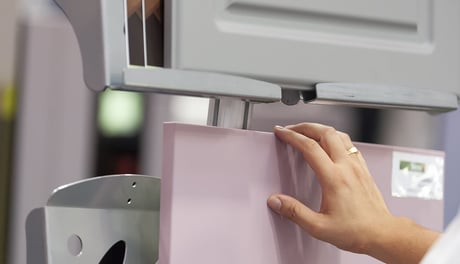
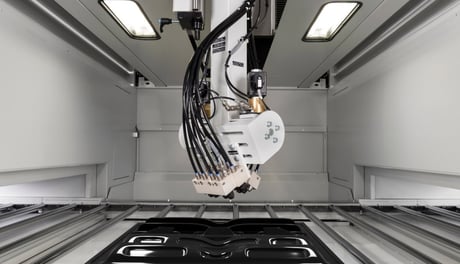
Automated solutions for panel loading reduce manual operations right from the start. Subsequently the panels are brushed on Smartclean to obtain a smooth surface. Applying glue to flat surfaces can be done using a Mito. This is a great way to move from manual activity to an automated solution. To maximise productivity and also apply the glue to edges without soiling the reverse side of the panel, we advise iBotic, our 5-axis application robot. Benefits include excellent application consistency, repeatability, operator health as well as all-round precision. The water content needs to evaporate from the glue and after using a Mito just for the flat surface, we would advise Aquadry, whereas Pieffe will be a better solution ensuring superior productivity if application to surface and edges was performed on an iBotic.

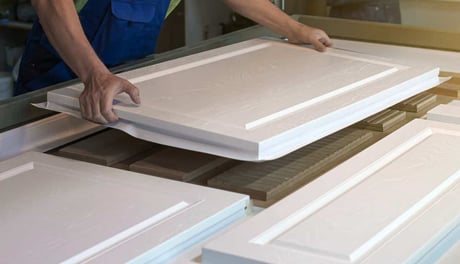
The PVC foil is then applied on a press (third party equipment). The last two stages involve trimming the excess foil, shredding it and disposing of it. We have a solution for both: Tarcut ensures greater efficiency and precision, especially when fitted with a 3D camera, while Twister takes care of shredding scrap foil and disposing of it, so it can be recycled.

Each customer will require the appropriate configuration, incorporating one or more of these machines in an integrated solution, able to feed any number of presses.

Contact us and discuss your needs with a finishing expert.

Application of PVC foils is one technique that necessitates the use of glue, and glue is by no means the easiest substance to handle. Uniformity of ...

Article

How satisfied are you with the way your operators are trained on new machinery?

How satisfied are you with the way your operators are trained on new machinery?

Good question. And the answer usually points to not enough time, not everyone got trained and we had to do it while the machine was being installed, which meant it was not complete or was not fully functional.

Simulator Cefla Finishing

Good question. And the answer usually points to not enough time, not everyone got trained and we had to do it while the machine was being installed, which meant it was not complete or was not fully functional. How satisfactory is this? Not enough. So paying for a technician to come out and train staff after installation is one way of improving training. Alternatively you could exploit your fully-trained operators to pass on their skills to less competent staff, but will they pass on all the information required? And how will you know what aspects are covered correctly? Neither of these options are ideal and the second option may lead to unnecessary downtime if training has not dealt with all aspects.

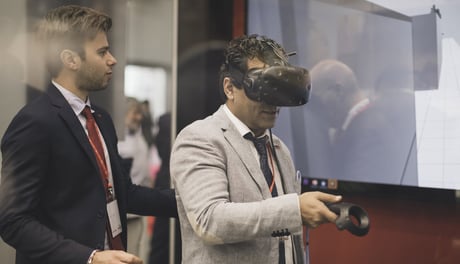
Why not exploit the advantages of Virtual Reality to train staff whenever you need to?
This is an even better question and the answer is: why not? Our cCloner simulation software combined with a VR visor allows you to undergo preliminary training in Cefla long before the equipment is installed, acquiring the primary skills to operate confidently. Together with machine-side training sessions, which remain a fundamental requirement, this means your staff will be ready to operate the machine correctly the day it is installed. A third step of training can be accomplished once the line is functioning, again using the opportunities provided by Virtual Reality. The benefit is that operators can train as required without interrupting production.

Learn more about our digital tools and software solutions.

Good question. And the answer usually points to not enough time, not everyone got trained and we had to do it while the machine was being installed, ...

Article

Digital printing FAQ

Digital printing FAQ

FAQ Industrial digital printing

Can I decide exactly what design I want? How can I effectively measure the quality of the print? Can I print on edges or profiles?

These are just some of the most frequently asked questions our customers pose when it comes to industrial digital printing in the field of surface enhancement.
More and more, this key technology is an opportunity to be considered for integration into your finishing process.

Yes, but how?

Our industrial digital printing specialists help us to find the best answer. So let's start with the first question:

Which substrates can I print on?

Many! Each requiring its own specific pre-treatment, curing level, finishing etc.
Examples: MDF and other wood derivatives – fibre cement – PVC – SPC – WPC – ABS – PS – Aluminium and other metals – glass – leather.

Thanks to Silver Santandrea - Product Manager


Silver Santandrea

Product Manager | Digital Printing Technologies

Product development, technologies and machines for digital printing

https://www.linkedin.com/in/silver-santandrea/

Can I decide exactly what design I want? How can I effectively measure the quality of the print? Can I print on edges or profiles? These are just ...

Article

Flooring? Enjoy a relaxing perspective


Explore the potential

The complete J-Print range of Cefla Finishing industrial digital printers integrate seamlessly into complete printing and texturing lines for flooring, performing the entire process, from raw material preparation to the finished product.Expert process guidance together with the appropriate inks and correct techniques will respond to demands relating to durability, depth, naturalness and definition of the textured effect.
Reproducing wood grain designs with a tactile effect is also simple to achieve with the latest digital printing solutions. A high-resolution surface texturing technique provides a realistic 3D surface finish (digilogico technology by ZEETREE).

When the going gets tough

Foot traffic resistance is a critical factor due to surface deterioration, especially in areas with a constant flow of people. As far as durability is concerned, Cefla Finishing has accomplished the required tests reaching AC4 and AC5 standards for digitally printed laminates.
Ink type also determines surface resistance over time. Outdoor applications will need to resist UV weathering. We will recommend the best inorganic inks with metal oxide pigments, that are hardly affected by light for up to 15 years. In the case of decking, they also reduce the need for a special UV-filtering top-coat.

Learn more about our Industrial Digital Printing solutions 

Shaping the future of finishing

Cefla Finishing LAB is a concept we have converted into a strategy, a facility where we test entire processes and share our expertise with customers and leading industry players.
The LAB houses several machines available for our customers to run trials using their own lacquers, inks or products.
Each process is examined within the context of an integrated line, identifying ways to improve performance and achieve the best results. The LAB is where we stretch the limits of technology to bring the market new, unique opportunities.

Want to see for yourself? Arrange a visit to the LAB

Explore the potential The complete J-Print range of Cefla Finishing industrial digital printers integrate seamlessly into complete printing and ...

Article

Flatbed Coating Lines for Automotive Components: Advantages and Technologies

Today, flatbed coating lines can play a fundamental role for companies in the automotive sector. The thought goes primarily to those players who, in an aim to strengthen their positioning in the sustainable mobility market, focus on manufacturing vehicles mainly made from lightweight and easily recyclable materials. To be precise, we are talking about plastic, particularly for the production of interiors that must be functional, resistant and aesthetically satisfying.

Finishing and decoration processes for plastic components therefore become an integral part of a value chain that aims to combine perceived quality, performance and low environmental impact. And this is exactly where flatbed solutions come into play.

What flatbed coating lines are

Let us start by defining this approach to finishing. A flatbed line, as the name suggests, is based on an architecture that features a flat and stable surface for material processing.

Generally, the solution consists of one or more in-line conveyors where the products are placed to undergo various operations required for their coating. Positioning the parts flat—usually fixed onto support frames—allows uniform treatment across all parts, with higher productivity compared to traditional solutions.

This principle has made flatbed lines essential tools in finishing processes that aim to optimise material handling and coating operations. This facilitates quality control, improves overall production efficiency and reduces waste.

THE MOST INNOVATIVE FINISHING SOLUTIONS

Discover new finishing solutions: more effective, more productive and more competitive than those currently used by the industry.

The benefits of flatbed coating lines in the automotive sector

This is why, in the automotive sector, adopting a flatbed line can offer several advantages over more traditional coating solutions. The main benefits are:

Efficiency and speed.
Flatbed lines are designed for continuous operation, enabling faster processing times. Thanks to their greater width, they can handle more pieces simultaneously, significantly reducing production times compared to traditional methods.

Repeatability and quality.
Automatic flat coating systems guarantee uniform coverage and consistent quality on all parts. This reduces the variability typical of manual coating, leading to superior finishes and fewer defects.

Optimisation of process stages.
Cefla flatbed lines have independent conveyors, allowing different advancement speeds in the various stages of the process. This means that loading, cleaning, coating, flash-off, drying, unloading and quality control times can be adjusted according to the specific requirements of each stage, independently of one another.

Cost control.
Although the initial investment in a flatbed line may be higher, long-term savings are substantial. Reduced labour costs, lower material waste, reduced energy consumption and increased productivity generate an extremely rapid ROI.

Versatility.
Flatbed lines can process a wide range of substrates, sizes and shapes. This flexibility enables manufacturers to work with different types of products without having to modify coating programmes, making it easier to respond to changing market demands.

Improved environmental control.
Modern flatbed systems include features that control overspray and manage VOC emissions more effectively than traditional methods thanks to lower and optimised airflow rates.

Monitoring and data collection functions.
Advanced flatbed systems can be equipped with integrated monitoring and data collection capabilities, allowing manufacturers to assess performance, optimise processes and take data-driven decisions for continuous improvement, as well as enabling traceability by matching process data with the parts produced.

Flatbed lines vs. traditional coating systems

But when is it really advisable to use these solutions?

If vertical spray coating lines are more suitable for handling larger components (such as bumpers), smaller parts—such as those used in car interiors, generally made of plastic—have different requirements.

Flatbed lines, besides ensuring better productivity, deliver better quality because overspray—typically responsible for defects in this type of processing—is removed from below.

In particular, the Cefla Finishing flatbed finishing solution not only offers 20% higher productivity compared to traditional systems but also delivers excellent glossy black (piano black) finishes on plastic components.

Cefla’s approach: integrated lines for a fully automated coating process

There is another element to consider. Today, the needs of entrepreneurs and plant managers receiving orders from the automotive world increasingly move towards complete solutions, including:

  • equipment for automatic part cleaning, increasingly using dry ice with no environmental impact
  • spraying robots with reduced—or zero—programming requirements
  • large ovens and UV lamp systems for in-line drying

The flatbed approach fits perfectly with this philosophy.

At Cefla Finishing, we specialise in designing flexible, complete and turnkey finishing solutions. A Cefla flatbed coating line for piano black interior parts includes the following stages:

  • Surface preparation:
    Automatic cleaning with dry ice and deionisation with the Mito oscillating spray coater
  • First coating application:
    The components pass through a 2D or 3D reading barrier into the iBotic cartesian spraying robot for the application of the basecoat. 
  • First drying
    the coated components move into the Omnidry vertical oven for 20-30 minutes. 
  • Second coating application:
    A new clearcoat layer is applied, again by the iBotic cartesian spraying robot.
  • Final drying:
    Passage through the Omnidry oven for 45 minutes at 70°C, and optional double curing using ultraviolet lamps in the UV oven (UV-R M2)to increase surface hardness.

Automation in coating lines: from robots to monitoring software

There are also components that require different processes. How can these be managed automatically and intelligently within a flatbed line? The answer comes from Cartesian robots and, above all, from line software such as cTracker.

This tool monitors the line and automatically regulates coating operations and process parameters, such as the correct temperatures for subsequent drying. In this way, each component can receive the most suitable treatment without slowing down or stopping production.

But this is not the only advantage. Thanks to cTracker, it is also possible to monitor the pieces on the line, record data and analyse productivity. These features allow production changes to be implemented without emptying the line, managing and tracing each part frame from a single point and adjusting all machines according to preset recipes or real-time needs.

In conclusion

In the automotive sector, the needs for innovation and sustainability find a response in flatbed coating lines, which stand out for quality and efficiency in producing plastic components for car interiors.

Adopting integrated flatbed lines is, in short, a strategic choice for companies aiming to position themselves at the forefront of the market, combining superior production performance with impeccable quality results.

Want to switch to a flexible, efficient and premium-quality coating system? Contact us—our experts are at your disposal for a professional consultation.


Today, flatbed coating lines can play a fundamental role for companies in the automotive sector. The thought goes primarily to those players who, in ...

Article

What does profile-wrapping mean?

What does profile-wrapping mean?

Covering profiles meaning

What does profile-wrapping mean?

​Profile wrapping is a process by which a decorative surface is laminated onto a substrate in linear form.
This is done by means of a profile-wrapping machine.

Why was the process invented?

Several decades before a decorative surface was manually laminated, mainly wood veneer, onto a substrate. The increasing demand for furniture at the beginning of the 60s was the reason profile-wrapping machines were developed. Beyond that the pressure at costs and prices as well as the requirements of the customers regarding the surface design played a substantial role. One of the first such machines was built by Mr. Reinhard Düspohl.


Want to know more about wrapping process?

Andreas Jäger
Sales Director Düspohl Maschinenbau GmbH
LinkedIn profile


What does profile-wrapping mean? Profile wrapping is a process by which a decorative surface is laminated onto a substrate in linear form. This is ...

Load more articles

Articles: 90 / 157