Article

Going from manual to automated spray coating…

Going from manual to automated spray coating…

iGiottoApp X2

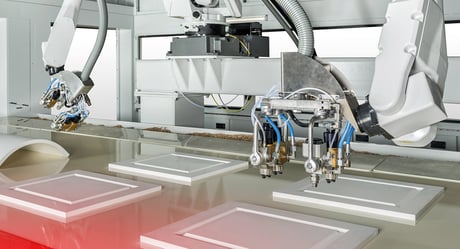
…is like the first time you used a dishwasher. Maybe not exactly, but think of it this way: put the dishes in, add the detergent, switch on and relax. You soon forget about piles of dirty dishes, running water, drying racks, soggy sponges, towels and wet hands.

Automated spray-coating equipment is efficient, consumes less lacquer and ensures consistent quality. The result you achieve first thing in the morning is the same as the quality obtained after 8 hours spent spraying panels. Because automated spray-coating machines don’t get tired or stop for coffee.

At Cefla Live we showcase a selection of automated spray-coating solutions all running to demonstrate the benefits of an affordable investment. Prima represents an upgrade which brings immediate savings in lacquer consumption. Perfect for businesses moving from manual to automatic spraying, this one-arm reciprocating spray machine will solve just-in-time requests and ensure fast returns on investment. Together with our partner IVM Chemicals srl, we will be coating panels which then run through our new excimer oven, Exydry-Z, to achieve a deep matt, fingerprint-proof, soft-touch finish.

Other spray-coating machines on show during the event include: Mito, entrusted to our partner ICRO COATINGS S.p.A. for live demos, Easy with Cefla Finishing partner Sirca S.p.A. and iBotic which will be in action using Sayerlack and Oece lacquers.

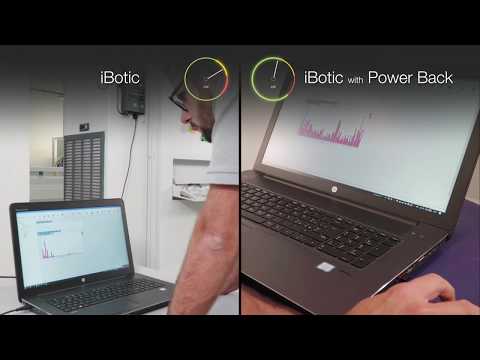
Featured on iBotic, participants will witness the new energy-saving system PowerBack, which retrieves energy from the machine’s decelerating spray arms in order to help power the outlet fan, saving at least 10% on energy costs compared to the iBotic without PowerBack.

More savings through our patented spray cleaning technology

Working with a sprayer or a robot with a belt for paint recovery means cleaning the belt regularly and the more paint you recover, the less you spend. If your spray cleaning system is conventional, you will not only throw away a lot of paint, but you will also use a significant amount of detergent. Conventional systems also lead to rapid belt deterioration, either through the abrasion from belt cleaner blades or aggressive solvents.

A system ensuring maximum cleaning potential recovers more paint and enables you to use less detergent during running time. Less detergent means lower operating costs, it safeguards your equipment and ensures a healthier environment. Our patented spray cleaning system ensures greater paint recovery, lower detergent consumption, fewer stoppages to replace belts, shorter cleaning times and, above all, enhanced production efficiency.

…is like the first time you used a dishwasher. Maybe not exactly, but think of it this way: put the dishes in, add the detergent, switch on and ...

Article

Digital printing and the advantages for business in manufacturing sectors

How many times have you had to say ‘no’ to a customer because they requested a unique finish, perhaps in just a few hours, or wanted a highly customised texture? How many times was that customer you?

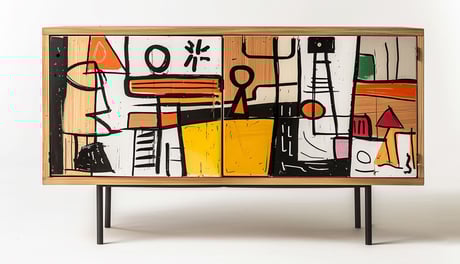
Industrial digital printing is very much the technology of the moment for the manufacturing sector. All over the world, in a wide range of industries, businesses have discovered its massive potential. Wood, plastic, packaging, metal, ceramic, fibre cement: digital printing can be used with a host of materials, giving them previously unthinkable levels of flexibility and customisation. Keep reading to find out all the advantages of digital printing.

The digital printing revolution

Something has changed in the finishing industry. Until recently, customising the finish, meeting specific requests and producing very small batches was a nuisance that meant worrying costs, risky downtime, low quality and, ultimately, a loss of money.
DigitalPrintAdvantages-1

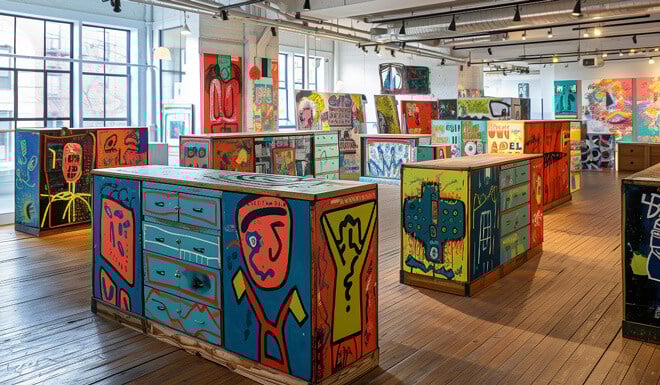
Now, though, creating small personalised batches is an opportunity. Innovative digital printing generates immediate earnings on the individual orders the technique now makes feasible and, in the long term, leads to a remarkable increase in business. The ability to penetrate new markets and expand a business while keeping production costs competitive is driving more and more companies to embrace the ‘digital printing revolution’ and rethink their range of products and services. 

At present, coating and finishing are trending towards the innovative mixing and matching of materials: customers are demanding flexibility so they can respond quickly to changes in such trends. Businesses that equip themselves with the technology capable of meeting these needs soon gain a predominant market position.

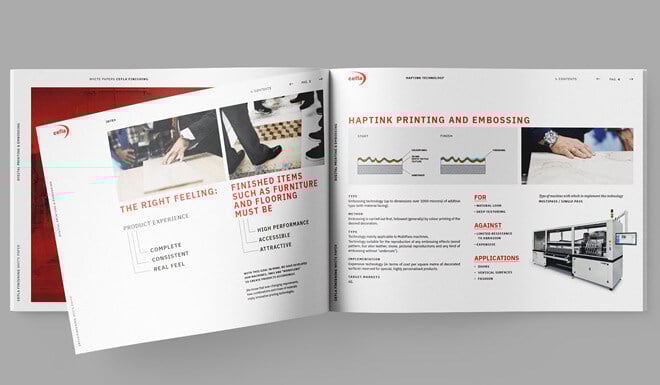
Learn about the most innovative relief printing technologies: applications, pros and cons and much more.

Download the white paper
DigitalPrintAdvantages-2

What is digital printing and how does it work?

Digital printing - based on modules with 4 to 6 colours and fully digital data - is an easy-to-control technique that delivers repeatable quality and results over time. It involves just a few simple steps. We begin with a model of the colour or aesthetic rendering we wish to reproduce. There are two possibilities:

  1. Create an initial graphics file (this might be a photo, a pattern, a specific colour code or any other image) 
  2. Scan a pattern to be replicated via printing. You can scan any pattern, natural or otherwise. What’s incredible is that the scanners we use faithfully replicate not just the image but also the texture of the initial sample!
DigitalPrintAdvantages-4

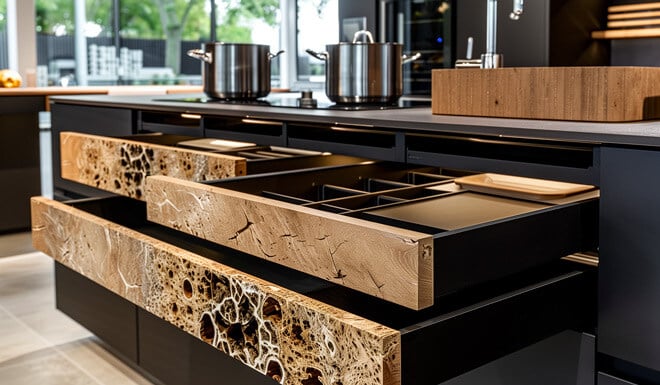
Once you’ve defined the effect to be reproduced, the innovative Cefla-developed digital printing solutions come into play. Small or large print runs of the selected image or pattern are possible, in large or small formats, on large or small surfaces, faithfully reproducing visual appearance and tactile effects. 

Finishes can be completed with texturing techniques to give surfaces the desired ‘feel’. For example, the J-PRINT-TD industrial printer uses digilogic texturing technology by Zee Tree to produce realistic 3D surface finishes at a resolution of 400 dpi. Thanks to roll-to-roll techniques, digital printing of ‘haptic’ relief effects is also being extended to applications on floors and edges. 

Lastly, it’s worth pointing out that finishes obtained with digital printing can, depending on the selected drying system, be either gloss or matt. All this can be achieved with enormous flexibility and, above all, while keeping costs competitive.

Digital printing and the economic advantages 

How much does digital print finishing cost? To give an idea of how much a process cycle might cost, bear in mind that cycles require no ‘wearing layers’: for example, to produce vertical surfaces, furniture and doors, the cost of the process is approximately €1.2 - 1.5/m2. Vice-versa, for cycles that do require wearing layers (essentially floors), one should add a further €1 - 1.5/m2. The exact additional cost will depend on the desired abrasion resistance class (AC3, AC4, AC5), the standards with which the products must comply (EN15468 or EN13329) and the desired texturing depth.

The advantages of digital printing for every industry

A finishing line that uses digital printing can be configured to match the industry and the application material, ensuring it responds to specific needs. However, regardless of the industry, regardless of whether a company processes metal, plastic, wood, ceramic, cardboard or even fibre cement, digital printing will always yield some key advantages

Whatever the field of application, new industrial digital printing technologies let you:

  1. Combine high productivity with the ultra-customisation required by the market.
  2. Reduce response times to changing aesthetic trends and fashions
  3. Create aesthetically appealing, economically sustainable products with outstanding durability (i.e. for both interiors and exteriors).
  4. Make realistic, precision high-volume reproductions of natural patterns (such as wood) with extremely hard-wearing surfaces, all at contained cost.

Summing up, digital printing technology is an increasingly essential business-booster in multiple manufacturing sectors. Compared to other techniques, the advantages of digital printing are evident: opportunities that stem from being able to keep pace with trends, huge scope for customisation, low costs and excellent production flexibility.

Can you imagine the benefits this technology might have in your business?

Talk to one of our experts and learn more about the potential of digital printing in your business.

Cefla Finishing Industrial Digital Printing


How many times have you had to say ‘no’ to a customer because they requested a unique finish, perhaps in just a few hours, or wanted a highly ...

Article

Which is faster: a roller coater or a roller coaster?

Which is faster: a roller coater or a roller coaster?

Quality of roller coating

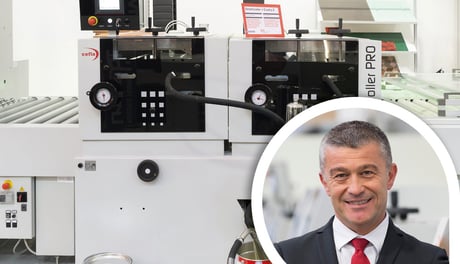
Which is faster: a roller coater or a roller coaster? The fastest roller coaster in the world travels at 240 km/h. which is nothing compared to the majority of our roller coating solutions.

Moreover, we are also able to ensure the same quality finish as you would expect from a spray coater or curtain coater with the Laser Roller. Firstly, the Laser Roller does not need to reach a height of 52 metres above ground level before accelerating and it does not need to stop and restart every few minutes. As an end-of-line machine, it applies large quantities of lacquer making it suitable for surfaces requiring top-quality finishes.

Just a few of the machine’s characteristics:
✓ application volume in a single pass up to 45 g/sqm
✓ application quality without defects thanks to laser-engraved roller and pressure applied by the new PRO series machines
✓ machine speed up to 60 metres/minute


Roberto Sorbini

Business Line Manager | Roller Coating Technologies

Product development, technologies and machines for roller coating

https://www.linkedin.com/in/roberto-sorbini-94663a13/

Which is faster: a roller coater or a roller coaster? The fastest roller coaster in the world travels at 240 km/h. which is nothing compared to the ...

Article

So many ways to cook an egg and a few good ways to coat a cooking pan

So many ways to cook an egg and a few good ways to coat a cooking pan

Pans roller coating

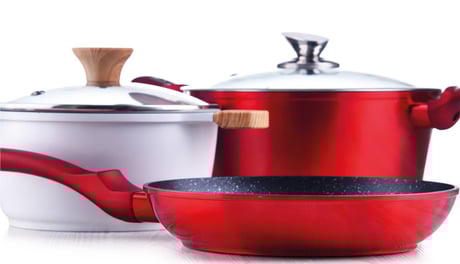
One of the requirements we often deal with is the coating of cooking utensils, especially those pots and pans requiring non-stick surface treatments. This is a process we have looked at and one way to structure it is as follows, even though each customer may have specific needs. In that case, our 360° knowledge of surface enhancement technologies allows us to customise a line or a single piece of equipment to account for customer-specific parameters or objectives. Let’s imagine an integrated line offering high volumes of Teflon coating and water or solvent-based coatings.

Normally we would advise a U-shaped layout, the first linear section dedicated to Teflon coating performed on 5 in-line roller coaters such as Smartcoater Pro and relevant ovens, either hot air or using IR lamps.  Each Smartcoater Pro on the outward run will handle a coating (Teflon) volume of 10 g/sqm. After the U-turn, a battery of 5 more such roller coaters can be used to apply a further 10 g/sqm of water or solvent-based coating to the product (still in its flat panel form) followed by the relevant number of ovens. The coated panels would then exit the line via an oven running at 500°C.

Producers of cooking utensils will all have a specific distinctive need. Our process experts will therefore examine the requirement and advise on how to generate efficiency by implementing cost-saving strategies as well as suggesting tailored solutions to reach quality objectives or increased productivity.

Contact us and discuss your needs with a finishing expert.

One of the requirements we often deal with is the coating of cooking utensils, especially those pots and pans requiring non-stick surface treatments. ...

Article

Excimer matting technology. The key number is 3

Excimer matting technology. The key number is 3

Drying excimer technology

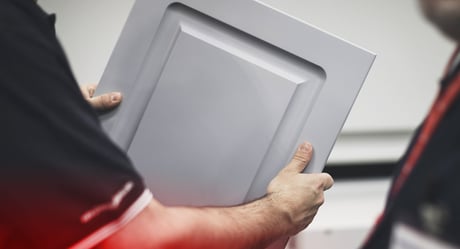
3 axes: X, Y and Z.  3D objects including raised panels.  3 patent pending technologies.  Once upon a time excimer matting technology was restricted to flat panels, a simple X and Y axis process achieving a resistant matt finish with a soft touch effect. Just a single flat surface. Cefla Finishing knew the market was ready to go a step further, by improving the technology, but also by adding the third dimension, or if you prefer, the Z axis.

Today’s Exydry-Z oven, featuring non-stop processing, implements a superior level of excimer matting and is able to handle raised panels and all panel edges. This latest-generation oven delivers deep matt surfaces that are totally fingerprint-proof, wonderfully soft to the touch and which boast an exceptional surface resistance. Thanks to our technology, much less nitrogen is needed for the oven, making the process more sustainable and economically convenient.

Tomorrow Cefla envisages Exydry-Z ovens with an increased capacity in terms of panel size and thickness. There is also a strong probability special lacquers for excimers, even water-based, will become easier to source than today.

Contact us and discuss your needs with a finishing expert.

3 axes: X, Y and Z. 3D objects including raised panels. 3 patent pending technologies. Once upon a time excimer matting technology was restricted to ...

Article

What makes industrial digital printing a viable solution for flooring?

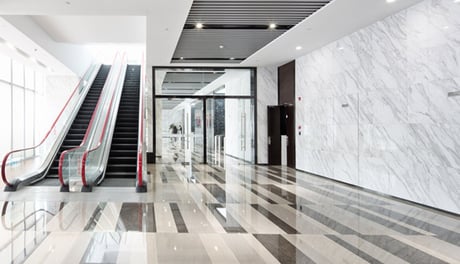
Flooring is one of the most demanding applications in terms of surface enhancement. Industrial digital printing technologies address issues such as quality, customisation and resistance to foot traffic in a highly satisfactory manner. In particular, close attention needs to be paid to the third issue, which is regulated by European standards, as well as international standards.
Recap of the process
Industrial digital printing as a solution for flooring involves a fairly articulated process. These are the steps that need to be considered:
• Sealing (in the case of MDF) or Adhesion Promoting (for plastic substrates)
• White layers
• Digital Printing
• Wearing layer
• Textured layer
• Finishing layer

Innate flexibility and a time-saver
One key advantage of this technology is the outstanding flexibility you benefit from in relation to changes in market trends and fashions. Even when running small batches that demand frequent set-up operations, time is saved thanks to fast line set-up, plus minimal stock of semi-finished goods.

Durability as a determining factor
Foot traffic resistance is one of the critical factors due to surface deterioration, especially in areas such as hotel foyers, corridors, offices, showrooms, schools and retail environments where there is a constant flow of people. Flooring durability is these cases is regulated by the EN 15468 and EN 13329 standards governing laminate floor coverings. In each case, Cefla Finishing has accomplished the required tests reaching AC4 and AC5 (Abrasion Criteria) standards for its digitally printed laminates.

Ink type determines the aesthetic qualities of a floor covering, sometimes also with regards to resistance over time. Flooring is mainly a market of products for interior use; there is nonetheless a specific kind of flooring especially for exterior use: decking. Whereas organic pigmented inks tend to fade, in the outside, in the first 2 years of exposure to natural lighting if no special UV-protection coatings are applied on top of the decoration layer, inorganic inks are also available with pigments made out of metal oxides, that are hardly affected by light for between 10 and 15 years. While organic pigmented inks, with their superior colour gamut (colour range), are perfect for interior use, as well as some exterior use when properly protected against UV weathering, the inorganic pigmented inks are an interesting choice for exterior use, as in the case of decking, reducing the need for a special UV-filtering top-coat.

J-Print industrial digital printers

The complete J-Print range of Cefla Finishing industrial digital printing integrate seamlessly into complete printing and texturing lines performing the entire process, from raw material preparation to the finished product. Expert process guidance together with the appropriate inks and correct techniques will respond to demands relating to durability, depth, naturalness and definition of the textured effect.

Reproducing wood grain designs with a tactile effect is also simple to achieve with the latest digital printing solutions. A high-resolution surface texturing technique provides a realistic 3D surface finish.

Want to know how quickly in the specific case of your company? Contact a Cefla expert and visit the Cefla Finishing Lab to experience, first-hand, all the solutions and technologies that help reduce energy consumption in your finishing processes.

Learn more about our Industrial Digital Printing solutions

Flooring is one of the most demanding applications in terms of surface enhancement. Industrial digital printing technologies address issues such as ...

Load more articles

Articles: 84 / 160