Article

iGiotto: overhead coating lines with high-performance anthropomorphic robots


Not all coating robots are the same. Achieving uniform, high-quality results while maximising productivity and minimising downtime means implementing overhead lines equipped with high-performance anthropomorphic robotic systems.

Oscillating spray coaters are not always capable of properly finishing complex three-dimensional objects, despite their high efficiency rates. In these cases, the solution offered by an overhead line equipped with an anthropomorphic robot makes it possible to achieve high performance, excellent quality, and a wide range of options and customisations.

The advantages of automatic coating plants

Let’s start with the most obvious considerations, derived from comparing automatic coating plants with traditional coating processes.

Operators are well aware that a manual approach does not allow full control over the paint application process and production capacity. Above all, for a number of reasons largely linked to the human factor, this philosophy does not guarantee consistent quality.

Using a coating robot for window frames, doors or complex three-dimensional objects instead allows you to promptly meet the four main needs of those who own and manage a finishing plant:

  • Save time when switching from one operation to another
  • Improve coating quality, even along complex trajectories
  • Reduce material and energy consumption
  • Increase productivity

An anthropomorphic coating robot does not completely replace human activity. In the coating process of windows, doors and three-dimensional objects such as disassembled chairs or musical instruments, for example, the coating robot still requires an operator to manage and monitor the various stages of the process. Moreover, the heaviest and most repetitive work is entirely handled by the machines.

Thanks to software developed by Cefla, the machine performs (automatically and repeatedly, based on the programme launched) all trajectories required to carry out coating operations with extreme precision. This, essentially, is what makes it possible to reduce manual activities that limit production efficiency.

In other words, a high-performance anthropomorphic coating robot eliminates at the root problems related to time loss, paint waste, and inconsistent quality and productivity levels. And by optimising process flows, it also helps to reduce energy consumption.

THE MOST INNOVATIVE FINISHING SOLUTIONS
Discover the most advanced finishing solutions to enhance your competitiveness.

Robotic systems for automatic finishing: advantages and technologies

Robotic systems therefore represent a fundamental evolution in finishing processes. They can guarantee precision, uniformity and repeatability in complex applications, in different use cases and regardless of the size of the plants in which they operate.

Based on digital technologies, standard components and integrated, modular solutions, robotic coating lines are also distinguished by another great advantage: they can be designed, installed and modified with a modular and flexible approach. This allows production schemes to be optimised dynamically, meeting the personalisation needs of both large and small customers.

Automatic coating plants: customised solutions for every requirement

Naturally, when we talk about customisation, we do not refer only to customers’ preferences. Manufacturers themselves increasingly need automatic systems capable of adapting to new use cases and to the constant drive for innovation, which today mainly focuses on efficiency and sustainability.

In this regard, overhead coating lines equipped with anthropomorphic robots are the ideal choice for building multifunctional systems that can be quickly reconfigured to seize new business opportunities or enter high-potential niche markets. The ability to differentiate one’s offering is indeed becoming a critical success factor in an increasingly challenging competitive environment. 

iGiotto: the highest coating quality without manual programming

Let us now go into greater detail and highlight how anthropomorphic coating robots differ from traditional automation solutions.

Automatic coating plants generally require manual programming. In the presence of complex geometric shapes, the machine must be manually programmed to ensure that its spraying axes move correctly around the workpieces. This means that the coating robot – which “learns” to move by replicating the gestures (and related inaccuracies) dictated by manual programming piece by piece – cannot always achieve the optimal result.

There are also automatic coating plants that allow point-to-point programming via dedicated software. This helps reduce the margin of error but still requires skilled users to handle robot programming. Yet we are still far from the optimum when it comes to guaranteeing quality finishes on complex 3D objects.

Therefore, if the goal is to combine high repeatability, low paint consumption and reduced application times without ever compromising on a flawless result, a self-generating anthropomorphic coating robot represents a strategic choice. Furthermore, it allows the carbon footprint to be reduced through lower energy consumption and the use of eco-friendly materials.

Industrial coating plants: energy saving and productivity

Investing in a next-generation robotic plant guarantees immediate and incremental advantages compared to the use of more traditional techniques (even automated ones), and certainly in comparison with manual spray coating of complex 3D objects or frames. Consider the following aspects regarding programming, precision and flexibility.

  1. PROGRAMMING. Some automation solutions allow the robot to be programmed manually, physically guiding the spray arms around the complex geometric shape. In this way, the machine learns to move and replicates the movements piece by piece. It is also possible to program point-to-point trajectories using offline software, but for each batch it will be necessary to manually enter the data into the software to obtain the required parameters.
  2. PRECISION. In addition to the cost of a specialised operator, the manual spraying of window frames often produces fluctuating performance and uneven paint thickness. Paint consumption frequently exceeds the optimal quantity by 15–30%, leading to frequent filter replacements and high disposal costs.
  3. FLEXIBILITY. Production batches are often small in size or require significant customisation. Operators must therefore stop the line for colour changes or to reprogram the trajectories. All this negatively affects production efficiency and causes costly downtime.

Anthropomorphic coating robot and cVision 3D reading barrier: the winning combination

Overcoming these limits means adopting a solution such as iGiotto by Cefla Finishing. But what exactly is iGiotto? How does it work?

We are talking about an automatic spray coating plant for water-based and solvent-based products — a true ecosystem built around an anthropomorphic coating robot designed to process both large wooden objects, such as doors and frames, and complex-shaped workpieces made from materials other than wood.

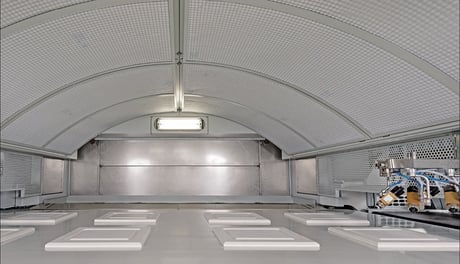
The products travel along the overhead lines, exiting the spraying area to enter a drying tunnel before being divided into batches. The constant speed and distance between the guns and the product optimise paint consumption and guarantee uniform coating.

From an environmental point of view, this translates into a significant improvement in sustainability KPIs, with reduced consumption and less waste.

This is also thanks to the integration with cVision, the 3D reading barrier (also developed by Cefla Finishing), capable of automatically generating trajectories for complex shapes. The combination of iGiotto and cVision enables a fully automated coating process even in the presence of objects with complex geometries. It improves finishing quality and consistency, reduces consumable material usage, and increases overall plant efficiency.

In particular, thanks to a next-generation scanning system, cVision can acquire the positions, dimensions and shapes of items in transit with unprecedented precision. The software then processes the 3D image of the workpiece to be coated and determines the best trajectories.

The combined action of this ultra-high-resolution reading system allows iGiotto to automatically generate precise working programmes based on the “families” of objects organised in its database. cVision therefore eliminates the need to manually set up an anthropomorphic coating robot. There is no longer any need to define trajectories by hand, as everything is automated. This results in considerable time savings (at least 50%) and ensures optimal parameters and consistent coating quality from the first to the last piece.

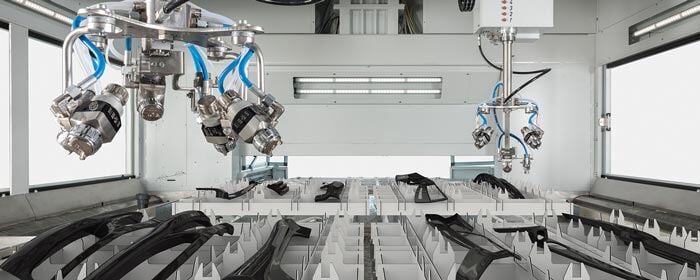
The iGiotto coating robot, for its part, takes advantage of the accuracy of predefined trajectories to optimise spraying using a dual-gun wrist. This provides significant paint savings while guaranteeing the best possible quality and consistency. Colour changes also take place without ever stopping the equipment, even when switching between different products, thereby eliminating downtime. Finally, when new workpieces enter the overhead line, the software ensures that iGiotto can move from one item to another and from one colour to another without interrupting production.

Optimising door coating with a three-gun wrist

The use of a three-gun wrist (optional) is a recently introduced approach and is proving particularly effective in door coating operations. The system improves production efficiency compared to the traditional two-gun wrist: for spraying the front side of the door, only a single pass is required. This avoids crossover trajectories, enabling lines equipped with anthropomorphic robots such as iGiotto to save approximately 40% in processing time.

Low-consumption coating lines: a sustainable future

Modern coating lines are revolutionising the production process through the integration of advanced technologies that significantly reduce paint waste and energy consumption.

Thanks to the use of automated systems and real-time trajectory monitoring, as we have seen, these lines optimise paint application, ensuring precise colour mixing and minimal overspray.

However, even more can be done to further reduce the environmental impact of coating lines equipped with anthropomorphic robots. Closed-cycle systems, for example, reuse excess paint, while intelligent sensors adjust energy output based on actual production requirements, avoiding unnecessary power consumption.

Moreover, the use of water-based formulations and coatings with low volatile organic compound (VOC) content not only enhances environmental safety but also helps to reduce energy requirements during drying and curing processes.

Adopted within an integrated approach, all these solutions help to reduce the impact of finishing operations and represent a significant step towards ever-greater sustainability in the coating sector. With its innovations, Cefla Finishing stands alongside companies seeking to lead this transformation.

LOOKING FOR THE IDEAL SOLUTION FOR YOUR COATING LINE?

Not all coating robots are the same. Achieving uniform, high-quality results while maximising productivity and minimising downtime means implementing ...

Article

Spray coating seen from 3 points of view


One of the most common surface enhancement techniques used in different industries is spray coating. There are a number of ways you can coat a surface using sprayed varnish and each is suited to specific needs. But before looking at the details of the spray-coating process, let’s take a look at the 3 categories that will focus their attention on spray coating as a widespread finishing technique.

Spray coating for small to medium-sized businesses

First of all, small to medium-sized businesses who manufacture items in wood or derivatives of wood. This may include kitchen furniture, doors, chairs and general furniture components. Until now, they probably relied on third-party companies to complete the finishing procedure of their semi-finished products, but today they are planning to handle this process internally. Turning away from outsourcing, they will need to turn to spray-coating experts for some fundamental advice and guidance.

Some of these smaller outfits will possibly have experience in manual spraying, but are looking to improve quality, efficiency and productivity with a first step into the world of automatic spray coating.

WhitePaper

Why switch from manual to automatic painting? Download the WhitePaper!

Why switch from manual to automatic painting

Spray coating for a third-part company

Second on our list of three, you will find the company which just performs spray coating, the third-party company our first category was outsourcing to. They have a broad experience and in a fast-moving market need to grab business opportunities, especially if competition is alive and kicking. They may handle countless different products, so we may be addressing the need to look at different spray-coating techniques and certainly they have experience and in-depth knowledge of spray coating technologies. We can help these companies in their quest to become more competitive. They will undoubtedly be looking for solutions enabling cost-savings, greater efficiency and, above all, maximum flexibility. This last aspect is key when you need to switch from one job to another with as little downtime as possible and broadens your business opportunities on the market.

spray coating

WhitePaper

Do you know how much it costs you to work with a paint recovery system?

Download the WhitePaper!

spray cleaning whitepaper

Spray coating for large companies

Our third category is made of large companies which already handle both manufacturing and finishing in an integrated process. Such companies can be market leaders in their sector and rely on consistent production volumes to stay profitable and maintain their market status. With a frequent need to improve productivity, achieving as much uptime as possible with production lines handling large volumes, these companies regularly face the need to invest in new high-performance equipment, exploiting automated systems as much as possible as well as digitalised data to optimise efficiency, plan maintenance and prevent downtimes. This is where our vast experience across many industries will help target an effective solution tailored to each scenario, basing our advice on similar cases and on the dedicated tests we run in our LAB, the world’s largest finishing laboratory at our facilities in Italy.

One of the most common surface enhancement techniques used in different industries is spray coating. There are a number of ways you can coat a ...

Article

2 technologies to suit your roll to roll processing requirements

High volumes, multiple shifts, mass production and a limited variety of finishing patterns represent one scenario related to edge processing on roll to roll equipment. Small volumes, tiny batches, customisation and an unlimited choice of finishing patterns are at the opposite end of the scale. Catering for both customer types means mastering two different technologies.

On one hand, roller coating equipment enables high volumes, non-stop production and minimises linear or square metre costs. On the other hand, a single-pass digital printer allows for maximum customisation, enhanced flexibility, fast time-to-market and superb quality.

We know your industry and each process requires a dedicated solution

One benefit of entrusting your roll to roll needs to Cefla Finishing is that we have over 60 years’ experience serving the furniture manufacturing industry. This places us in a position to advise on how to manage each process and choose the most appropriate solution.

Whichever technology is best adapted to your needs, there is a turnkey solution which includes lacquers or inks for the start-up phase, all of which have been tried and tested on our machines. Furthermore, our Finishing LAB is open to all customers interested in running tests on their own products to pinpoint any critical issues before production starts.

Check out our LAB - the world’s largest laboratory dedicated to surface enhancement technologies.

The right machine for you

When a customer is running machinery non-stop and processing huge volumes with little variety, our Smartprint roller coater with an engraved application roller will maximise productivity and keep operating costs to a minimum.

  • Smartprint
    Companies looking for flexibility, processing small batches and responding to the demand for customised patterns will find our single-pass industrial digital printer J-Print SP to be the best answer.

  • J-Print SP
    For both scenarios, we also provide equipment for bottom primer application, drying ovens and roller coaters for high-gloss and deep matt finishing. The equipment can be completed with roll winders, unwinders and tensioners, and alignment devices.

Besides the right equipment, we also provide software solutions to allow you to monitor your lacquer ink consumption, helping you achieve savings throughout the process.

What could your line look like?

Cefla Finishing has the broadest range of finishing technologies and machines that have been designed to deal with specific processes such as roll to roll. Imagining your set-up will depend on many factors, all of which we will consider when establishing the best solution to meet your needs.

Contact us for more detailed information or fix an appointment with our specialists to visit our laboratory and run a few tests.

High volumes, multiple shifts, mass production and a limited variety of finishing patterns represent one scenario related to edge processing on roll ...

Article

Decoration and coating of panels and edges: digital printing offers a new alternative

These days, maximising the flexibility of the panel/edge decorating and coating process means making use of digital printing technologies. When properly integrated into coating systems, such solutions don’t just improve the quality of the final products, ensuring a perfect match between surfaces and edges: they also reduce the environmental impact of the process.

First of all, let’s examine the needs of companies that perform panel/edge decoration and coating and explain why digital printing - still, all too often, underestimated by the market - provides an excellent response to those needs.

Why is digital printing useful in a routine panel/edge decorating and coating process?

Most of the companies that finish panel surfaces, especially furniture manufacturers, tend to overlook the opportunities offered by digital printing. Generally speaking, this isn't just due to a certain lack of experience with the technology. There are also historical reasons: over the years, the majority of manufacturers have focused on large output volumes, for which traditional coating techniques have always ensured a good cost/benefit ratio.

On today's market, however, there’s growing demand for customised items, with an ever-increasing number of orders involving small batches and short delivery times.
In this scenario, the ability to match the edge finish with the flat surface finish, in terms of both colour and pattern, offers a crucial competitive advantage. And the technology that lets manufacturers make this developmental leap, instantly and definitively, is none other than digital printing.

kitchen drawer

Flawless and uniform surfaces and edges. Discover the power of digital printing in panel finishing.
Download the white paper.

Benefits of digital printing for finishing panels and edges

But what advantages does switching from traditional techniques to digital printing actually yield when it comes to decorating and coating panels and edges? To begin with, it can be stated that, by starting with a digital image file, it’s now possible to do virtually anything. And, because patterns are developed from a single source, both surface and edge can be finished with practically unlimited flexibility.

But the benefits don’t end here. When properly implemented as part of a coating system, a digital printing solution also lets you:

  • maximise product customisation
  • manage extremely small production batches (<100 m2)
  • deliver products quickly (a few hours or days)
  • reduce inventory requirements
  • minimise warehousing space


Developing a unified procedure from a single digital image

Digital printing allows you to obtain a perfect match between the surface of the panel and the edge, even when the process has several stages and even when it’s managed by two different companies. This is because it’s possible to process a single digital image, which will then be used for both the edge and the surface tasks; where possible, these tasks can also adopt the same inks to maximise uniformity of both surface and edge decoration.

Moreover, these options make it easier to overcome the problem of metamerism (the phenomenon by which different light sources modify, to a greater or lesser extent, the perceived colour of the decorations).

More flexibility means more creativity

Industrial digital printing also ensures outstanding flexibility: integrating it into a finishing line as a complementary technology helps the plant respond to customer requests for small batches with personalised, high-quality decoration.

All said and done, the only limits are those posed by creativity: after sanding and applying the primer, a digital printer can be used to decorate the flat surface with any pattern desired. And after applying a transparent base coat you can, when necessary, create a matt, gloss or, again with a digital printer, textured finish with a ‘haptic’ relief effect (this is discussed in greater detail in the White Paper on Industrial Digital Printing.

Shorter lead times and no minimum quantities

In the edge decoration and coating field, industrial digital printing offers a response to the need to progress from the creative idea to its practical realization in the shortest time possible. It also allows companies to process orders even for just a single panel decoration reel without having to invest in materials (engraved rollers, decorative paper, dedicated inks etc.) as would be the case with traditional techniques.

kitchen top


Comparison between digital printing and traditional decoration and coating techniques

At this point it should be clear why digital printing solutions are - and will increasingly be - valuable allies for manufacturers who have set themselves the dual goal of improving panel decoration/coating processes and expanding the range of products in their catalogue, with increasingly sophisticated customisation options.

Adopting digital printing ensures precision control of colour and details, making it a must-have on projects that require complex patterns and intricate graphics. Furthermore, digital printing lets you maintain the same degree of artistic freedom and creativity as manual decoration techniques while significantly increasing the attainable level of detail, ensuring more precise, homogeneous, consistent finishes on all types of surface. 

surface samples

Another fundamental difference compared to traditional techniques concerns the time, the stock of papers needed to offer a variety of products and the labour costs of perfecting each process. For orders that involve customisation work on small batches, decorating and coating edges and surfaces using traditional methods can require considerable resources, above all in relation to the quantity of finished products leaving the factory. With digital printing, however, manufacturers can optimise the required time, cost and workers’ tasks thanks to the total control provided by user-friendly dashboards. Furthermore, being able to the reduce paper stocks significantly lowers both the cost of purchasing any minimum batches and the need for space inside company facilities.

Last but not least, digital printing tends to be more environment-friendly than traditional edge/panel decorating and coating techniques: latest-generation solutions use fewer resources and minimise waste, making them a decidedly more sustainable option for companies looking to reduce their carbon footprint.

LOOKING FOR THE IDEAL COATING LINE SOLUTION?

These days, maximising the flexibility of the panel/edge decorating and coating process means making use of digital printing technologies. When ...
Articles: 154 / 154