Article

Industrial production process: how to simulate and optimise it?

The expression “production process” contains a key concept related to business management and, more generally, modern economy. It is the set of procedures, activities and skills involved in the processing of raw materials into finished goods and services.

What is a production process?

According to its most exact definition, the production process – or production cycle – is a method by which inputs (raw materials, labour, technology and capital) are turned into outputs, i.e. products and services. There are different production logics: one is based on orders, another one on batches, one is mass-based and another one is continuous; each one is characterised by different phases, going from the initial idea of a product to its design, all the way to actual implementation and delivery of the output package to the end consumer. It follows that understanding how each stage works and incrementally identifying areas for improvement is essential for organisations seeking to optimise business efficiency, reduce costs, and meet customer requests.

Let's see in more detail, before analysing the approaches that can help improve overall management, what the different phases of the production cycle consist of.

Planning and design

The process starts with brainstorming sessions for the creation of new products and services or for the improvement of existing ones. The activity includes market research to focus on consumer needs, feasibility studies and prototype creation.

Procurement

Once the project is finalised, the next step is to purchase the necessary raw materials and components. This phase often involves negotiating with suppliers, assessing quality, and handling logistical challenges.

Production

The next step is the actual production phase. Depending on the nature of each product, there may be different production chain set-ups: the choice of the most suitable one impacts both process efficiency and output quality.

Quality Control

During the production cycle, companies implement quality control measures to ensure that products meet specific standards. Let's review the inspection, testing and regulatory compliance processes.

Packaging

After production, the products must be carefully packaged for distribution. The purpose of packaging is not only to protect goods, but also to play a critical role in marketing and branding.

Distribution

The final phase consists in delivering the finished products to retailers or directly to consumers. This involves managing logistics, inventory and transportation to ensure that products are available wherever and whenever they are needed.

THE MOST INNOVATIVE FINISHING SOLUTIONS
Discover how highly advanced finishing solutions can elevate your competitiveness.


Production process improvement

The matter is extremely complex - as all those working in the field are well aware of. However, not everyone is aware of the fact that analysing the data generated in each of phases listed above can significantly improve the production process.

A data-centric strategy, especially if implemented within a modular and flexible technological environment, results in greater efficiency, lower costs and improved product quality, enabling organisations to make informed decisions, even in real time, to proactively respond to critical issues, or to anticipate problems before they even occur. Organisations that adopt data analytics systems are also better positioned to adapt to changes and improve production capacity even in times of crisis.

Data analysis, however, is only the first step on the way to smart manufacturing. Today, companies can use simulation models that provide a “digital twin” of new or existing production scenarios by feeding to them data generated by existing processes (we will see an example below). This makes it possible to consider the adoption of different strategies and identify optimal workflows before implementing changes in actual practice.

The same approach can be applied to people management. Data analysis and simulation development help assess employee productivity and performance, identifying areas where staff may need additional training or support, and also improving shift scheduling. The result is twofold: labour costs are reduced and employee satisfaction is increased.

Finally, by evaluating customer preferences and feedback, a data-centric strategy allows companies to adapt their production processes in order to better meet requests and drive product development so as to responds to market trends and fill any gaps.

Optimisation of production processes

When performed correctly, these activities can help plan specifically targeted actions able to streamline costing policies related to labour, materials, and overheads - thereby increasing profitability.

A well-defined manufacturing process includes quality control measures, ensuring that the end product is up to the required standards while reducing waste. Fine-tuning these procedures can also lead to a significant improvement in the available offering.

A clear understanding of the production process allows companies to adapt their lines to changes in consumer demand, technology and market conditions, helping smoother supply chain management, improving inventory management and shortening delivery times.

Finally, optimising the production cycle is an essentially important choice for companies that aim to minimise possible bottlenecks in the supply chain, to cope with periods characterised by a shortage of qualified workforce and to comply with regulatory frameworks, which, given the increasingly stringent requirements in terms of environmental sustainability, may require significant investments.
iPad-ccloner-ok

Tools for production process simulation: cCloner

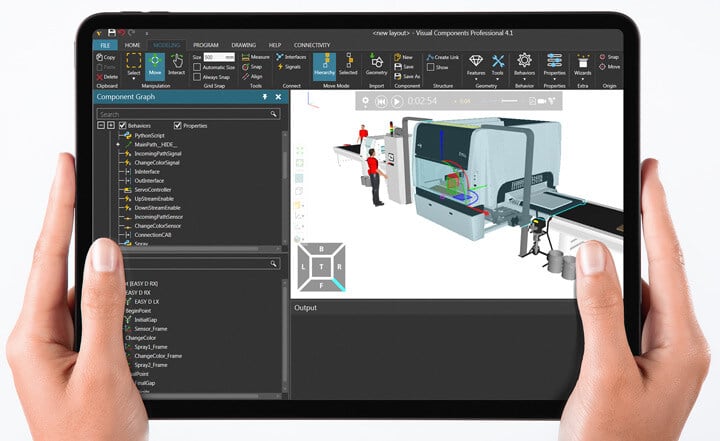
How do you carry out, in actual practice, a simulation of the industrial production process and use it to make your process evolve to achieve your business objectives? Cefla Finishing has created cCloner, a line simulator with several advanced features designed to improve each phase of the production cycle and respond to specific market needs.

More specifically, the solution:

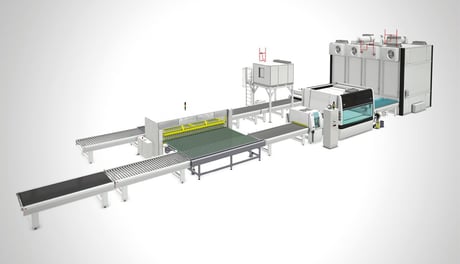
  • shows a realistic 3D configuration of the line layout, delivering an effective, reliable picture based on measurements, 3D imaging and objective data.
  • simulates real line operation. In this way, as early as in the design phase, it is possible to prevent critical issues, avoid machine downtime, and obtain more general information.
  • highlights actual productivity and helps identify the best line configuration.

The real strength of cCloner lies in its ability to offer a holistic view of the plant make-up and production process functioning: if used systematically, the software helps to configure each section, thus ensuring that the value chain as a whole complies with production requirements.

Companies that adopt a solution like the one designed by Cefla Finishing can therefore develop skills to not only minimise inefficiencies along the line, but also predict the ROI for plant upgrades.

LOOKING FOR THE IDEAL SOLUTION FOR YOUR COATING LINE?

The expression “production process” contains a key concept related to business management and, more generally, modern economy. It is the set of ...

Article

Raised doors: spray coating line

Raised doors: spray coating line

If you are evaluating a spray-coating line for wooden panels, raised or flat, maybe for furniture elements, stairs, noise barriers or several other finished products with similar characteristics, we at Cefla Finishing have an integrated solution.

This system enables a high degree of flexibility to handle varying production needs. It is comprised of different machines for brushing/cleaning, spraying, curing and drying and is specially conceived to offer maximum productivity, requiring more or less 200 sqm of floorspace.

Go here for more general information on our range of spray coating solutions

If you are evaluating a spray-coating line for wooden panels, raised or flat, maybe for furniture elements, stairs, noise barriers or several other ...

Article

How easy is it to programme a coating robot?

How easy is it to programme a coating robot?

Window fixtures coating Robot programming

"How easy is it to programme a coating robot?"
Given their considerable size, being able to hang doors and windows is essential. Moreover, overhead lines allow both sides to coated.

"Can I coat my windows assembled or disassembled?"
Coating can be done either way without any shape or size restrictions. It's this aspect, in fact, that makes overhead lines so advantageous.


Danilo Tamburini

Product Manager | Overhead Coating Technologies

Product development, technologies and machines for overhead coating

https://www.linkedin.com/in/danilo-tamburini/

"How easy is it to programme a coating robot?" Given their considerable size, being able to hang doors and windows is essential. Moreover, overhead ...

Article

iGiotto anthropomorphic spraying robot and cVision 3d reading barrier: the winning duo

iGiotto anthropomorphic spraying robot and cVision 3d reading barrier: the winning duo

Achieving coating quality and consistency, together with the highest production efficiency and minimal downtime is the major issue facing companies who are coating complex 3D objects, as well as windows and doors.

Coating robot with cVision iGiotto

iGiotto when used in conjunction with our exclusive cVision 3D Reading Barrier ensures time savings through coating process automation, improves the quality and consistency, thus leading to reduced lacquer consumption and lower costs. Faced with the following key issues, companies can become instantly more competitive by investing in a system where special software and automation provide immediate benefits.

These are the main challenges we have addressed:

• PROGRAMMING
Today’s options allow you to manually program a robot by physically guiding its spraying arms around the complex geometrical shape. The robot learns how to move and replicates the movement piece after piece. You can also program point-to-point trajectories using a software off-line, but each batch will require your manual intervention to enter data into the software to obtain the coating parameters.

• COATING
Apart from the cost of a skilled operator, manual spraying of window frames often leads to fluctuating yields and coating inconsistency. Lacquer consumption frequently exceeds the optimal amount by 15 to 30%, leading to high filter replacement and disposal costs.

• OUTPUT
Production batches can often be small or customised. Operators will need to stop the line for colour changeover or to re-program the trajectories.

All this is an obstacle to production efficiency and incurs costly downtime. So let’s see how we have solved these issues:

cVision avoids the need to manually program an anthropomorphic robot. This means no time at all spent defining trajectories. It’s all done automatically. cVision acquires the 3D image of the piece to be coated and uses its special software to determine the best trajectories. You save time (at least 50%), can be sure of obtaining optimal parameters and consistent coating quality from the first piece to the last. When iGiotto comes into play, the robot capitalises on the accuracy and optimisation of the pre-defined trajectories. In the case of doors, spraying with the new 3-gun wrist now saves considerably on lacquer consumption and ensures the best possible quality and consistency. Colour changes can be performed without even stopping the equipment, even for different products, so downtime is eliminated. And as new pieces enter the overhead line, the software makes sure iGiotto can switch from one piece to the next and one colour to the next without interrupting production.

More info about iGiotto and cVision

iGiotto
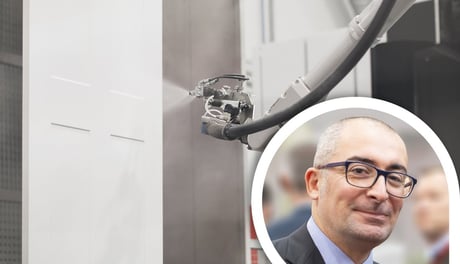
iGiotto is a complete spray coating system for water-based and solvent-based products using an anthropomorphic robot designed to paint large-sized objects such as doors, window frames or objects with a complex shape, and materials other than wood. Products transit on overhead lines and exit the spraying area into a drying tunnel before being collected in batches. Constant speed and constant distance between the spray guns and the product optimise lacquer consumption and ensure coating consistency. In environmental terms, lower consumption and less waste improves sustainability. 

cVision
The latest-generation, automatic 3D reading system (laser + camera) acquires position, size and shape of pieces in transit with unprecedented precision. The combined action of the laser and ultra-high resolution cameras allow iGiotto to automatically generate precise work trajectories based on the “recipes” of objects present in its database.

Achieving coating quality and consistency, together with the highest production efficiency and minimal downtime is the major issue facing companies ...

Article

An articulated process for a straightforward product – veneered skirting boards

An articulated process for a straightforward product – veneered skirting boards

Baseboard spray painting

One look at a skirting board and the finishing process it undergoes does not immediately come to mind, yet there is a lot to consider when defining an integrated finishing line for this product. One of the many possible solutions serves simply as an example. Each customer we have dealt with has a slightly different objective, so we like to evaluate each case separately. Standard solutions never seem to give more than standard satisfaction, whereas we at Cefla Finishing want to be sure we exceed the customer’s expectations, so we conceive the solution carefully, adapting a feature to solve a problem or adding a function to deliver a better result.

Starting with a brushing machine, we would then move on through a linear spraying machine. The first coat will probably be UV polyacrylic and Performa will apply it at 100 g/sqm. A seven-minute flash off in a Cross oven will then be needed, followed by a UV curing stage. The top side of the profiles will then be sanded on the brushing machine, a topcoat will be applied on the Performa and the flash off repeated for 7 minutes in the Cross oven. Running at speeds between 3000 and nearly 5000 pieces/shift, this is just one approach to finishing veneered skirting boards.

Contact us and discuss your needs with a finishing expert!

One look at a skirting board and the finishing process it undergoes does not immediately come to mind, yet there is a lot to consider when defining ...

Article

Coating doors and kitchen cabinets: changing the rules to save money

Coating doors and kitchen cabinets: changing the rules to save money

None

Until recently raised panels used for kitchen cabinet doors or even standard doors with raised sections or grooves on the surface were spray coated, start to finish. The process involves various application steps for base and topcoats, sometimes differing according to whether the finished effect is glossy or matt. It also foresees sanding operations between two base application steps and involves a fair bit of handling by operators. Streamlining this process with a hybrid line made up of roller coating and spray coating equipment increases overall efficiency and reduces operator intervention. But how can you process raised panels with a roller coater?

If this were possible, savings could come from less lacquer consumption because whereas transfer efficiency using spray coating equipment may exceed 60%, roller coating procedures ensure even better transfer efficiency and thereby cut lacquer-related costs in comparison.

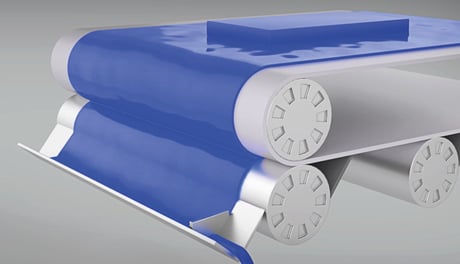
However, roller coating for raised panels was unheard of until the Smartcoater PRO family of roller coaters adopted the soft rubber application roller technology. This innovation has led to a change in the rules and companies are beginning to adopt the technology which has proven in our laboratory tests to achieve savings on lacquer consumption of up to 1€/sqm.

Equipped with a soft rubber application roller, Smartcoater PRO is able to shorten the coating process:

  • avoiding the need for sanding between base coats, 
  • avoiding the need to deal with poorly calibrated panels,
  • reducing the handling operations,
  • reducing lacquer and solvent consumption,
  • and reducing lead times.

And this is possible on kitchen cabinet doors and other substrates with 10 mm grooves.

Discover how the soft roller works for raised panels here.


Roberto Sorbini

Business Line Manager | Roller Coating Technologies

Product development, technologies and machines for roller coating

https://www.linkedin.com/in/roberto-sorbini-94663a13/

Until recently raised panels used for kitchen cabinet doors or even standard doors with raised sections or grooves on the surface were spray coated, ...

Load more articles

Articles: 138 / 158