Article

Why matt doesn’t have to be flat

Why matt doesn’t have to be flat

What do the letters XYZ mean to you? On a flat panel, you may only be concerned with the X and Y axes, but on a raised panel, Z comes into play. Now ask yourself why matt does not have to be flat, and what difference it may make if excimer matting could reach every dimension of a raised panel, ensuring the edges and all surfaces benefit from a below-5 gloss finish with unrivalled surface resistance. Our new excimer oven, Exydry-Z, covers the X, Y and Z axes

Discover more about Exydry-Z

Cefla Finishing Matt Surfaces

How do excimer ovens work?

Excimer technology adopts a short-wave UV polymerisation process performed in an oxygen-free atmosphere. This is an effective way of obtaining high-performance, matt surfaces whose scratch and abrasion resistance is complemented by a soft-touch effect, enhancing the look and feel of the panel, be it wood or another substrate suitable for excimer drying. The physical effect on the lacquer, once it is fully cured, is such that it amounts to an extremely low-gloss finish, anywhere between 5 and 20 gloss, with an excellent anti-fingerprint effect.

Taking excimer matting technology beyond its customary limits

So far, this technology has been used on flat panels because removing oxygen from 3D objects, especially the edges of a raised panel, has never been accomplished satisfactorily. Exydry-Z is the next step which breaks down the barriers that were present until now. Boasting three patent pending technologies, this innovative system developed by Cefla Finishing effectively washes away all the oxygen from the X, Y and Z axes of a raised panel, enabling excimer matting on all surfaces. Furthermore, Exydry-Z achieves an impressive below-5 gloss finish and cuts back on nitrogen consumption.

So if you were looking for a way to obtain a deep matt, super resistant, soft-touch finish for your raised panels, Exydry-Z is the oven for you.

Contact us and discuss your needs with a finishing expert.

What do the letters XYZ mean to you? On a flat panel, you may only be concerned with the X and Y axes, but on a raised panel, Z comes into play. Now ...

Article

Edge finishing machines: simpler with Smartedge

Edge coating machines are playing an increasingly crucial role on panel construction and finishing lines. The market is, in fact, striving to respond to fast-changing trends that are fuelled by strong demand for customisation (just think of the automotive sector): this explains why orders for small batches are becoming more commonplace, and only those who hone their capacity to process semi-finished products - especially their edges - flexibly will manage to retain their competitiveness. Consequently, edge coating and sanding machines must not only ensure optimal processing regardless of the material or type of finish requested by the customer: they must also make it easier to perform the frequent format changeovers intrinsic to customisation in order to avoid bottlenecks and unprofitable downtime.

What are the requisites for top-level edge coating machines?

Because of the refinement and complexity of the parts requiring intervention, it’s simply a fact that edge processing influences the entire panel coating process: that’s why outstanding edge coating machine performance is vital to improving and speeding up production. Machines must be efficient to manage large-scale production, flexible to provide just-in-time capabilities and hyper-precise to ensure consistent quality that matches the panel finish.

And it’s no coincidence that our customers ask us - ever-more insistently - if we can provide systems that let them achieve a good balance between processing speed and cost containment, but without compromising performance. Our response? It’s called Smartedge.
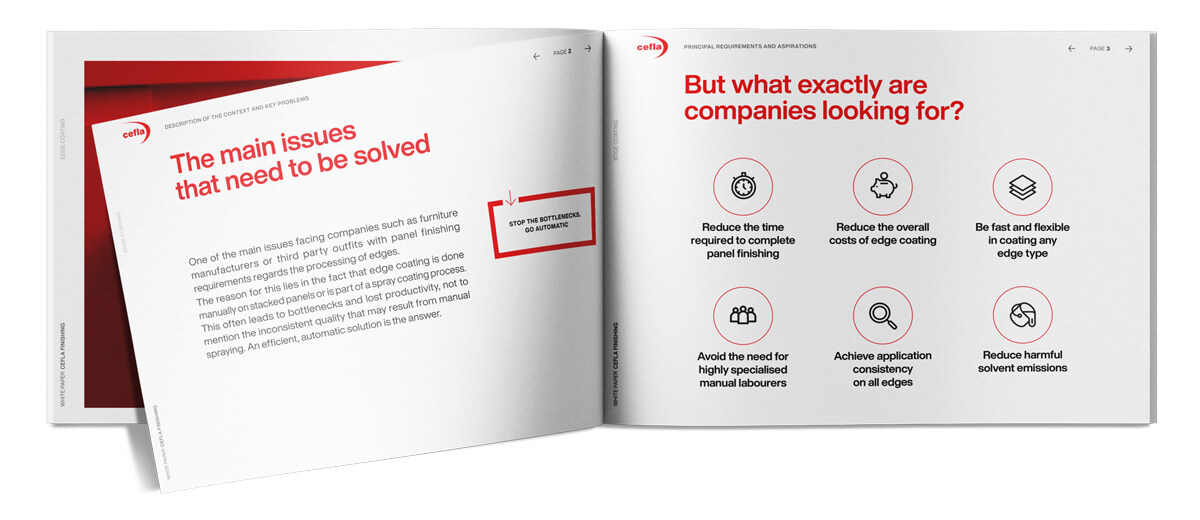
Mockup-EdgeCoating-ENG

EDGE COATING
Discover how to solve edge processing problems

Smartedge: applications and advantages

Smartedge is the ultimate edge coating machine. Featuring integrated functions, it doesn’t just ensure high-performance, low-consumption edge coating, filling and sanding: because it’s configurable, with specific modules designed to meet every quality and productivity requirement, the solution also delivers outstanding flexibility.
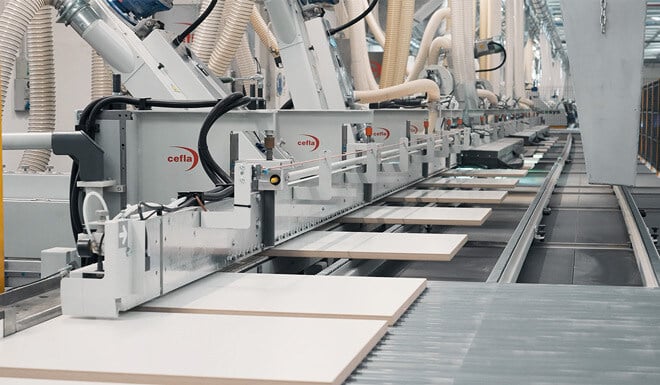
Smartedge2

Coatings can be applied with either a traditional vertical roller or a patented soft vertical roller, which automatically models itself to the shape of the edge without the aid of counter-templates. You can also choose to use vacuum injection technology, a Cefla Finishing patent that lets you coat any type of edge. How? By using an applicator head that’s contoured perfectly over the edge to be treated, ensuring precise, uniform coating whatever the shape of the piece.

Lastly, drying takes place in an integrated oven: UV (for 100% acrylic paints) or IR (for water or solvent-based products).
Smartedge can be configured to work with all types of edge, improving application consistency, reducing the need for specialised labour and preventing solvent emissions thanks to the exclusive use of 100% acrylic UV products.

Innovative edge processing with Edge&Go

For the most demanding clients, Cefla Finishing provides Edge&Go, our vacuum technology with applicator head that revolutionises the traditional approach to edge processing and edge coating machine control.

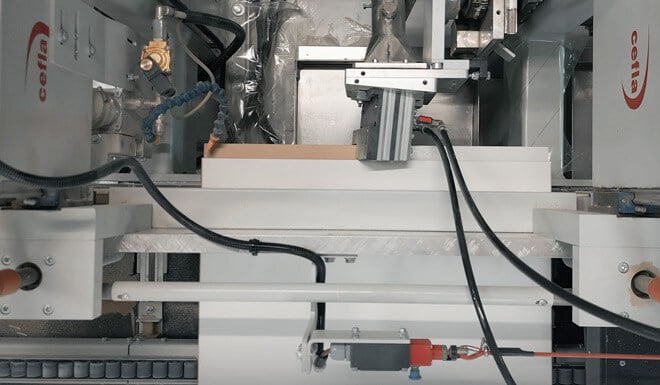
Normally, dismantling the applicator head and realigning the components to match the size and shape of the metal profile require a lot of time. Edge&Go is an integral part of Smartedge. By allowing continuous processing of different edges, it boosts productivity and maintains excellent coating quality while allowing workers to manage different edge shapes and sizes in the shortest time possible.
Smartedge1

As the saying goes, time is money: that's why managing shape changeovers with Edge&Go (which can switch from straight edges with a 3 mm radius to J-Pull handle edges in less than 15 seconds) generates tangible, measurable economic savings.

A special (patented) dual applicator head with skimmer is now available; installed between the two coating dispensers, the skimmer acts as a filler, sealing all the micro-holes that might be in the MDF substrate. Each edge coating station can apply from 150 to 180g/m2.

Cefla Finishing, the perfect partner for better edge processing

To see Edge&Go and all the different technologies that make our profiling machine range one of the most advanced on the market, simply visit us at the Cefla Finishing Lab. Featuring more than a hundred Cefla Finishing machines, this technology hub is designed to impart experience, generate business goals and enable new opportunities by allowing for the creation and testing of entire processes and production lines. And there's more: visiting the Cefla Finishing Lab also provides great opportunities for identifying the most suitable case-specific configuration parameters and calculating the ROI for each machine.

If you need to reduce edge finishing costs and times, come and see the technologies and services that offer just what you’re looking for: our experts are at your disposal to assess and customise every single solution.

LOOKING FOR THE IDEAL COATING LINE SOLUTION?

Edge coating machines are playing an increasingly crucial role on panel construction and finishing lines. The market is, in fact, striving to respond ...

Article

Smartcoater PRO. Flexibility, automation and savings

Smartcoater PRO. Flexibility, automation and savings

Flat surface roller coating technologies have evolved since introducing our first roller coater nearly 60 years ago. In 2000 we launched the Smartcoater, and since then we have regularly renewed the range in line with the market’s requirements.

Today our customers are asking us for more flexibility, a greater degree of automation and savings, both in terms of time and costs. These are the key issues to which we have added further benefits when developing the latest addition to the range: Smartcoater PRO.

Smartcoater-PRO

How flexible can we get?

Built to process all types of material (only flat surfaces) - wood and its derivatives, as well as glass, cork, metal, fibre cement and plastic - Smartcoater PRO gives customers the chance to gain greater control over their process, over the lacquer applied and over productivity in general. Handling all sorts of products, they require flexibility and better performance: one machine for all product types. Different shapes, different thicknesses, uncalibrated panels all require flexibility. But variations in lacquer also influence the operating parameters and based on temperature, viscosity and other variables, machine settings need to be adjusted. Instead of doing this manually, we have designed a platform which automates parameter regulations, saving time and improving performance.

How can we lower production costs?

Customers also want to save on lacquer, solvents, cleaning operations, and they are looking for a solution any operator will feel at ease monitoring all these parameters. We have built Smartcoater PRO so that operators can see inside the machine to check key parts are working correctly. Cleaning operations are partly automated and use of a roller cleaning device reduces solvent consumption and costs substantially. Automation also plays a role in reducing production costs by monitoring coating parameters (weight of lacquer, temperature, etc.) and thereby adjusting dose roller pressure automatically. Recalling a specific recipe will adjust parameters accordingly without added manual intervention.

What else is new compared to previous roller coaters?

An improved lifting system based of 4 screw jacks ensures greater stability and sturdiness. Furthermore a floating system with optional pneumatic control responds perfectly to surface variations on flat panels transiting through the machine. Belt adjustments are now automatic, with an optional belt-centring system. Belt change is quicker than on the previous version. Smartcoater PRO also features dose roller positioning and an independent electric application device.

Discover more about Smartcoater PRO.

Flat surface roller coating technologies have evolved since introducing our first roller coater nearly 60 years ago. In 2000 we launched the ...

Article

Which is the best way to wrap #drawers?

Which is the best way to wrap #drawers?

 Our #profilewrapping brand düspohl Maschinenbau GmbH has developed productivity increasing solutions for both vertical and horizontal wrapping of drawers.

Both of them apply #hotmelt adhesive, which allows you to move on to further production steps directly after wrapping.

DrawerLine 300V ☚ wraps drawers of up to a height of 300 mm vertically - including grooves.

YOUR BENEFITS:
✔ automatic format adjustment: wrapping zone switches from 50 to 300 mm in six minutes
✔ reduced set-up times to boost your productivity
✔ automatic reel changing to minimise downtimes

DrawerLine 250H ☚ wraps drawers up to a width of 250 mm and other profiles horizontally - including grooves.

YOUR BENEFITS:
✔ high flexibility: 360° wrapping of different types of profiles
✔ many systems to reduce set-up times and increase output
✔ includes high quality glue application system and synchronised cutting system

Contact us and discuss your needs with a finishing expert.

Our #profilewrapping brand düspohl Maschinenbau GmbH has developed productivity increasing solutions for both vertical and horizontal wrapping of ...

Article

Roller coating on wood and its derivatives: techniques and advantages

Roller coating on wood and its derivatives is an ideal way to accurately and evenly apply coating on panels, cabinet doors, doors, flooring and any other object with flat surfaces. Various techniques and lines are available to help you set up this type of process: each one has specific characteristics and, depending on the type of result you wish to achieve, has its own pros and cons.

While a customised solution is always the best response to any manufacturer's finishing needs, this article gives a general overview of how wood and wood-derivative roller coating machines work and illustrates their advantages.

When should roller coating be used for wood and its derivatives?

These days, roller coating is universally seen as a tried and tested industrial technique. This is thanks to increasingly reliable technology. Such technology meets the needs of a variety of product categories (one of the foremost being items in the furnishing sector), with panel and edge coating playing a crucial role in the wooden accessory manufacturing process.

In addition to wood and its derivatives, roller coating is also suitable for glass, cork, plastic and fibre cement surfaces. Indeed, a growing number of companies are choosing it to make production more efficient and boost their capacity for differentiated production. Lines can, in fact, be customised to meet specific requirements; they’re designed to meet the needs of both companies that repeatedly perform large-volume, same-batch processing and plants that require frequent colour and thickness changes, thus reducing downtime. A roller coating line maximises flexibility: this makes it perfect for third-party finishing set-ups, which require that the switch from one colour or thickness to another be completed without prolonged machine downtime.

THE MOST INNOVATIVE FINISHING SOLUTIONS
Discover new finishing solutions: more effective, more productive, more competitive

Composition of roller coating lines for wood and wood derivatives

Getting into the specifics, what do wood and wood-derivative roller coating lines consist of?

Rollercoatingline

The lines are generally made up of a sander, followed by coaters which, in turn, precede a series of UV ovens.

After the sanding process, if the panels have flat edges (i.e. a sharp edge with respect to the surface), coatings are mainly applied with roller machines and curtain coaters to obtain finishes with differing degrees of gloss.

On a modern coating line, being able to control the process via interactive dashboards is essential: by monitoring performance, manufacturers can boost the operational versatility of their plant over time.

Moreover, manufacturing companies require maximum flexibility across a range of different products. That’s why they increasingly choose easy-to-use, modular, customisable solutions that smoothly adapt to production/space requirements and contain consumption: not just in terms of the stability of the basis weight of the applied coating and the reduced need for cleaning solvents, but also in terms of the time the operator has to dedicate to washing, which can be partially automated.

What are the advantages of roller coating wood and its derivatives?

Compared to a traditional, manual manufacturing process, industrial roller coating of wood and wood derivatives offers a series of tangible, measurable advantages that range from more precise coating application to better control of the production process. More specifically, the main benefits of adopting a roller solution are:

  • even, precise application of the coating, with consistent quality
  • monitoring and optimisation of each stage of the process
  • better control over the materials used, allowing waste reduction
  • flexibility when diversifying production lines
  • partially automated cleaning operations, significantly reducing solvent consumption and costs.

ImmagineRullo

Cefla Finishing solutions for roller coating wood and its derivatives

After making an in-depth assessment of the needs of companies that process wood and wood derivatives, Cefla Finishing breathed life into a series of solutions that simplify the adoption of roller coating processes. For example, Smartcoater PRO is designed to combine better control of the different processing phases with greater flexibility and ever-better performance: different shapes, different thicknesses and panels with varying degrees of deformation require maximum agility, and the Smartcoater PRO dashboard helps automate parameter settings on each process.

The machine is designed to ensure effective, efficient operation: the lifting system, which uses four screw jacks, provides greater stability and rigidity, while the optional pneumatically-controlled floating head system responds perfectly to surface variations on the panels transiting through the machine. Belt adjustments are automatic. There’s also an optional alignment system. Smartcoater PRO also features a dosing roller positioning mechanism and an independent electric applicator. Lastly, thanks to the latest innovation to be added to the machine - a soft rubber applicator roller - Smartcoater PRO now has an even more appealing set of functions that include the roller coating of raised panels.

As stated, a roller coating line also includes a series of ovens. Cefla Finishing offers the UV-R series: a UV drying oven (also usable on spraying lines) that can halve the number of lamps needed for processing (and, consequently, the machine's running costs). The system also incorporates a PLC-controlled electronic transformer that allows adjustment of lamp power, recipe management and energy savings in the event of missing pieces.

Who is Cefla Finishing for?

The Cefla Finishing range of plants and machines continues to evolve by leveraging decades of worldwide experience in the surface finishing sector. With no less than 300 active patents and approximately 15,000 machines installed all over the world, Cefla Finishing develops coating equipment that aims to maximize production efficiency and bolster the sustainability of woodworking companies that make flat cabinet doors, parquet, doors and panels in general. What’s more, the range extends beyond the wood and furniture sector to encompass supply chains for glass surfaces and items in cork, plastic and fibre cement.

So, regardless of the industry you’re involved in, if you’re looking for an innovative roller coating system simply contact a Cefla Finishing expert to receive a free consultation and identify the solution that’s right for you.

LOOKING FOR THE IDEAL COATING LINE SOLUTION?

Roller coating on wood and its derivatives is an ideal way to accurately and evenly apply coating on panels, cabinet doors, doors, flooring and any ...

Article

How can overspray be reduced?

How can overspray be reduced?

Reduction Overspray spray coating

Objective: efficiency and sustainability.
When it comes to coating, there is a crucial point beyond all else, that of lacquer consumption.

Above all, how can overspray be reduced to a minimum in favour of improved transfer efficiency?

The Airsphere air diffusion plenum (a Cefla Finishing patent) is already a huge step in the right direction.

It acts as a way of controlling the air flow inside the machine, thus ensuring maximum spraying quality, uniform lacquer distribution and greater transfer efficiency.

➜ What other precautions are needed with regards to the machine?

✓ Choose the section of the gun nozzles correctly, according to the paint and in view of the desired application outcome: better to choose a larger section, so as to reduce the pump’s operating pressure
✓ Keep the guns’ atomisation air to a minimum
✓ During the "end of ventilation" phase, act on the Air "plenum and exhaust" parameters bringing them down to the minimum possible values
✓ From the machine display, set the spraying area to a minimum
✓ Position the guns as close as possible to the piece being coated
✓ Use spray in “all” instead of “backspray”.

Go here for more general information on our range of spray coating solutions.

Objective: efficiency and sustainability. When it comes to coating, there is a crucial point beyond all else, that of lacquer consumption. Above all, ...

Load more articles

Articles: 150 / 157