For those involved in the decoration and finishing of flexible materials on rolls, the recurring question is almost always the same: how can high production volumes be reconciled with a demand for customization that grows year after year?
This is no trivial matter. The market demands shorter runs, ever-changing designs, shorter lead times, and the ability to change graphics without slowing down production. Traditional printing technologies (rotogravure, flexography, screen printing) deliver excellent results for large print runs, but they come with significant setup costs, the need for dedicated cylinders or plates and screens, and minimum run sizes that are difficult to reconcile with an increasingly fragmented market. The result is often a compromise that takes its toll over time: excess inventory of pre-printed material, production downtime due to job changes, or the decision to forego small batches because they are economically unviable.
It is against this backdrop that roll-to-roll digital printing has established itself as one of the most practical solutions, redefining the way the industry approaches the decoration of roll-fed substrates. This technology does not require a choice between productivity and flexibility, but rather aims to combine both.
In this article, we’ll provide a comprehensive overview of roll-to-roll digital printing, leading up to the role that Cefla Finishing plays in this sector.
What is roll-to-roll digital printing?
Roll-to-roll digital printing is a decoration technology in which the material is unwound from a roll, passes through the printing module and, where required, through material preparation and finishing stages, in a continuous stream, and is then rewound or sent on to downstream processes. Unlike printing on individual sheets or panels (sheet-fed or flatbed), the substrate here is flexible and flows without interruption: it is precisely this continuous feed mechanism that defines the process.
The term “digital,” on the other hand, refers to the way the image is transferred onto the substrate. The digital decoration is performed by inkjet printheads that deposit ink drop by drop (drop-on-demand), directly following a graphic file, without the use of cylinders, printing plates and screens, or physical matrices, as is the case with traditional analog technologies. Essentially, the image goes from the file to the material without any mechanical intermediaries, and it can be modified at any time simply by editing the graphic data.
The substrates used are inherently flexible and available in rolls: PVC, ABS, polystyrene, paper, laminates, foils, technical films, and even metal coils. It is the combination of these two elements, the continuous movement of the web and the digital nature of printing, that sets roll-to-roll printing apart from other finishing solutions and positions it as a direct evolution of continuous industrial printing systems.
How industrial roll-to-roll digital printing works
The operating principle is continuous processing: the material never stops but flows at a constant speed beneath a stationary print module. In the most common industrial configurations, known as single-pass, the print heads cover the entire width of the web and do not move laterally; instead, the substrate moves beneath them. Focusing solely on the core printing process and excluding any web preparation and finishing stages, the process comprises the following essential phases:
- Unwinding the roll: the blank material is unwound from an unwinding roller and fed into the line, initiating the continuous process.
- Conveyance and tensioning: a series of drive rollers and tensioning devices keeps the web flat and perfectly aligned with the printing path, a condition essential for precise ink deposition.
- Ink deposition: in the printing zone, the inkjet printheads release ink droplets according to the graphic file, forming the image directly onto the moving substrate.
- Pinning and UV curing: immediately downstream of the printheads, UV or UV-LED lamps fix the ink (pinning) and complete its curing in a matter of seconds, setting the design and preventing the droplets from spreading or mixing with one another.
- In-line quality control: vision systems check color registration, check for clogged nozzles, and detect printing defects as the material moves through the line, without interrupting the flow.
- Rewinding or downstream processing: the printed material is rewound onto a reel or sent directly to the next stages, such as cutting, lamination, or finishing.
The key difference from multipass systems, in which the print head moves back and forth on a stationary support, lies precisely here: by eliminating the transverse scanning and feeding the web continuously, the single-pass system achieves significantly higher speeds, on the order of tens of meters per minute.
The advantages of roll-to-roll digital printing
The value of roll-to-roll digital printing becomes particularly clear when compared to traditional analog technologies, where each design requires the creation of a dedicated cylinder or plate. By eliminating this step entirely, roll-to-roll digital printing fundamentally reshapes the economics of continuous decoration.
- Total flexibility and customization: since the image comes from a file, changing the design simply involves uploading a new graphic file, no new dies, no downtime for setup. This makes it possible to handle different designs in rapid succession, variable data, and customizations that would be unfeasible with analog technologies.
- The cost-effectiveness of short runs and just-in-time production: with no fixed costs for printing cylinders or setup, even small batches become economically viable. You can print what you need when you need it, eliminating the need for inventory of pre-printed materials and reducing the risk of obsolete stock.
- Reduction of waste and scrap: by printing only the quantities actually required and eliminating the need for consumables associated with printing plates and screens, the process generates less waste and supports more sustainable production, in line with the industry’s environmental requirements.
- High productivity for large volumes: in single-pass configurations, continuous web processing allows for speeds in the tens of meters per minute, making this technology suitable not only for small batches but also for the most intensive production cycles.
- Consistent quality over long runs: inline control and stable material transport ensure uniform results even with large quantities of material, without the registration or color variations typical of extended production runs.
- Integration into existing lines: the modular design of roll-to-roll systems allows them to be incorporated into plants that are already in operation, supplementing or replacing individual stages without having to redesign the entire line.
In short, roll-to-roll digital printing no longer requires choosing between the flexibility of small batches and the efficiency of high volumes: its competitive advantage lies precisely in its ability to combine the two worlds.
Applications of roll-to-roll digital printing
The versatility of roll-to-roll digital printing translates into a very wide range of applications, spanning sectors that may be quite different from one another but share one common element: the processing of flexible materials on rolls.
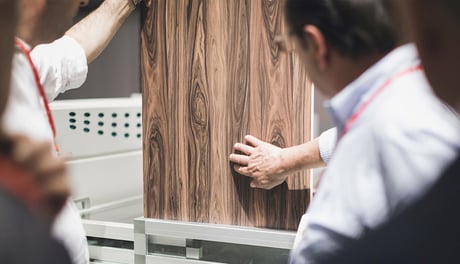
In the world of furniture and interior design, technology is used to enhance laminates and panels, decorative papers, panel edging, wall coverings, and flooring such as LVT vinyl, where the ability to faithfully reproduce wood grain, stone textures, and custom patterns is particularly valuable.
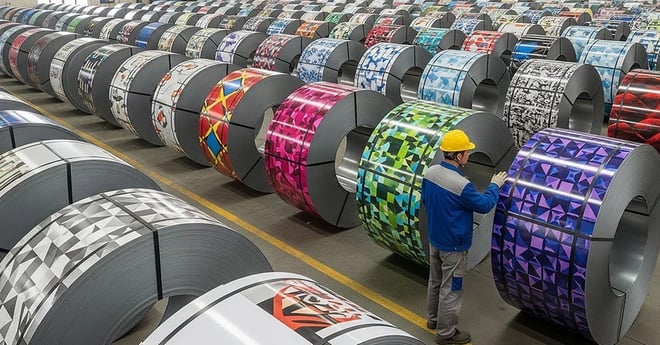
In the industrial sector more specifically, roll-to-roll technology is used in the decoration of metal coils, steel and aluminum, intended for the construction, home appliance, and furniture industries, as well as in the printing of flexible packaging and labels and in the finishing of technical films and foils. The common thread running through all these applications is the ability to apply complex and customized designs to large, continuous surfaces consistently and quickly.
Digital printing for edge banding
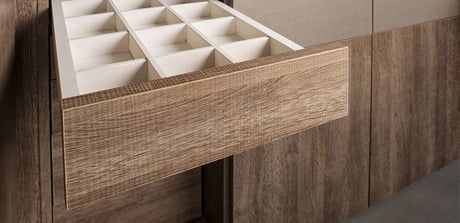
Among the applications seen in the furniture industry, edge banding deserves a separate discussion. Edge banding is the thin strip that covers the sides of a panel to hide its core and provide aesthetic continuity to the piece of furniture: to look authentic, it must perfectly replicate the pattern of the surface it is paired with.
In the traditional process, the edges are decorated using rotogravure, a technique that requires the engraving of a new set of cylinders for each new design. Every time a new finish is introduced to the market, new cylinders must therefore be developed, with the associated costs and lead times; added to this are potential color variations between batches and the difficulty of precisely matching the edge to the panel, which is often produced on different machines.
Digital printing for edge banding turns this logic on its head. Starting with a scan of the panel’s surface, a graphic file is generated and printed directly onto the edge (made of PVC, ABS, or paper), resulting in precise color matching and pattern continuity that analog techniques struggle to achieve. The advantages are clear: consistent color matching across batches, the ability to produce even a single roll without minimum order quantities, and just-in-time production that reduces inventory of pre-printed edges and minimizes pattern repeats, resulting in a more natural final effect. It is in this context that roll-to-roll digital printing most clearly demonstrates the link between customization and industrial production.
Cefla Finishing machines for roll-to-roll digital printing
As we have seen, roll-to-roll digital printing is now one of the most strategic technologies for the industrial decoration of roll-fed materials. But technology alone is not enough: what makes the difference is the machine that puts it into practice. Feeding a flexible web at speeds of tens of meters per minute while maintaining its flatness and high-precision alignment, controlling high-definition print heads, synchronizing the printing of the color design with the printing of any texture in perfect registration, and integrating all of this into an existing production line are engineering challenges that require expertise, experience, and robust construction. This is why choosing the right partner is crucial: relying on professionals who design and build these systems is what distinguishes a catalog-quality result from a truly industrial-scale outcome.
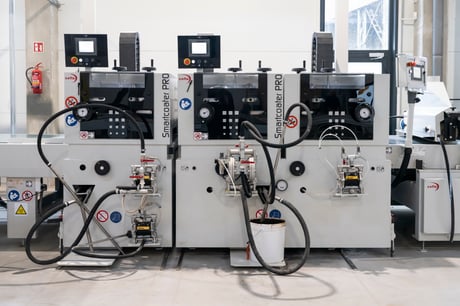
This is where Cefla Finishing comes in. With the J-PRINT SP Roll to Roll, the company offers a single-pass machine dedicated to digital printing on flexible roll-fed materials, designed to build fully digital industrial printing lines capable of handling flexible batches, customized designs, and high print runs without compromising quality. Key features:
- Single-pass technology for roll-to-roll printing, with standard working widths ranging from 120 mm to 1,800 mm.
- Operating speeds of up to 50 m/min and beyond, for maximum productivity in continuous cycles.
- High-definition industrial DOD printheads, compatible with specialty and UV inks.
- Integrated pinning and UV/UV-LED curing for immediate drying.
- Wide range of compatible materials: PVC, ABS, PS, paper, laminates, foil, technical films, and metal coils.
- A drive and tensioning system that ensures belt stability even at high speeds.
- Reel change and parameter settings managed by centralized software.
- Modular architecture, configurable to meet production needs.
Ultimately, roll-to-roll digital printing performs at its best when the technology is paired with the right manufacturing expertise. This is where Cefla Finishing’s value shines through: the ability to integrate the most innovative digital solutions, such as the J-PRINT SP, into hybrid lines that combine digital technology with analog processes honed over decades of experience. This approach provides companies with both the potential of emerging technologies and the reliability of tried-and-true methods, allowing them to choose the combination best suited to each production need on a case-by-case basis. To explore how to integrate this into your production process, contact the Cefla Finishing team!



.png?width=460&height=310&name=image%20(2).png)