
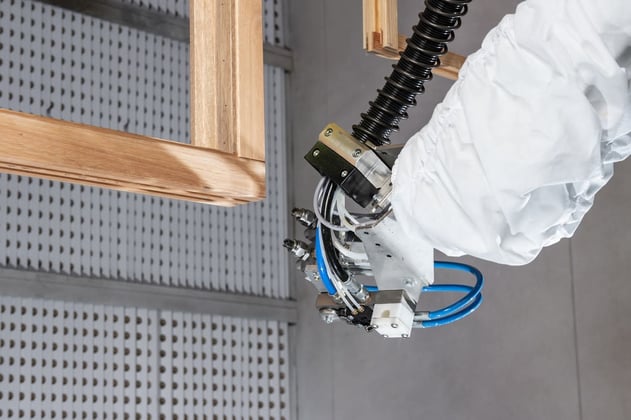
For wooden doors and windows, the finish is not merely an aesthetic detail, but the layer that protects the product from moisture, light, and the wear and tear of time: it determines how long a door or window will retain its appearance and performance. For manufacturers, the finish is therefore one of the factors that most significantly affects the product’s value.
Achieving this result consistently, and at the volumes required by industrial production, is what makes the finishing of wooden windows and doors a matter of great importance to the industry.
In this article, we’ll provide a comprehensive overview of the finishing process for wooden windows and doors, leading up to the role that Cefla Finishing plays in this sector.
The challenges of industrial finishing for wooden windows and doors
The industrial finishing of wooden windows and doors involves a number of specific challenges that arise from the combination of the product’s characteristics, the required quality standards, and production schedules.
The first challenge stems from the very shape of the product. A wooden window or door is not a flat surface: it has contoured profiles, multiple sides, edges, rebates, and recesses, and the paint must coat every part evenly. Coating a three-dimensional object of this size completely and evenly is much more complex than coating a flat panel, and requires working on all sides of the piece without leaving any uncovered areas or buildup of product.
Added to this is the nature of the process, which rarely involves just a single step: it consists of multiple coats, each separated by sanding and drying phases. Each additional coat enhances the quality but extends the timeline, increases costs, and multiplies the opportunities for defects to occur. The stakes are high, because the window or door is intended for outdoor use: the finish must withstand moisture, temperature fluctuations, and UV rays for years, leaving very little room for error.
Finally, there is the issue of consistency and efficiency. Quality must remain consistent from part to part and throughout the entire workday, while paint consumption and overspray affect costs and sustainability. All of this must then be balanced with market demands: high volumes, increasingly shorter production runs, customization, and shorter lead times. These are areas where manual coating, which relies on the individual operator’s experience, reveals its most obvious limitations.
To understand where these critical issues are concentrated, it’s worth taking a closer look at how the finishing process for a wooden window or door is structured.
The stages of the finishing process for wooden windows and doors
The finishing process for a wooden window or door is not a single operation, but a series of steps in which each application of the product is followed by a drying period and, when necessary, sanding. There is no absolute standardization of the process: the number and combination of steps vary depending on the type of wood, the finish used, and the country of destination, as well as the desired quality level and final effect.
A typical cycle consists of a sequence of applications:
- Surface preparation: lightly sand the raw surface to remove residue and irregularities and create a uniform base to which the paint can adhere.
- Application of wood stain: where called for, it provides deep protection for the wood and defines its base color, preparing the surface for subsequent coats.
- Applying the primer: builds up thickness and fills in imperfections, leveling the surface and preparing it for the finish coat.
- Finishing coat: this is the visible layer that determines the appearance, finish (matte or glossy), and durability of the window or door.
Interwoven with these applications are two recurring operations that run throughout the entire cycle:
- Complete drying: after each finishing stage, whether applying wood stain or spray coatings, the finished product must be allowed to dry completely.
- Sanding: performed to achieve a smooth, even surface; it is done as needed, depending on the type of wood and the finish applied.
It is precisely this alternation of application, drying, and sanding that determines the process’s time, cost, and likelihood of defects, and explains why, on an industrial scale, the way each individual phase is managed matters so much.
Cefla Finishing's finishing systems for wooden windows and doors
Managing such a complex sequence on an industrial scale effectively means moving away from treating individual operations as isolated steps and integrating them into a single, coherent production line. This is precisely the field in which Cefla Finishing operates: as one of the world’s leading manufacturers of wood finishing systems, it designs and builds custom coating lines for wooden doors and windows, as well as turnkey solutions tailored to each customer’s product, production volumes, and quality objectives.
A system of this type is not a single machine, but a system that links all the stages of the cycle, preparation, application of the various coats, drying, and handling of the workpiece, into an automated and continuous flow. The configuration varies according to production needs: from the type of window or door (assembled or disassembled) to the range of finishes required, and the production volumes to be handled. It is this modularity that allows the system to be adapted to both manufacturers producing a few hundred custom pieces and those working with large production runs.
Behind every configuration, however, there are two fundamental choices that determine its architecture: the type of line, that is, how the workpiece moves through the workstations, and the application technology, that is, how the paint is actually applied to the workpiece.
The type of finishing line for windows and doors
The production line is the first element to be defined; it determines how the workpieces are transported through the various processing stations, affecting the geometry of the workpieces that can be processed, the number of sides that can be machined in a single pass, and the overall footprint of the system. For wooden windows and doors, the standard configuration is the overhead production line.
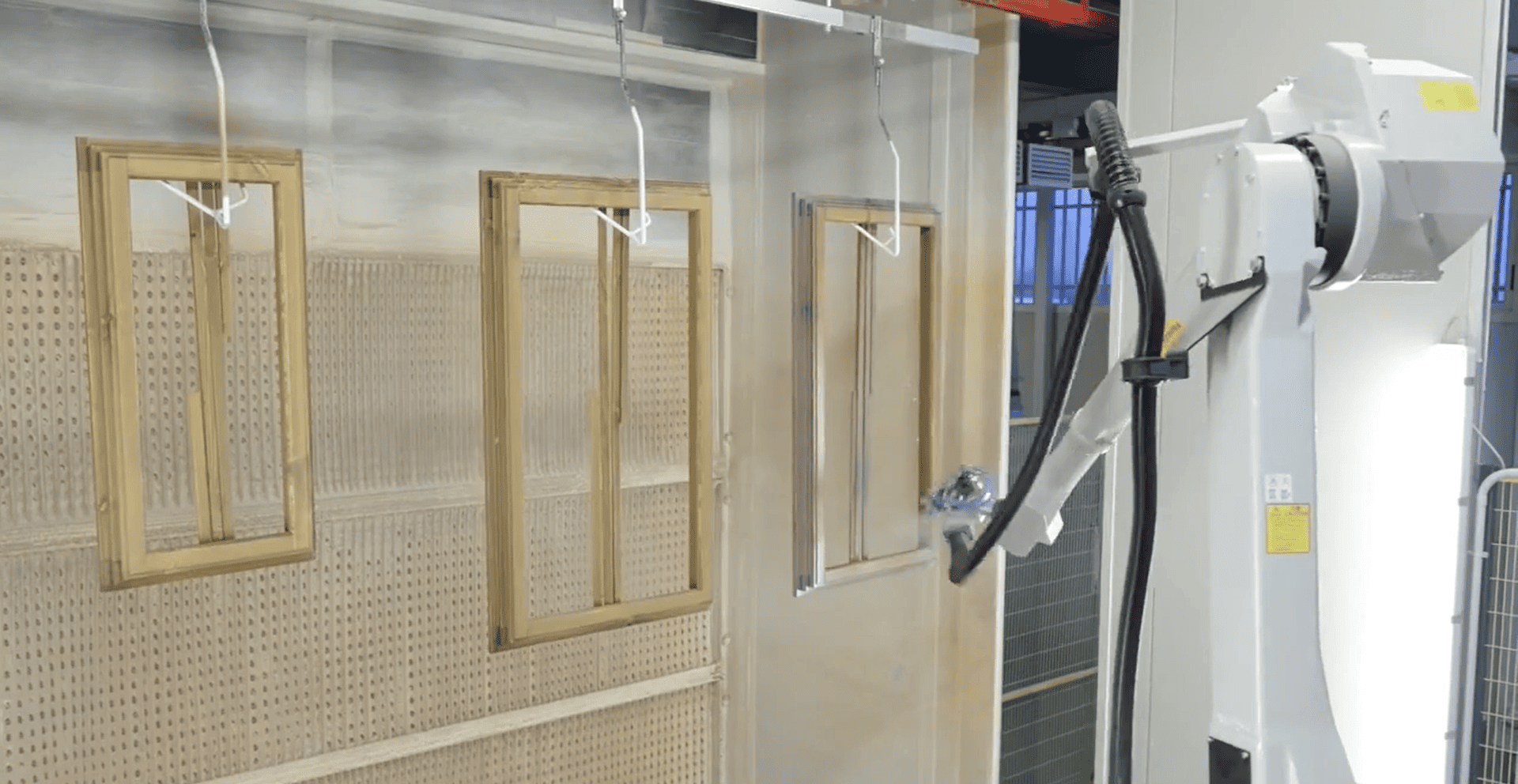
In the chain-type overhead line, parts are suspended from carriers that are pulled along overhead chains, keeping them raised and accessible from all sides. This allows both sides to be coated in a single pass and enables the handling of bulky, three-dimensional items without specific constraints on shape or size, whether assembled or disassembled. This configuration is specifically designed for items such as doors and windows: the ability to suspend the item and access every surface in a single pass directly addresses the challenges related to shape and coverage mentioned at the beginning.
And it is precisely along these lines that the application technology, the second level of the system, comes into play.
Technologies for the automated coating of wooden windows and doors
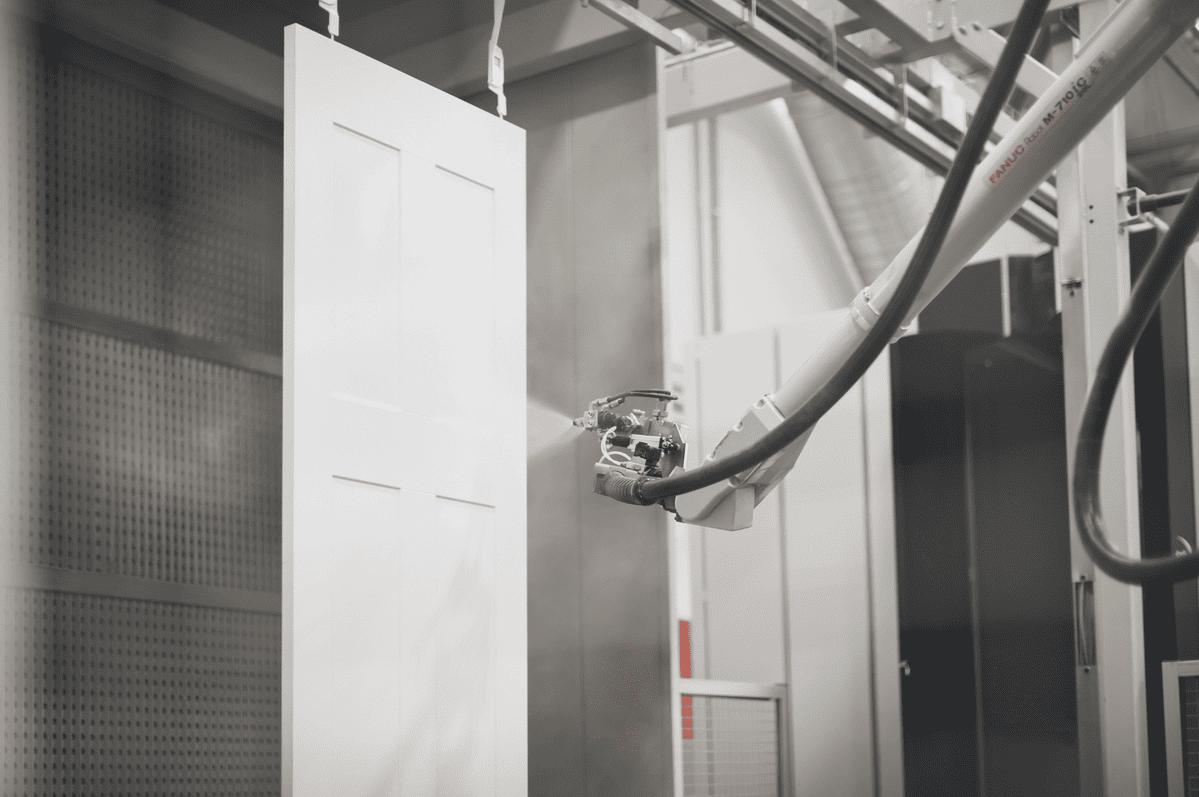
Now that the production line has been defined, the most important question remains: how is the paint actually applied? On the overhead production line, Cefla Finishing’s solution for wooden windows and doors is iGiotto, an anthropomorphic robot that performs spray coating by moving around the suspended workpiece and reaching every surface, including profiles and rebates.
It is guided by cVision, the scanner that works in tandem with the robot. As the workpiece passes by, cVision captures its shape and position via 2D or 3D scanning; the software processes this data and automatically generates the trajectories the robot will use to coat the part optimally. In practice, there’s no need for manual programming for each new item: the system recognizes what’s in front of it and adapts, handling both assembled and disassembled windows in the same way, with no limits on shape or size. This is the true strength of the robotic overhead line, especially for those who produce custom-made items and frequently switch between different types of parts.
iGiotto, in combination with cVision, is at the heart of the solution, but the application technology varies depending on the type of product and production line. On overhead lines, both exterior doors and assembled window frames can be processed: application is handled by iGiotto for spray coating or, alternatively, by the iFlow flowcoating system, which applies impregnating coatings efficiently and uniformly. When working on disassembled parts, however, iGiotto and the Lineflow + Dryflow horizontal flowcoating system (for product application and drying) are used.
It is this combination of production lines, robots, and automated trajectory control that transforms a complex cycle into a manageable industrial process. But what does this mean, in practical terms, in terms of results?
The benefits of process automation
Automating the coating of wooden windows and doors doesn’t simply mean replacing the operator with a machine: it translates into tangible benefits in terms of quality, costs, and production capacity. Here are the main ones:
- Consistent and repeatable quality: the robot always applies the paint using the same parameters, eliminating variations caused by individual operators and ensuring uniform results on every part throughout the entire workday.
- Uniform coverage on all surfaces: by applying the coating to the window frame while it is suspended, the product is evenly distributed across every surface, including profiles and rebates. This results in better protection against the elements and improved long-term aesthetic appeal and performance.
- Optimal use of paint: by dispensing the ideal amount of product, the system reduces waste and overspray, with direct benefits in terms of cost and sustainability.
- Flexibility in shapes, sizes, and batch sizes: with no limits on shape or size and automatic trajectory generation, the system handles highly variable orders, frequent color changes, and short runs without costly retooling.
- Productivity and continuity: the automated workflow ensures consistent output over time and reduced setup times, freeing staff from repetitive tasks so they can focus on what adds the most value.
A concrete example comes from Di Canosa, an Italian company that manufactures wooden and wood-aluminum windows and doors. By entrusting the coating phase to Cefla Finishing, the company has adopted a robotic system featuring iGiotto: each window or door frame thus receives a consistent coat of paint on all sides, with uniform coverage that increases its resistance to the elements and preserves its elasticity and appearance over time. As the plant management summarizes, the system coats the windows and doors with the ideal amount of water-based paint in a uniform manner, leaving the company more time to devote to its customers.
Conclusions and the key role of Cefla Finishing
Finishing wooden windows and doors remains one of the most delicate steps in the production process: it must balance complex shapes, a multi-step process involving multiple coats, and high quality standards with the production volumes and flexibility demanded by the market. This is a challenge that manual labor struggles to meet, but automation makes it possible to address while ensuring consistent quality, long-lasting protection, and production efficiency.
This is where the value of a partner like Cefla Finishing truly shines: not just a single machine, but custom-designed finishing systems for wooden windows and doors, where the choice of production line and application technology, from the iGiotto robot to the cVision scanner, work together to transform a complex process into a manageable and repeatable production workflow. This approach, as demonstrated by those who have adopted it, allows you to raise the bar on quality without sacrificing output. Want to find the coating solution best suited to your wood window and door production? Contact the experts at Cefla Finishing.