
In the world of surface decoration and finishing, the way an image is transferred onto a material has undergone a long evolution. For decades, traditional techniques required matrices, plates, engraved cylinders, or intermediate steps, with time and cost depending on the size of the print run. However, the gradual digitization of production processes has changed the rules of the game, paving the way for technologies capable of printing directly from a file, without the need to prepare physical media each time.
In this context, UV digital printing has established itself as one of the most versatile and rapidly growing technologies. Its name refers to the unique way in which the ink is cured onto the surface, a principle that sets it apart from other printing techniques and makes it suitable for a wide variety of materials and applications, ranging from visual communications to industrial applications.
Precisely because there is so much talk about it, though not always using the same terminology, it’s worth clarifying exactly what it is, how it works, and in what contexts it is used. In this article, we at Cefla Finishing will take an in-depth look at UV digital printing, from its basic characteristics to its most advanced applications.
What is UV digital printing?
UV digital printing is a direct printing technology that transfers an image onto a surface from a digital file and cures the ink using ultraviolet light. What sets this technology apart is not how the design is applied, but the type of ink used: UV-curable inks, formulated to solidify the moment they are exposed to a UV light source. It is precisely this principle that gives the technology its name.
To understand this correctly, a clarification is helpful, because the terms “digital printing” and “UV digital printing” are often used interchangeably, even though they are not entirely synonymous. Digital printing is the general category: it encompasses all techniques that reproduce an image directly from a file, without plates or stencils, and includes different families such as inkjet printing and laser printing. UV digital printing is a specific application of inkjet technology, distinguished by the use of UV-curable inks and, consequently, their curing via UV lamps. In other words, every UV print is a digital print, but not every digital print is UV: what sets them apart is the chemistry of the ink and the way it is cured.
This characteristic has an important consequence, which explains why UV digital printing is considered a technology in its own right: the ink is neither absorbed by the substrate nor left to air-dry, but transforms from a liquid to a solid almost instantly. This distinctive feature opens up a wide range of application possibilities compared to traditional techniques and makes the technology compatible with a particularly broad range of materials.
How UV printing works
UV printing operates on a principle that is simple in theory but sophisticated in practice: the ink is applied to the surface in liquid form and, immediately afterward, is cured by exposure to ultraviolet light. This transition from liquid to solid, known as polymerization, occurs in a fraction of a second and is at the heart of the entire technology. Unlike techniques that rely on the evaporation of solvents or water for drying, here the ink does not need time to dry: it sets the very instant it is struck by UV rays.
To understand how this result is achieved, it is helpful to look at the three elements that make up the process.
The first are the print heads. These are the components that deposit ink onto the surface, precisely controlling the amount and position of each drop. Image resolution and the accuracy of the result depend on their precision.
The second type is UV-curable inks. These inks are specifically formulated to react to ultraviolet light: they remain liquid until exposed to UV radiation, but as soon as they are exposed, their molecules bond together and the ink cures into a stable, long-lasting layer on the surface.
The third component is the UV lamps. Positioned in line with the print heads, they emit ultraviolet radiation that triggers polymerization. The most widely used technologies today employ UV LED lamps, which operate at low temperatures and with low power consumption, making it possible to process even heat-sensitive materials.
It is the combination of these three elements that defines how UV printing works: the printheads deposit the ink onto the substrate to create the image, the inks remain stable until the desired moment, and the lamps cause them to cure instantly. This process takes place in a single, continuous step, with no waiting time between ink deposition and drying.
The benefits of UV printing
Instant polymerization is not just a technical feature, it translates into a number of concrete advantages that explain the growing popularity of UV printing. Compared to traditional printing techniques, the main benefits relate to four aspects:
- Speed and productivity: since the ink cures the moment it is exposed to UV light, no drying time is required between passes. The part is ready to be handled or processed immediately after printing, enabling faster and continuous production cycles.
- Versatility in materials: UV ink is not absorbed by the substrate but cures on its surface. This makes it possible to print on a very wide range of materials, including plastic, glass, metal, wood, and other substrates, even non-porous ones, that would be difficult to print on using other techniques.
- Durability and longevity: once cured, the ink forms a stable, compact layer that is more resistant to abrasion, scratches, and external factors. The result is a print that retains its color quality and integrity over time.
- Sustainability: UV-curable inks are characterized by low emissions of volatile organic compounds (VOCs) compared to many conventional printing technologies, and their seamless integration with Cefla Finishing’s decoration lines makes it possible to print on any substrate, minimizing material waste. In addition, UV LED lamps operate at low temperatures and with low energy consumption, reducing the overall environmental impact of the process.
Taken together, these advantages make UV printing a technology capable of combining speed, quality, and flexibility. It is precisely this combination that explains why, in addition to its best-known applications, UV printing is now also used in production settings where the focus is on finishing large volumes of surfaces.
UV digital printing in the industrial sector
The characteristics we’ve discussed (instant curing, compatibility with many materials, and print durability) become even more significant when UV digital printing moves beyond small-scale customization and enters production processes. Here, it is no longer a matter of decorating individual objects, but of applying images, colors, and designs directly to the surfaces of materials used in products for furniture, construction, packaging, and many other industries.
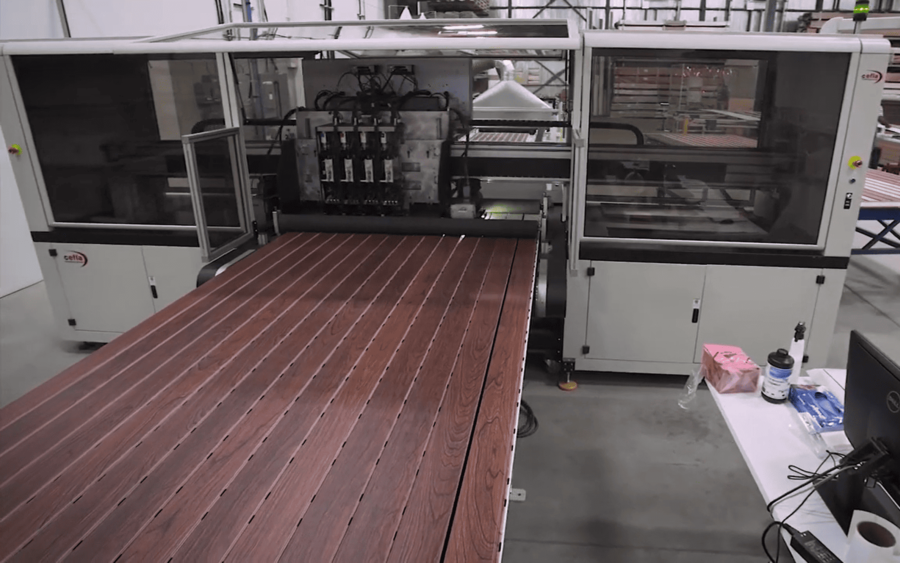
In the industrial sector, UV digital printing is an advanced solution for surface decoration. Thanks to high-precision print heads and the use of UV-curable inks, it allows for the reproduction of extremely realistic textures and finishes, such as wood, stone, or natural materials, on panels, slabs, edges, and other elements, while maintaining high standards of quality and definition. The surface is not simply colored; it is decorated according to a digital file that can be modified at any time, without the need to prepare cylinders, dies, or specialized decorative papers.
It is precisely this digital nature that represents the most significant competitive advantage for a manufacturing company. Compared to traditional decoration methods, UV digital printing allows for:
- To combine productivity with customization, handling both large volumes and small batches, down to a single piece, without prohibitive setup costs;
- Respond quickly to trends by switching from one design to another simply by replacing the file, and drastically reducing the time between the initial idea and the creation of a sample;
- Reduce inventory and work-in-progress, because it is no longer necessary to store large quantities of decorated materials waiting to be used.
Another aspect that makes this technology particularly well-suited for production is its ability to ensure consistency between different parts of the same product. Starting from a single digital image, the surface of a panel and its edge can be decorated with the exact same pattern, resulting in a perfect match that would be complex and costly to achieve using traditional techniques.
In a market where there is growing demand for increasingly customized products that can be delivered quickly and in varying quantities, UV digital printing offers a practical solution to the needs of modern industrial finishing.
Cefla Finishing solutions for UV digital printing
Integrating UV digital printing into a production line doesn’t simply mean adding a printer, it means integrating the technology into a complete finishing process, from the preparation of the raw substrate to the finished, decorated product. This is where Cefla Finishing’s expertise comes into play: the company designs and manufactures industrial digital printing machines and lines based specifically on UV-curable inks.
Our solutions are designed to fit flexibly into a variety of production environments. The printers can be integrated into fully digital or hybrid printing environments, where digital technology coexists with traditional finishing techniques, and are available in single-pass and multi-pass configurations depending on the required volume and quality. In addition, the Cefla Finishing Lab, located in Imola, Charlotte, and Tianjin, allows companies to test the technologies firsthand and identify the configuration best suited to their needs before making any investment decisions.
The J-PRINT line for every application
At the heart of Cefla Finishing’s offering for industrial digital printing is the J-PRINT series, a family of printers designed to integrate into finishing lines and adapt to different materials and applications. Printing is performed using industrial printheads, with modular print bars capable of achieving large print widths and high operating speeds. Among the solutions in the range, the J-PRINT SP is designed to use UV-curable inks and integrate into fully digital or hybrid printing environments: this is where the principle of UV digital printing finds its expression within Cefla Finishing’s product lines.
Within the product line, each solution addresses specific needs depending on the product to be decorated.
|
Application |
Line configuration |
J-PRINT Solution |
|
Panels, sheets, and furniture components |
Digital or hybrid single-pass |
J-PRINT SP: High-definition decoration on large flat surfaces |
|
Edges |
Single-pass digital or hybrid roll-to-roll (R2R) |
J-PRINT SP R2R: on-demand decorative edge banding rolls, with preparation, printing, and finishing in a single loading/unloading cycle |
|
Digital or hybrid single-pass |
J-PRINT SP EDGE: direct edge printing for extreme JIT |
|
|
Baseboards and moldings |
Digital or hybrid single-pass |
J-PRINT SP TS: Reproduces the texture and finish of the floor it will be paired with on the profile |
|
Relief Effects and Textures |
Single-pass or hybrid |
J-PRINT SP TD: Decorative and tactile printing with realistic 3D effects |
|
Sheets, panels, and components |
Digital or hybrid multi-pass |
J-PRINT MP: 2D or 3D printing on various materials |
The underlying principle across the entire product line is to start with a single digital file to manage the entire decoration process, with the ability to reproduce the same pattern on different parts of the same product and to switch quickly from one design to another. This principle also underpins the most advanced processes: with the Embossing In Register (EIR) technique, for example, the printed decoration is combined with embossed patterns perfectly synchronized with the design, so that a motif such as wood grain is rendered not only visually but also to the touch.
Conclusions and the key role of Cefla Finishing
In conclusion, UV digital printing has established itself as one of the most versatile printing technologies available today: its ability to cure ink instantly, process a wide variety of materials, deliver durable and long-lasting results, and integrate with Cefla Finishing’s finishing lines, which allow for the addition of an extra layer of protection to the design depending on the end use, makes it an effective solution to the needs of a market that demands increasingly customized, high-quality products available quickly. This potential is fully realized when the technology is integrated into production processes and becomes a tool for surface finishing and decoration on an industrial scale.
It is in this context that we at Cefla Finishing offer our expertise. Not simply as a machine supplier, but as a technology partner capable of guiding companies every step of the way: from the design of complete, integrable production lines, to the opportunity to test solutions in our Lab, all the way through to support in fine-tuning the process and preparing print files. This approach transforms the adoption of digital printing into a concrete growth opportunity for those working in industrial finishing.
Just how far this technology can go in the manufacturing sector is demonstrated by a concrete example: the Marcegaglia Group’s CROMATICA project, implemented using Cefla Finishing technology. It is a continuous “coil-to-coil” digital printing line that decorates steel in four-color process with a high degree of customization, within a fully automated system. This is an example of how digital surface decoration is now capable of redefining the aesthetic possibilities of materials once considered purely functional.
Would you like to find out how to integrate UV digital printing into your finishing line? Contact our experts: together, we’ll identify the Cefla Finishing solution that best meets your production needs.