Magazine

Industrial digital printing

Article

Industrial digital printing as a competitive way to grow your business

Industrial digital printing as a competitive way to grow your business

Industrial digital printing

Competitive because your degree of flexibility allows you to respond immediately in face of changing trends and fashions. Competitive because you save time, reduce stocks of semi-finished goods and reduce equipment in your production line. Appealing because you can respond rapidly to each demand being able to offer customised, top quality, durable products.

The key issue facing customers is the need to combine high productivity with the high degree of customisation required by the market. In particular, the ability to obtain realistic, high-volume, high-quality reproductions of natural (wood) patterns with extremely hard-wearing surfaces, all at an affordable process cost. A further commercial benefit is the ability to produce one-off panels when required. By scanning the desired pattern, you can respond to impromptu requests or replace damaged pieces with much less effort and in a much shorter time than before.

Ideal for furnishing components, doors, flooring, PVC sheets and packaging

Our J-Print MP, J-Print SP and J-Print TD machines for colour and 3D, integrate seamlessly into complete printing and texturing lines that perform the entire process, from preparation of the raw material to the finished product. J-Print industrial digital printers, supported by our process knowledge and expertise, together with careful selection of inks and technologies, responds better to the needs of durability, depth, naturalness and definition of the textured effect.

The smart solution for edging manufacturers

When you need to faithfully reproduce the pattern from the panels to which the edging will be applied, with a short response from the request to the delivery of the finished material, and with small batches. J-Print SP roll-to-roll (R2R) for edging strips produces reels of decorated edging on demand, even in small batches, with preparation, printing and finishing in a single reel loading/unloading operation.

Naturally beautiful and naturally resistant for skirting and profiles

J-Print SP top-side printers for skirting and profiles is able to replicate the pattern from the floors on which the skirting boards will be fitted, with short response from request to delivery of the finished material. Even for small batches, manufacturers can reproduce natural patterns, particularly those of wood varieties, with the most natural appearance possible. Textured effects are also possible with the J-Print single-pass printer.

In short we provide complete lines, from preparation of the bare skirting to the decorated and finished product; fine-tuning of the entire technological process, from reception of the flooring samples to be reproduced; support to help our customers acquire the necessary knowledge and experience for the preparation of final print files.

Haptic effects and EIR (Embossing In Register)

The J-PRINT TD employs the technology to create positive and negative tactile effects with outstanding realism and an affordable, reliable process. J-PRINT TD, performs embossing in register (EIR), printing with a resolution of 400 dpi and speeds reaching 50 m/min. The printer uses special inks, ensuring the same surface resistance as you would expect from any high-quality flooring. Whether it’s wood, MDF or cork, you can digitally print and emboss with exceptional 3D quality.

Learn more about our Industrial Digital Printing solutions 

Competitive because your degree of flexibility allows you to respond immediately in face of changing trends and fashions. Competitive because you ...

Article

Digital printing and the advantages for business in manufacturing sectors

How many times have you had to say ‘no’ to a customer because they requested a unique finish, perhaps in just a few hours, or wanted a highly customised texture? How many times was that customer you?

Industrial digital printing is very much the technology of the moment for the manufacturing sector. All over the world, in a wide range of industries, businesses have discovered its massive potential. Wood, plastic, packaging, metal, ceramic, fibre cement: digital printing can be used with a host of materials, giving them previously unthinkable levels of flexibility and customisation. Keep reading to find out all the advantages of digital printing.

The digital printing revolution

Something has changed in the finishing industry. Until recently, customising the finish, meeting specific requests and producing very small batches was a nuisance that meant worrying costs, risky downtime, low quality and, ultimately, a loss of money.

DigitalPrintAdvantages-1

Now, though, creating small personalised batches is an opportunity. Innovative digital printing generates immediate earnings on the individual orders the technique now makes feasible and, in the long term, leads to a remarkable increase in business. The ability to penetrate new markets and expand a business while keeping production costs competitive is driving more and more companies to embrace the ‘digital printing revolution’ and rethink their range of products and services. 

At present, coating and finishing are trending towards the innovative mixing and matching of materials: customers are demanding flexibility so they can respond quickly to changes in such trends. Businesses that equip themselves with the technology capable of meeting these needs soon gain a predominant market position.

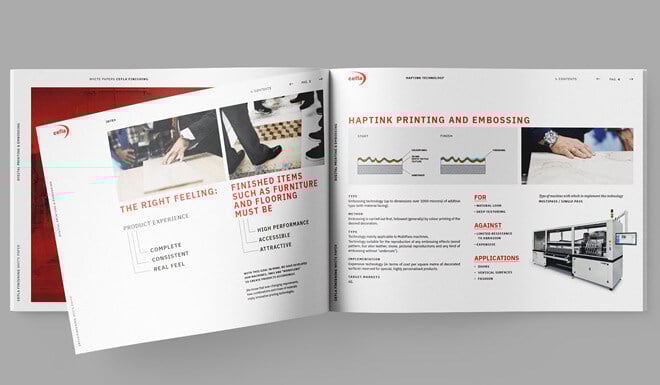
Learn about the most innovative relief printing technologies: applications, pros and cons and much more.

Download the white paper

DigitalPrintAdvantages-2

What is digital printing and how does it work?

Digital printing - based on modules with 4 to 6 colours and fully digital data - is an easy-to-control technique that delivers repeatable quality and results over time. It involves just a few simple steps. We begin with a model of the colour or aesthetic rendering we wish to reproduce. There are two possibilities:

  1. Create an initial graphics file (this might be a photo, a pattern, a specific colour code or any other image) 
  2. Scan a pattern to be replicated via printing. You can scan any pattern, natural or otherwise. What’s incredible is that the scanners we use faithfully replicate not just the image but also the texture of the initial sample!

DigitalPrintAdvantages-4

Once you’ve defined the effect to be reproduced, the innovative Cefla-developed digital printing solutions come into play. Small or large print runs of the selected image or pattern are possible, in large or small formats, on large or small surfaces, faithfully reproducing visual appearance and tactile effects. 

Finishes can be completed with texturing techniques to give surfaces the desired ‘feel’. For example, the J-PRINT-TD industrial printer uses digilogic texturing technology by Zee Tree to produce realistic 3D surface finishes at a resolution of 400 dpi. Thanks to roll-to-roll techniques, digital printing of ‘haptic’ relief effects is also being extended to applications on floors and edges. 

Lastly, it’s worth pointing out that finishes obtained with digital printing can, depending on the selected drying system, be either gloss or matt. All this can be achieved with enormous flexibility and, above all, while keeping costs competitive.

Digital printing and the economic advantages 

How much does digital print finishing cost? To give an idea of how much a process cycle might cost, bear in mind that cycles require no ‘wearing layers’: for example, to produce vertical surfaces, furniture and doors, the cost of the process is approximately €1.2 - 1.5/m2. Vice-versa, for cycles that do require wearing layers (essentially floors), one should add a further €1 - 1.5/m2. The exact additional cost will depend on the desired abrasion resistance class (AC3, AC4, AC5), the standards with which the products must comply (EN15468 or EN13329) and the desired texturing depth.

The advantages of digital printing for every industry

A finishing line that uses digital printing can be configured to match the industry and the application material, ensuring it responds to specific needs. However, regardless of the industry, regardless of whether a company processes metal, plastic, wood, ceramic, cardboard or even fibre cement, digital printing will always yield some key advantages

Whatever the field of application, new industrial digital printing technologies let you:

  1. Combine high productivity with the ultra-customisation required by the market.
  2. Reduce response times to changing aesthetic trends and fashions
  3. Create aesthetically appealing, economically sustainable products with outstanding durability (i.e. for both interiors and exteriors).
  4. Make realistic, precision high-volume reproductions of natural patterns (such as wood) with extremely hard-wearing surfaces, all at contained cost.

Summing up, digital printing technology is an increasingly essential business-booster in multiple manufacturing sectors. Compared to other techniques, the advantages of digital printing are evident: opportunities that stem from being able to keep pace with trends, huge scope for customisation, low costs and excellent production flexibility.

Can you imagine the benefits this technology might have in your business?

Talk to one of our experts and learn more about the potential of digital printing in your business.

Cefla Finishing Industrial Digital Printing


How many times have you had to say ‘no’ to a customer because they requested a unique finish, perhaps in just a few hours, or wanted a highly ...

Article

What makes industrial digital printing a viable solution for flooring?

Flooring is one of the most demanding applications in terms of surface enhancement. Industrial digital printing technologies address issues such as quality, customisation and resistance to foot traffic in a highly satisfactory manner. In particular, close attention needs to be paid to the third issue, which is regulated by European standards, as well as international standards.
Recap of the process
Industrial digital printing as a solution for flooring involves a fairly articulated process. These are the steps that need to be considered:
• Sealing (in the case of MDF) or Adhesion Promoting (for plastic substrates)
• White layers
• Digital Printing
• Wearing layer
• Textured layer
• Finishing layer

Innate flexibility and a time-saver
One key advantage of this technology is the outstanding flexibility you benefit from in relation to changes in market trends and fashions. Even when running small batches that demand frequent set-up operations, time is saved thanks to fast line set-up, plus minimal stock of semi-finished goods.

Durability as a determining factor
Foot traffic resistance is one of the critical factors due to surface deterioration, especially in areas such as hotel foyers, corridors, offices, showrooms, schools and retail environments where there is a constant flow of people. Flooring durability is these cases is regulated by the EN 15468 and EN 13329 standards governing laminate floor coverings. In each case, Cefla Finishing has accomplished the required tests reaching AC4 and AC5 (Abrasion Criteria) standards for its digitally printed laminates.

Ink type determines the aesthetic qualities of a floor covering, sometimes also with regards to resistance over time. Flooring is mainly a market of products for interior use; there is nonetheless a specific kind of flooring especially for exterior use: decking. Whereas organic pigmented inks tend to fade, in the outside, in the first 2 years of exposure to natural lighting if no special UV-protection coatings are applied on top of the decoration layer, inorganic inks are also available with pigments made out of metal oxides, that are hardly affected by light for between 10 and 15 years. While organic pigmented inks, with their superior colour gamut (colour range), are perfect for interior use, as well as some exterior use when properly protected against UV weathering, the inorganic pigmented inks are an interesting choice for exterior use, as in the case of decking, reducing the need for a special UV-filtering top-coat.

J-Print industrial digital printers

The complete J-Print range of Cefla Finishing industrial digital printing integrate seamlessly into complete printing and texturing lines performing the entire process, from raw material preparation to the finished product. Expert process guidance together with the appropriate inks and correct techniques will respond to demands relating to durability, depth, naturalness and definition of the textured effect.

Reproducing wood grain designs with a tactile effect is also simple to achieve with the latest digital printing solutions. A high-resolution surface texturing technique provides a realistic 3D surface finish.

Want to know how quickly in the specific case of your company? Contact a Cefla expert and visit the Cefla Finishing Lab to experience, first-hand, all the solutions and technologies that help reduce energy consumption in your finishing processes.

Learn more about our Industrial Digital Printing solutions

Flooring is one of the most demanding applications in terms of surface enhancement. Industrial digital printing technologies address issues such as ...

Article

Digital printing FAQ

Digital printing FAQ

FAQ Industrial digital printing

Can I decide exactly what design I want? How can I effectively measure the quality of the print? Can I print on edges or profiles?

These are just some of the most frequently asked questions our customers pose when it comes to industrial digital printing in the field of surface enhancement.
More and more, this key technology is an opportunity to be considered for integration into your finishing process.

Yes, but how?

Our industrial digital printing specialists help us to find the best answer. So let's start with the first question:

Which substrates can I print on?

Many! Each requiring its own specific pre-treatment, curing level, finishing etc.
Examples: MDF and other wood derivatives – fibre cement – PVC – SPC – WPC – ABS – PS – Aluminium and other metals – glass – leather.

Thanks to Silver Santandrea - Product Manager


Silver Santandrea

Product Manager | Digital Printing Technologies

Product development, technologies and machines for digital printing

https://www.linkedin.com/in/silver-santandrea/

Can I decide exactly what design I want? How can I effectively measure the quality of the print? Can I print on edges or profiles? These are just ...

Article

Flooring? Enjoy a relaxing perspective


Explore the potential

The complete J-Print range of Cefla Finishing industrial digital printers integrate seamlessly into complete printing and texturing lines for flooring, performing the entire process, from raw material preparation to the finished product.Expert process guidance together with the appropriate inks and correct techniques will respond to demands relating to durability, depth, naturalness and definition of the textured effect.
Reproducing wood grain designs with a tactile effect is also simple to achieve with the latest digital printing solutions. A high-resolution surface texturing technique provides a realistic 3D surface finish (digilogico technology by ZEETREE).

When the going gets tough

Foot traffic resistance is a critical factor due to surface deterioration, especially in areas with a constant flow of people. As far as durability is concerned, Cefla Finishing has accomplished the required tests reaching AC4 and AC5 standards for digitally printed laminates.
Ink type also determines surface resistance over time. Outdoor applications will need to resist UV weathering. We will recommend the best inorganic inks with metal oxide pigments, that are hardly affected by light for up to 15 years. In the case of decking, they also reduce the need for a special UV-filtering top-coat.

Learn more about our Industrial Digital Printing solutions 

Shaping the future of finishing

Cefla Finishing LAB is a concept we have converted into a strategy, a facility where we test entire processes and share our expertise with customers and leading industry players.
The LAB houses several machines available for our customers to run trials using their own lacquers, inks or products.
Each process is examined within the context of an integrated line, identifying ways to improve performance and achieve the best results. The LAB is where we stretch the limits of technology to bring the market new, unique opportunities.

Want to see for yourself? Arrange a visit to the LAB

Explore the potential The complete J-Print range of Cefla Finishing industrial digital printers integrate seamlessly into complete printing and ...

Article

How the texturing process works: technologies and applications

The texturing process: technologies and applications for the décor market

In the décor market, manufacturers are increasingly focused on the texturing process as it allows them to create hyper-realistic patterns inspired by natural materials on any type of surface. With this approach, for example, a PVC shelf can take on the appearance of a marble slab or a wooden board, making it adaptable to any furnishing style.

It’s a technique that lets producers alter both the visual and tactile qualities of surfaces via a process that can create dense relief patterns or tiny marks. This results in - thanks also to skilful finishing - an expanded sensory experience, making products even more pleasing and giving them added value.

What is the texturing process?

In the industrial finishing field, the texturing process leverages various techniques - in combination or individually - to create a surface layer or a pattern on otherwise smooth, plain panels.

Regardless of the techniques used, the goal is to transform products in a way that improves their practical and aesthetic properties.

The texturing process is particularly widespread on the woodworking production lines that are primarily seen in the furniture industry. However, it’s also gaining ground in the metallurgy and textile sectors.

Why is texturing important on the décor market?

In the décor industry - especially the furniture sector - the texturing process involves the creation of patterns or surface finishes on panels in a range of materials (usually wood, metal or synthetics). This makes furniture more appealing to both the eye and to the touch.

Surfaces are modified via sanding, embossing and engraving techniques, or by applying coatings that create an intricate finish.

The thus-created texture adds visual appeal and depth to furniture and furnishing items, making them stand out. It also makes them suitable for a wide range of architectural styles, from rustic to modern. Well-textured surfaces also create a more engaging, inviting tactile experience, increasing the impact and appeal of the product. On a market saturated with often-indistinguishable goods, this is essential as it lets furniture manufacturers differentiate their products with unique texturing techniques that - if properly promoted - can become the hallmark of a brand. That said, it should be remembered that texturing also has a practical function. For example, it improves grip, makes scratches less visible and boosts product durability.

THE MOST INNOVATIVE FINISHING SOLUTIONS
Discover how highly advanced finishing solutions can sharpen your competitiveness.


Advantages of texturing for manufacturers and consumers

The texturing process also plays a pivotal role in marketing strategies, especially when it comes to aligning production with consumer preferences or market trends. Trends, on the other hand, change ever-more frenetically: they are constantly diversifying and stratifying, with styles spanning from minimalism to the bohemian or industrial.

Lastly, in an era in which consumers want one-of-a-kind, personalised products, texturing provides vast scope for customisation. Digital solutions give customers the opportunity to select and transfer specific motifs or patterns onto the furniture they purchase, reflecting their own styles or evoking unique designs, making products more personal and meaningful.

The main texturing technologies available today

So which machines enable the texturing process? What solutions are needed to combine precision and efficiency?

At present, there are essentially two technologies available on the market:

  • 3D digital printing (subtractive texturing)
  • Additive printing

3D digital printing may well be the most versatile technology as it allows fast implementation of a texturing process, even on production lines that are already operational.

Cefla Finishing offers its customers the new J-PRINT TD single-pass printer, a machine capable of printing ‘relief’ tactile effects (digilogico technology by ZEETREE).

More specifically, the J-PRINT TD can print at resolutions of up to 400 dpi at rates of up to 50 m/min. It recreates relief effects with maximum realism using a reliable, economical process.

The solution is usually configured with a standard print station but can accommodate a second. The graphics management software enables high-definition, grey-scale images to be printed using ultra-high-quality print heads. DOD (Drop on Demand) grey-scale technology is seen as a winner on the digital printing market, so its incorporation on the J-PRINT MP comes as no surprise.

Special shaping of the ink reservoirs and automatic management of all critical parameters such as temperature, flow rate and circuit pressure ensure optimal fluid control. Furthermore, a special system that circulates the ink through the print heads ensures the machine does not require frequent cleaning.

Versatility and applications of additive manufacturing in texturing

Additive manufacturing can be applied in two ways: creating textures on individual products through direct additive manufacturing or creating molds that are later used to texture individual products via presses or calenders using those molds.

Direct additive manufacturing

Direct additive manufacturing can be executed with both Single-pass and Multi-pass machines. Compared to the "digilogico by zeetree" solution, direct additive manufacturing has the disadvantage of a higher processing cost (cost of consumables used).

Additionally, this finishing process offers less surface resistance, making it suitable for vertical walls but not for high-traffic horizontal surfaces. On the other hand, direct printing allows for potentially deeper textures—especially in multi-pass mode—with greater detail.

Additive manufacturing for mold creation

Additive manufacturing for mold creation is carried out with specific multi-pass machines. This method can produce textures with depths of several millimeters, with resistance characteristics dependent on the fluid/ink used, which in turn determines the application area of the resulting molds.

LOOKING FOR THE IDEAL COATING LINE SOLUTION?

Industrial digital printing texturing process


The texturing process: technologies and applications for the décor market In the décor market, manufacturers are increasingly focused on the ...

Load more articles

Articles: 12 / 17