Magazine

Roller coating

Article

So many ways to cook an egg and a few good ways to coat a cooking pan

So many ways to cook an egg and a few good ways to coat a cooking pan

Pans roller coating

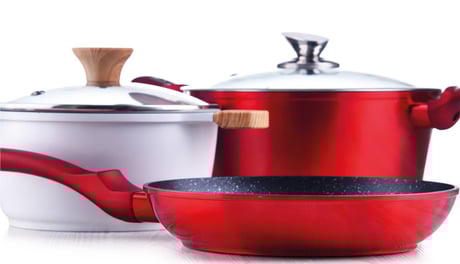
One of the requirements we often deal with is the coating of cooking utensils, especially those pots and pans requiring non-stick surface treatments. This is a process we have looked at and one way to structure it is as follows, even though each customer may have specific needs. In that case, our 360° knowledge of surface enhancement technologies allows us to customise a line or a single piece of equipment to account for customer-specific parameters or objectives. Let’s imagine an integrated line offering high volumes of Teflon coating and water or solvent-based coatings.

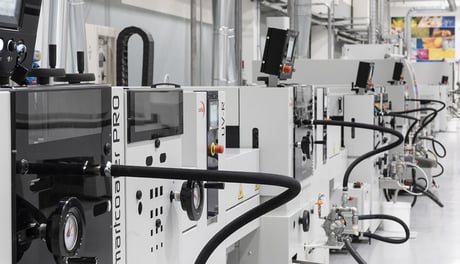
Normally we would advise a U-shaped layout, the first linear section dedicated to Teflon coating performed on 5 in-line roller coaters such as Smartcoater Pro and relevant ovens, either hot air or using IR lamps.  Each Smartcoater Pro on the outward run will handle a coating (Teflon) volume of 10 g/sqm. After the U-turn, a battery of 5 more such roller coaters can be used to apply a further 10 g/sqm of water or solvent-based coating to the product (still in its flat panel form) followed by the relevant number of ovens. The coated panels would then exit the line via an oven running at 500°C.

Producers of cooking utensils will all have a specific distinctive need. Our process experts will therefore examine the requirement and advise on how to generate efficiency by implementing cost-saving strategies as well as suggesting tailored solutions to reach quality objectives or increased productivity.

Contact us and discuss your needs with a finishing expert.

One of the requirements we often deal with is the coating of cooking utensils, especially those pots and pans requiring non-stick surface treatments. ...

Article

Coating doors and kitchen cabinets: changing the rules to save money

Coating doors and kitchen cabinets: changing the rules to save money

None

Until recently raised panels used for kitchen cabinet doors or even standard doors with raised sections or grooves on the surface were spray coated, start to finish. The process involves various application steps for base and topcoats, sometimes differing according to whether the finished effect is glossy or matt. It also foresees sanding operations between two base application steps and involves a fair bit of handling by operators. Streamlining this process with a hybrid line made up of roller coating and spray coating equipment increases overall efficiency and reduces operator intervention. But how can you process raised panels with a roller coater?

If this were possible, savings could come from less lacquer consumption because whereas transfer efficiency using spray coating equipment may exceed 60%, roller coating procedures ensure even better transfer efficiency and thereby cut lacquer-related costs in comparison.

However, roller coating for raised panels was unheard of until the Smartcoater PRO family of roller coaters adopted the soft rubber application roller technology. This innovation has led to a change in the rules and companies are beginning to adopt the technology which has proven in our laboratory tests to achieve savings on lacquer consumption of up to 1€/sqm.

Equipped with a soft rubber application roller, Smartcoater PRO is able to shorten the coating process:

  • avoiding the need for sanding between base coats, 
  • avoiding the need to deal with poorly calibrated panels,
  • reducing the handling operations,
  • reducing lacquer and solvent consumption,
  • and reducing lead times.

And this is possible on kitchen cabinet doors and other substrates with 10 mm grooves.

Discover how the soft roller works for raised panels here.


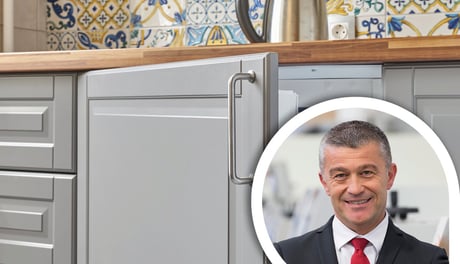
Roberto Sorbini

Business Line Manager | Roller Coating Technologies

Product development, technologies and machines for roller coating

https://www.linkedin.com/in/roberto-sorbini-94663a13/

Until recently raised panels used for kitchen cabinet doors or even standard doors with raised sections or grooves on the surface were spray coated, ...

Article

Roller coating on wood and its derivatives: techniques and advantages

Roller coating on wood and its derivatives is an ideal way to accurately and evenly apply coating on panels, cabinet doors, doors, flooring and any other object with flat surfaces. Various techniques and lines are available to help you set up this type of process: each one has specific characteristics and, depending on the type of result you wish to achieve, has its own pros and cons.

While a customised solution is always the best response to any manufacturer's finishing needs, this article gives a general overview of how wood and wood-derivative roller coating machines work and illustrates their advantages.

When should roller coating be used for wood and its derivatives?

These days, roller coating is universally seen as a tried and tested industrial technique. This is thanks to increasingly reliable technology. Such technology meets the needs of a variety of product categories (one of the foremost being items in the furnishing sector), with panel and edge coating playing a crucial role in the wooden accessory manufacturing process.

In addition to wood and its derivatives, roller coating is also suitable for glass, cork, plastic and fibre cement surfaces. Indeed, a growing number of companies are choosing it to make production more efficient and boost their capacity for differentiated production. Lines can, in fact, be customised to meet specific requirements; they’re designed to meet the needs of both companies that repeatedly perform large-volume, same-batch processing and plants that require frequent colour and thickness changes, thus reducing downtime. A roller coating line maximises flexibility: this makes it perfect for third-party finishing set-ups, which require that the switch from one colour or thickness to another be completed without prolonged machine downtime.

THE MOST INNOVATIVE FINISHING SOLUTIONS
Discover new finishing solutions: more effective, more productive, more competitive

Composition of roller coating lines for wood and wood derivatives

Getting into the specifics, what do wood and wood-derivative roller coating lines consist of?
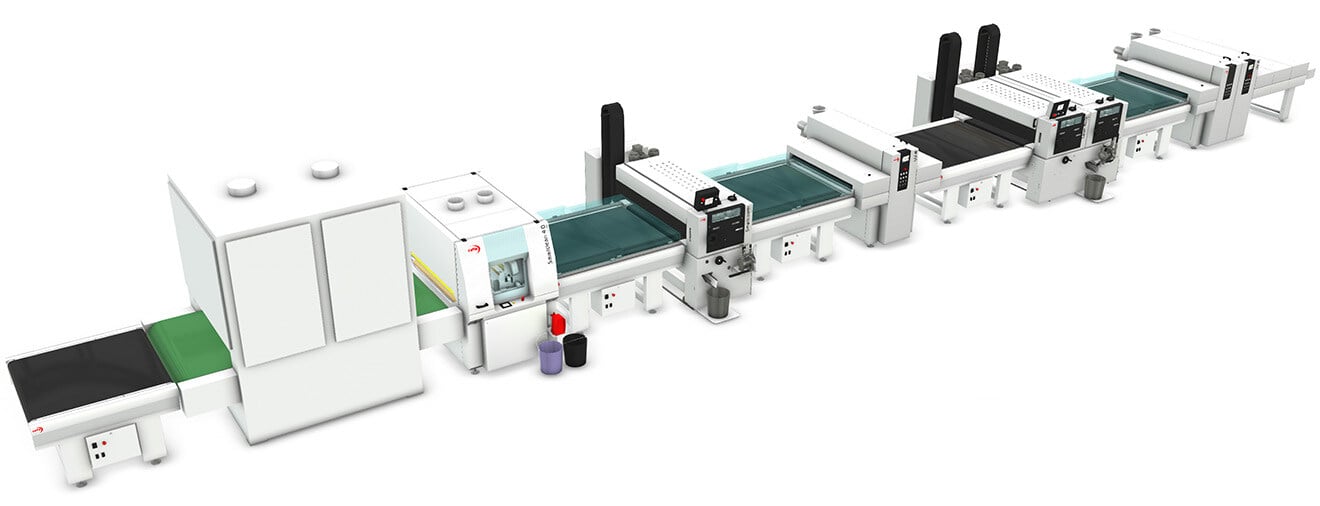
Rollercoatingline

The lines are generally made up of a sander, followed by coaters which, in turn, precede a series of UV ovens.

After the sanding process, if the panels have flat edges (i.e. a sharp edge with respect to the surface), coatings are mainly applied with roller machines and curtain coaters to obtain finishes with differing degrees of gloss.

On a modern coating line, being able to control the process via interactive dashboards is essential: by monitoring performance, manufacturers can boost the operational versatility of their plant over time.

Moreover, manufacturing companies require maximum flexibility across a range of different products. That’s why they increasingly choose easy-to-use, modular, customisable solutions that smoothly adapt to production/space requirements and contain consumption: not just in terms of the stability of the basis weight of the applied coating and the reduced need for cleaning solvents, but also in terms of the time the operator has to dedicate to washing, which can be partially automated.

What are the advantages of roller coating wood and its derivatives?

Compared to a traditional, manual manufacturing process, industrial roller coating of wood and wood derivatives offers a series of tangible, measurable advantages that range from more precise coating application to better control of the production process. More specifically, the main benefits of adopting a roller solution are:

  • even, precise application of the coating, with consistent quality
  • monitoring and optimisation of each stage of the process
  • better control over the materials used, allowing waste reduction
  • flexibility when diversifying production lines
  • partially automated cleaning operations, significantly reducing solvent consumption and costs.
ImmagineRullo

Cefla Finishing solutions for roller coating wood and its derivatives

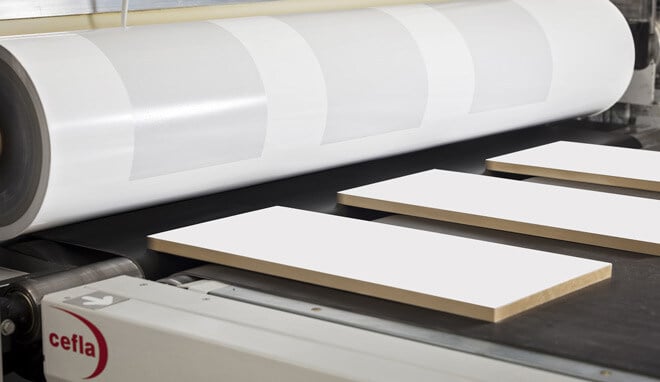
After making an in-depth assessment of the needs of companies that process wood and wood derivatives, Cefla Finishing breathed life into a series of solutions that simplify the adoption of roller coating processes. For example, Smartcoater PRO is designed to combine better control of the different processing phases with greater flexibility and ever-better performance: different shapes, different thicknesses and panels with varying degrees of deformation require maximum agility, and the Smartcoater PRO dashboard helps automate parameter settings on each process.

The machine is designed to ensure effective, efficient operation: the lifting system, which uses four screw jacks, provides greater stability and rigidity, while the optional pneumatically-controlled floating head system responds perfectly to surface variations on the panels transiting through the machine. Belt adjustments are automatic. There’s also an optional alignment system. Smartcoater PRO also features a dosing roller positioning mechanism and an independent electric applicator. Lastly, thanks to the latest innovation to be added to the machine - a soft rubber applicator roller - Smartcoater PRO now has an even more appealing set of functions that include the roller coating of raised panels.

As stated, a roller coating line also includes a series of ovens. Cefla Finishing offers the UV-R series: a UV drying oven (also usable on spraying lines) that can halve the number of lamps needed for processing (and, consequently, the machine's running costs). The system also incorporates a PLC-controlled electronic transformer that allows adjustment of lamp power, recipe management and energy savings in the event of missing pieces.

Who is Cefla Finishing for?

The Cefla Finishing range of plants and machines continues to evolve by leveraging decades of worldwide experience in the surface finishing sector. With no less than 300 active patents and approximately 15,000 machines installed all over the world, Cefla Finishing develops coating equipment that aims to maximize production efficiency and bolster the sustainability of woodworking companies that make flat cabinet doors, parquet, doors and panels in general. What’s more, the range extends beyond the wood and furniture sector to encompass supply chains for glass surfaces and items in cork, plastic and fibre cement.

So, regardless of the industry you’re involved in, if you’re looking for an innovative roller coating system simply contact a Cefla Finishing expert to receive a free consultation and identify the solution that’s right for you.

LOOKING FOR THE IDEAL COATING LINE SOLUTION?

Roller coating on wood and its derivatives is an ideal way to accurately and evenly apply coating on panels, cabinet doors, doors, flooring and any ...
Article

Roller-coating line for flat panels

Roller-coating line for flat panels

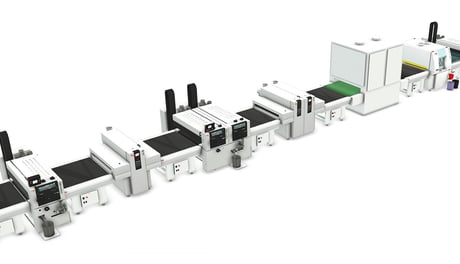
If you are looking for a roller-coating line for flat panels in wood or its derivatives, we at Cefla Finishing have an integrated solution which reaches high levels of productivity and outstanding flexibility. Integrating our most innovative solutions, you may also envisage roller coating moderately raised panels on the same line. Comprised of roller-coating and curing/drying machines, this line requires more or less 210 sqm of floorspace and ensures up to 5000 sqm of coated panels per work shift.

Contact us and discuss your needs with a finishing expert.

If you are looking for a roller-coating line for flat panels in wood or its derivatives, we at Cefla Finishing have an integrated solution which ...

Article

2 technologies to suit your roll to roll processing requirements

High volumes, multiple shifts, mass production and a limited variety of finishing patterns represent one scenario related to edge processing on roll to roll equipment. Small volumes, tiny batches, customisation and an unlimited choice of finishing patterns are at the opposite end of the scale. Catering for both customer types means mastering two different technologies.

On one hand, roller coating equipment enables high volumes, non-stop production and minimises linear or square metre costs. On the other hand, a single-pass digital printer allows for maximum customisation, enhanced flexibility, fast time-to-market and superb quality.

We know your industry and each process requires a dedicated solution

One benefit of entrusting your roll to roll needs to Cefla Finishing is that we have over 60 years’ experience serving the furniture manufacturing industry. This places us in a position to advise on how to manage each process and choose the most appropriate solution.

Whichever technology is best adapted to your needs, there is a turnkey solution which includes lacquers or inks for the start-up phase, all of which have been tried and tested on our machines. Furthermore, our Finishing LAB is open to all customers interested in running tests on their own products to pinpoint any critical issues before production starts.

Check out our LAB - the world’s largest laboratory dedicated to surface enhancement technologies.

The right machine for you

When a customer is running machinery non-stop and processing huge volumes with little variety, our Smartprint roller coater with an engraved application roller will maximise productivity and keep operating costs to a minimum.

  • Smartprint
    Companies looking for flexibility, processing small batches and responding to the demand for customised patterns will find our single-pass industrial digital printer J-Print SP to be the best answer.

  • J-Print SP
    For both scenarios, we also provide equipment for bottom primer application, drying ovens and roller coaters for high-gloss and deep matt finishing. The equipment can be completed with roll winders, unwinders and tensioners, and alignment devices.

Besides the right equipment, we also provide software solutions to allow you to monitor your lacquer ink consumption, helping you achieve savings throughout the process.

What could your line look like?

Cefla Finishing has the broadest range of finishing technologies and machines that have been designed to deal with specific processes such as roll to roll. Imagining your set-up will depend on many factors, all of which we will consider when establishing the best solution to meet your needs.

Contact us for more detailed information or fix an appointment with our specialists to visit our laboratory and run a few tests.

High volumes, multiple shifts, mass production and a limited variety of finishing patterns represent one scenario related to edge processing on roll ...
Articles: 11 / 11